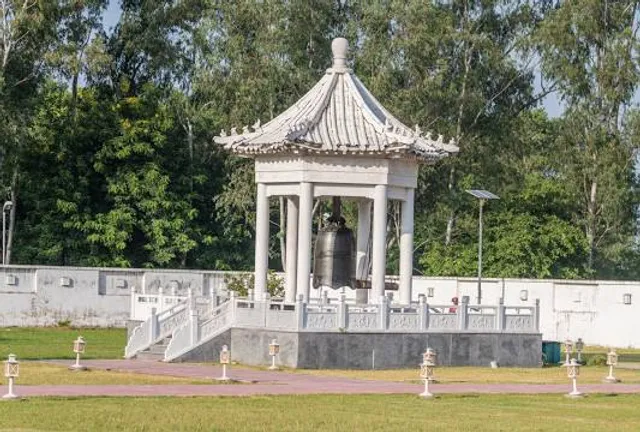
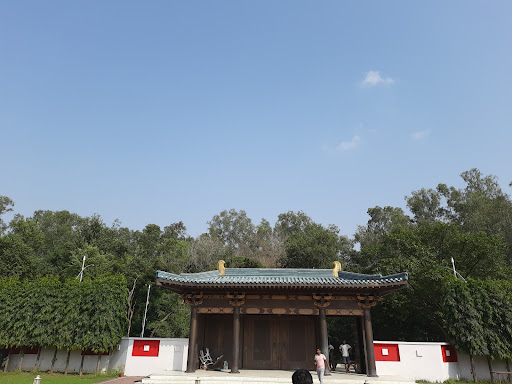
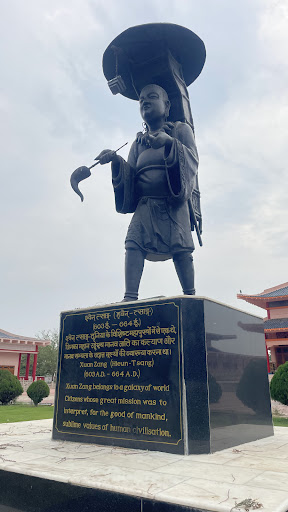
Hiuen Tsang was a Chinese scholar and traveller who came to India (the land of dreams). He is known for the epoch-making contributions to Chinese Buddhism, the travelogue of his journey to India in 629–645 CE, his efforts to bring over 657 Indian texts to China, and his translations of some of these texts. He visited the then famed Nalanda monastery. To commemorate his visit to Nalanda, this museum was built. It's a peaceful museum next to Vipassana meditation centre. One may spend hours in peace at this place. Less visitors come here as most generally return after visiting the Nalanda archeological site. The architecture is built in Japanese/Chinese style and has a large black stone statue of Hiuen Tsang.
The most famous of the Chinese travellers to India was Hsuan-Tsang who came in the seventh century when the great T'ang dynasty flourished in China and Harshavardhana ruled over an empire in North India. Hsuan-Tsang came overland across the Gobi Desert and passing Turfan and Kucha, Tashkand and Samarkand, Balkh, Khotan and Yarkand, crossed the Himalayas into India. He tells us of his many adventures, of the perils he overcame, of the Buddhist rulers and monasteries in Central Asia, and of the Turks there who were ardent Buddhists. In India he travelled all over the country, greatly honoured and respected everywhere, making accurate observations of places and peoples, and noting down some delightful and some fantastic stories that he heard. Many years hel spent at the great Nalanda University, not far from Pataliputra, which was famous for its many-sided learning and attracted students from far corners of the country. It is said that as many as 10,000 students and monks were in residence there. Hsuan-Tsang took the degree of Master of the Law there and finally became vice-principal of the university.
Hsuan-Tsang's book the Si-Yir-Ki or the Record of the Western Kingdom (meaning India), makes fascinating reading. Coming from a highly civilized and sophisticated country, at a time when China's capital Si-an-fu was a centre of art and learning, his comments on and description of conditions in India are valuable. He tells us of the system of education which began early and proceeded by stages to the university where the five branches of knowledge taught were: (1) Grammar, (2) Science of Arts and Crafts, (3) Medicine, (4) Logic, and (5) Philosophy. He was particularly struck by the love of learning of the Indian people. Some kind of primary education was fairly widespread as all the monks and priests were teachers, Of the people he says:
With respect to the ordinary people, although they are naturally light minded, yet they are upright and honourable. In money matters they are without craft, and in administering justice they are considerate... They are not deceitful or treacherous in their conduct, and are faithful in their oaths and promises. In their rules of government there is remarkable rectitude, whilst in their behaviour there is much gentleness and sweetness. With respect to criminals or rebels, these are few in number, and only occasionally troublesome.
He says further:"As the administration of the government is founded on benign principles, the executive is simple... People are not subject to forced labour... In this way taxes on people are light... The merchants who engage in commerce come and go in carrying out their transactions.
Hsuan-Tsang returned the way he came, via Central Asia, carrying a large number of manuscripts with him. From his account one gathers a vivid impression of the wide sway of Buddhism in Khorasan, Iraq, Mosul, and right up to the frontiers of Syria. And yet this was a time when Buddhism was in decay there and Islam, already beginning in Arabia, was soon to spread out over all these lands. About the Iranian people, Hsuan-Tsang makes an interesting observation: they care not for learning. but give themselves entirely to works of art. All they make the neighbouring countries...
Read moreMEMORIAL HALL AT NALANDA was a rare world citizen whose great mission was to propagate the sublime teachings tho Buddha on life and human values. Before Xuan Zang's ordination, his childhood name was Chen Wet. Anthe age of twelve, even as a novice, he was ordained and received higher ordination af the age off 21 in Chengdu. From childhood, he surpassed his classmates in the pursuit of Imowledge and was well versed in Confucius thoughts. The call of the 'West' came early to Xuan Zang. I'm 629 AD. he set out alone, secretly from China towards India - the land of his dreams - to imbibe the trie dharma of the Buddha. Standing high on a summit, still far from India, aware of the smallness of human life and the greatness of it's potential, Xuan Zang's calm determination and presemce of mind gave him the, stremgi to carry on. He was a being of great moral character who strictly adhered to the rules of the Vinava. The main sims of his pilgrimage were to visit the sacred places connected with the Buddha, to learm and practice the Dharma and to collect texts to take back to China. Upon returning home to Chima, he planned to translate the texts in order to spread known the message of the Buddha. It was'a quest fo. truth, for the supreme knowledge. To him, the teachings of the Buddha meant a system ol progressive social thought, of significance to every living being. He gave a vivid account of his travels including Nalanda where he stayed for five years as a student and one year as a tencher in 'The Great Tang Journey to the Western Region'. It was mainly on the basis of his travelogue that the present site of ancient Nalanda Mahavihara was excavated. man Zang's pilgrimage proved to be a fruitful period of learning. He returned back to China fully contented with 657 volumes of sacred texts and many Buddha statues. He spent his final years translating and interpreting, and instructing his fellow monks. Xuan Zang made a unique contribution to the literature of the teachinss of the Buddha. Deeply respected for his work, this great being was a remarkable exponent of the Buddha to millions in Asia. As a mark of respect to this great being this Memorial hall has been erected. Ven. Jagdish Kashyap first proposed the establishmend of the Xuan Zang Memorial Hall. With the blessings of Pandit Jawaharlal Nehru, India's first Prige Minister and Chinese Premier Zhou Enlai, work for the establishment of the Xuan Zang Memorial Hall was initiated in January 1957, the Government of India received the relics of Xuan Zamg along with an endowment for the construction of the Xuan Zang Memorial Mall and sone Chinese Buddhist texts, from the Chinese Government at a function at Nava Nalanda Mahavihara, Nalanda. The physical structure of Xuan Zang Memorial Hall was started in 1960 and completed in 1984. The essential components of the creative works to give it the shame of a memorial were carried out subsequently. In the year 2001, the Memorial Hall was andled over to the Nava Valanda Mahavitara tor is renovation, restoration and creative development. In porsming this objective, Nava Nalauda Mahavihara is particularly thankial 10 the Ministry of Culture, Government of India, the Covernment and the People of China uddhist organizations for supporting...
Read moreXuanzang Museum, is a significant cultural landmark located in Nalanda, Bihar, India. It pays tribute to the renowned Chinese Buddhist monk, scholar, traveler, and translator Xuanzang (also known as Hiuen Tsang or Hsüan-tsang), who visited India in the 7th century AD and spent a considerable amount of time studying and teaching at the ancient Nalanda University.
The Xuanzang Memorial Hall is generally well-regarded as a place of historical, cultural, and spiritual significance. It offers a serene and reflective experience, particularly for those interested in Buddhism, Indo-Chinese relations, and the legacy of ancient Nalanda.
Tribute to Xuanzang: The museum is dedicated to Xuanzang's epic journey to India, his studies at Nalanda, his contributions to Buddhist philosophy, and his role in translating Buddhist scriptures. Visitors can learn about his life, travels, and scholarly achievements.
Architectural Significance: The hall's architecture is influenced by Chinese design, symbolizing the historical cultural exchange between India and China and reflecting Xuanzang's homeland.
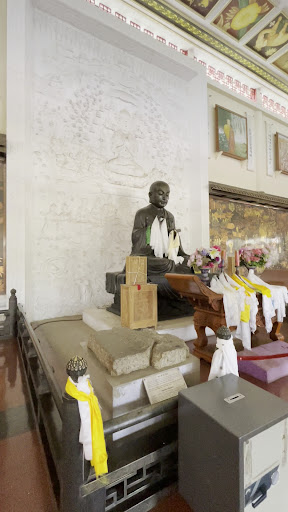
Exhibits and Displays: Inside, you'll find various exhibits, including photographs, manuscripts, and translations related to Xuanzang's work. There are also displays of reliquaries and artifacts connected to the ancient Nalanda University. Some sources mention that it houses the holy relics of Xuanzang, believed to be a bone relic.
Historical Connection: The museum serves as a powerful reminder of the deep historical ties between India and China, forged through the spread of Buddhism and scholarly exchange. It reinforces the bond between the two cultures.
Proximity to Nalanda University Ruins: Its location near the ruins of the ancient Nalanda University makes it a logical and enriching addition to a visit to this historically important site.
Who would enjoy it: History Buffs: Those interested in ancient Indian history, the history of Buddhism, and the Silk Road will find the museum highly informative. Scholars and Researchers: Given Xuanzang's meticulous records, the museum offers valuable insights for academic pursuits. Spiritual Tourists: For those on a Buddhist pilgrimage or seeking a reflective experience, the memorial hall provides a meaningful stop. General Tourists: Anyone visiting Nalanda will find it an interesting and educational experience, offering context to the ruins of the university.
Opening Hours: Typically from 9:00 AM to 5:00 PM, though it's always advisable to check the latest timings before your visit as they can change.
Entry Fee: Rs 60
Time Allocation: An average visit can take around 1 to 2 hours, allowing sufficient time to explore the exhibits and learn about Xuanzang's...
Read more