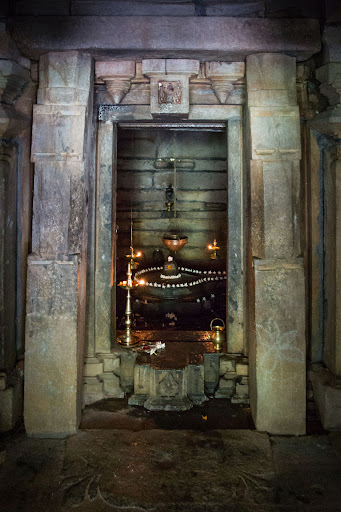
Mahadeva Temple, Tambdi Surla is a 13th-century Hindu temple in the Kadamba style dedicated to Lord Shiva, one of the main deities in Hinduism, and is an active place of Hindu worship. It is an ASI protected Monument of National Importance in Goa. The temple is dedicated to Lord Shiva and is reminiscent of the temples at Aihole in neighbouring Karnataka.
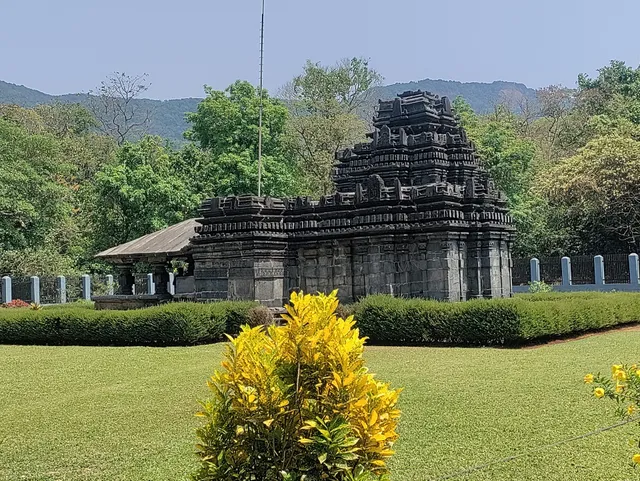
The temple was built in the Kadamba style from basalt, carried across the mountains from the Deccan plateau and carved by craftsmen. It is considered to be the only specimen of Kadamba architecture in basalt stone preserved and available in Goa. The temple survived the Islamic invasions and the Goa Inquisition, due to its remote location in a clearing deep in the forest at the foot of the Western Ghats which surround the site.
The temple is dedicated to Lord Shiva and is reminiscent of the temples at Aihole in neighbouring Karnataka. There is a linga (symbol of Lord Shiva) mounted on a pedestal inside the inner sanctum, and local legend has it that a huge king cobra is in permanent residence in the dimly lit interior.
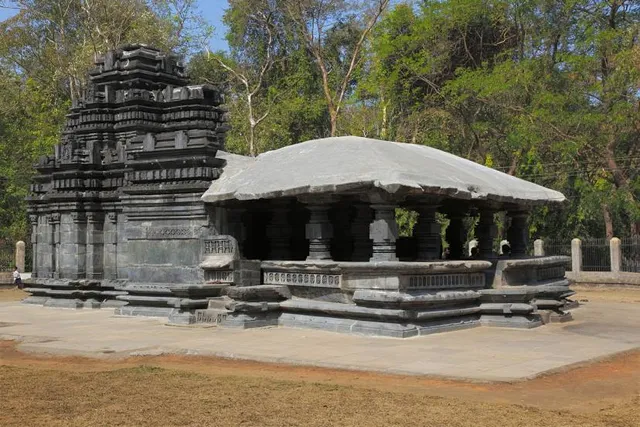
The temple consists of garbhagriha, antarala and a pillared Nandi mandapa built of basalt. The four pillars, embellished with intricate carvings of elephants and chains support a stone ceiling decorated with finely carved Ashtoken lotus flowers.1
The intricate carvings created by skilled craftsmen adorn the interior and the sides of the building. Bas-relief figures of Lord Shiva, Lord Vishnu and Lord Brahma, with their respective consorts appear on panels at the sides of the temple. Unusually, the mandap (pillared hall) is covered with a roof of plain grey sloping slabs. The temple faces east so that the first rays of the rising sun shine on the deity. There is a small mandap and the inner sanctum is surmounted by a three-tired tower whose top is incomplete or has been dismantled sometime in the distant past.[3]
There is a headless Nandi (bull, Shiva's vehicle) in the centre of the mandap, surrounded by four matching columns. The symbol of the Kadamba kingdom, an elephant trampling a horse is carved on the base of one of the columns. The river Ragado, (via village Keri, Sattari) flows nearby and is reachable for ritual bathing by a flight of stone steps.
The festival of Mahashivratri is celebrated with pomp and gaiety at the temple by local people residing in surrounding villages. The temple is built in a place which is quite inaccessible and away from the main settlements of the time. The temple is small compared to the average Goan temple.
The temple is at 15°26′20″N 74°15′8″E near a small village called Tambdi Surla located 13 kilometres (8.1 mi) east of Bolcornem village, in the north east region of the Bhagwan Mahaveer Sanctuary and Mollem National Park. Nearby village is Molem.
Mahadev Temple is approximately 65 kilometres (40 mi) from the capital city of Panaji. It is accessible from the north via minor roads 22 kilometres (14 mi) south from the main town of Valpoi in Sattari Taluka. The temple is at the foot of the Anmod Ghat, which connects Goa to the state...
Read moreThe Mahadev Temple at Tambdi Surla (also known as Kadamba Mahadev Temple) is a stunning and historically rich Hindu shrine nestled deep in the Bhagwan Mahaveer Wildlife Sanctuary, Sanguem, Goa.
🕉️ History & Significance
Date & Dynasty: Constructed in the 12th century under the Kadamba–Yadava lineage, possibly commissioned by Queen Kamladevi or minister Hemadri under Yadava King Ramachandra .
Survival: Shielded from destruction during Islamic and Portuguese invasions due to its remote jungle setting .
Recognized as an ASI-protected Monument of National Importance .
🏛️ Architecture & Layout
Style: Exemplifies the Kadamba–Yadava & Hemadpanthi style, built entirely of grey-black basalt or chlorite schist from the Deccan plateau .
Plan: Consists of:
Garbhagriha (sanctum with Shiva Linga)
Antarala (vestibule)
Mandapa (pillared hall) with a headless Nandi bull at its center .
Carvings:
Intricate elephants trampling horses, lotus medallions, chains, rosettes, and reliefs of Shiva, Vishnu, and Brahma with their consorts; reminiscent of Aihole and Hoysalas .
Roof: Simple sloping stone slabs—no mortar: a testament to precision in Hemadpanthi architecture .
Orientation: Faces east so dawn touches the deity directly .
The tower (shikhara) atop is truncated or unfinished .
🌿 Setting & Surroundings
Located in dense Western Ghats forest, alongside the Surla stream (accessible via stone steps) .
About 65 km from Panaji, reached via Valpoi and Mollem; nestled at the Anmod Ghat foothills .
Offers a serene blend of heritage, spirituality, and nature—ideal for temple tours, birdwatching, or trekking to Rundhi Falls .
🙏 Religious & Cultural Highlights
Shiva worship continues daily, with special celebrations during Mahashivratri .
Legendary resident cobra is said to live near the Linga—adding mystical lore to the temple .
🧭 Visiting Info
Timing: Generally 8:30 AM–5:30 PM, daily .
Entry: Free; parking available.
Dress code: Modest attire needed for an active temple.
Best season: October to March—pleasant weather and lush greenery.
Tips:
Comfortable shoes and water are advisable.
Combine visit with nearby attractions like Dudhsagar Falls or forest treks.
Limited mobile connectivity—plan accordingly.
✅ In Summary
Tambdi Surla Temple is Goa’s oldest surviving temple, an exquisite example of Kadamba heritage quietly nestled in the forest. It combines spiritual ambiance, architectural brilliance, and natural beauty in a way few places in Goa can match.
Let me know if you'd like help planning your route, transport options, or combining this trip with other...
Read moreA Timeless Gem Nestled in the Western Ghats – A South Indian Pilgrim’s Delight
As a devotee and admirer of ancient temples across South India, my visit to the Kadamba Shri Mahadeva Temple in Tambdi Surla, Goa, was nothing short of a spiritual and architectural revelation. Tucked away deep in the forests of the Western Ghats, this 12th-century temple is an absolute jewel—quiet, unspoiled, and serenely beautiful.
Coming from Karnataka, where we’re blessed with towering gopurams and sprawling temple complexes, I was pleasantly surprised to discover the understated elegance of this temple. The moment I stepped into the premises, the calmness of the surrounding jungle, the soft murmur of the Surla River, and the cool mountain breeze created an atmosphere that felt sacred and untouched by time. The intricate carvings on the basalt stone instantly reminded me of the finesse seen in Hoysala and Chalukya architecture from Karnataka—each sculpture telling a story, especially the beautifully adorned Nandi in the inner sanctum facing Lord Shiva.
The temple's modest size belies its spiritual grandeur. Its sanctum, housing a linga, invoked a deep sense of devotion. It’s rare to find a place where nature and divinity merge so seamlessly. Unlike the more commercialized temples in other parts of India, this one is pristine, quiet, and well-preserved. It’s as if you’re stepping into a different era, unhurried and reverent. I could truly reflect and offer my prayers without the usual crowds or distractions.
What particularly stood out for me as a South Indian traveler was how well this temple represents Goa’s lesser-known cultural and spiritual heritage. The Kadamba dynasty's architectural influence is clear, and yet it feels familiar in a way that connects South Indian and Deccan traditions. The temple priest was humble and knowledgeable, and even helped explain some of the iconography that often goes unnoticed.
I’d highly recommend reaching here early in the morning—it adds to the mystic charm. The drive itself is scenic, and the road leading to the temple takes you through lush green forests and winding trails. Do pair your visit with a short nature walk around the temple premises—there are butterflies, birds, and the gentle sounds of nature all around.
In a state famed for its beaches and nightlife, Tambdi Surla is a sacred escape—a place where you reconnect with history, nature, and the divine. Whether you're a history buff, a pilgrim, or someone seeking peace, this temple is a must-visit. I left feeling spiritually uplifted and deeply grateful for this...
Read more