HTML SitemapExplore
logo
Find Things to DoFind The Best Restaurants

Patan Patola Heritage — Attraction in Gujarat

Name
Patan Patola Heritage
Description
Nearby attractions
Shree Gokneswar Mahadev Temple Patan
V458+C9H, Bhairav Nagar, Patan, Samalpati, Gujarat 384265, India
Nearby restaurants
Prajapati Nasta House
near by Ranki Vav Ni Same, Patan, Samalpati, Gujarat 384265, India
Nearby hotels
Related posts
Keywords
Patan Patola Heritage tourism.Patan Patola Heritage hotels.Patan Patola Heritage bed and breakfast. flights to Patan Patola Heritage.Patan Patola Heritage attractions.Patan Patola Heritage restaurants.Patan Patola Heritage travel.Patan Patola Heritage travel guide.Patan Patola Heritage travel blog.Patan Patola Heritage pictures.Patan Patola Heritage photos.Patan Patola Heritage travel tips.Patan Patola Heritage maps.Patan Patola Heritage things to do.
Patan Patola Heritage things to do, attractions, restaurants, events info and trip planning
Patan Patola Heritage
IndiaGujaratPatan Patola Heritage

Basic Info

Patan Patola Heritage

Rani Ki Vav Road, opp. New Kalika Mandir, Gujarat 384265, India
4.5(876)
Open 24 hours
Save
spot

Ratings & Description

Info

Cultural
Family friendly
Accessibility
attractions: Shree Gokneswar Mahadev Temple Patan, restaurants: Prajapati Nasta House
logoLearn more insights from Wanderboat AI.
Phone
+91 98987 75748
Website
patanpatola.com

Plan your stay

hotel
Pet-friendly Hotels in Gujarat
Find a cozy hotel nearby and make it a full experience.
hotel
Affordable Hotels in Gujarat
Find a cozy hotel nearby and make it a full experience.
hotel
The Coolest Hotels You Haven't Heard Of (Yet)
Find a cozy hotel nearby and make it a full experience.
hotel
Trending Stays Worth the Hype in Gujarat
Find a cozy hotel nearby and make it a full experience.

Reviews

Nearby attractions of Patan Patola Heritage

Shree Gokneswar Mahadev Temple Patan

Shree Gokneswar Mahadev Temple Patan

Shree Gokneswar Mahadev Temple Patan

4.4

(14)

Closed
Click for details

Nearby restaurants of Patan Patola Heritage

Prajapati Nasta House

Prajapati Nasta House

Prajapati Nasta House

5.0

(1)

Click for details
Get the Appoverlay
Get the AppOne tap to find yournext favorite spots!
Wanderboat LogoWanderboat

Your everyday Al companion for getaway ideas

CompanyAbout Us
InformationAI Trip PlannerSitemap
SocialXInstagramTiktokLinkedin
LegalTerms of ServicePrivacy Policy

Get the app

© 2025 Wanderboat. All rights reserved.
logo

Posts

Deval ShahDeval Shah
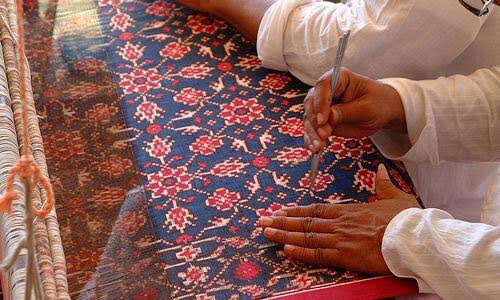
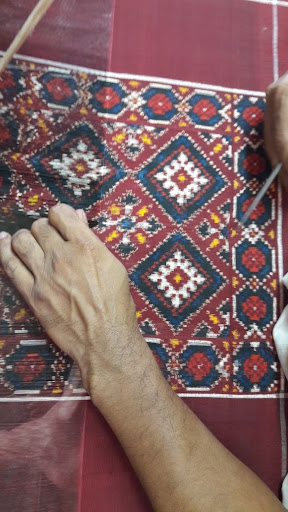
We are talking about the Patola sarees of Patan. It takes the combined effort of four weavers anywhere between four to six months, sometimes even more, to weave a single saree. This unique weave, usually made from silk, is a double Ikat and combines the techniques of tying, dyeing and weaving. Many consider Patola as the ‘ultimate manifestation of weaving perfection’ because the displacement of even one thread can resulted in a deformed pattern. Also, the dyeing and the weaving process is extremely complicated, requiring mathematical precision coupled with a vivid imagination. The double Ikat weave means once the saree or fabric is woven, you cannot differentiate between the sides – the colour and the intensity, the feel and the look, are the same on both sides. Rohit bhai belongs to the 16thgeneration of a family that has been pursuing this weaving art form. The fame, charm, and the Patola sarees have been woven by centuries of rich history. From a mention in the Kalpsutra, a 2000-year-old Jain holy book, to carvings in the Ajanta caves, and numerous folk tales in different languages – from Gujarati to Telugu, the Patola sarees make for a fascinating subject. In fact, it took 34 years of constant research for two Swiss writers, Alfred Buhler and Eberhard Fischer, to pen a book The Patola of Gujarat. The book was published in 1979.
Ashok PatelAshok Patel
Patolas are very expensive woven silk saris worn only by rich people (the price starts with Rs 150,000/-). The common people can’t afford these saris. The secret of patola weaving is closely guarded and only three families of Salvi caste know the art. This art of patola weaving is 850 years old and is dying and only handful of family members know the techniques. It takes 6 months to make one patola and owning a patola is considered a social status. Usually, the dyeing of the fabric is done after the weaving but for Patola, the threads are dyed first as per the design and then the fabric is woven. In this museum, the Salvi family exhibits how the Patola silk is made in action on real hand loom. This Salvi family is involved in Patola making since 35 generations. They have been awarded many awards from the government for keeping this art alive. This family is specialized on double-ikat weaving. In the Patola house, many fabrics from different parts of the world are displayed which are single-ikat weaving. We can clearly see the difference in quality of the Patola weaved by this family as compared to the other patolas weaved by other countries.
Priyanka MukerjeePriyanka Mukerjee
This Sunday we were interested to visit this place and see the weaving and purchase some stuff but the main door leading to the house was locked from inside and we were asked to wait for 5-10 mins since apparently some individual had come with a police vehicle with his family & they were being shown around. So the young boy there asked us to wait outside. Upon asking after 10 mins he again asked us to wait for 5-10 mins. This time given by him seemed to be never ending and we were made to wait in the afternoon heat outside. Moreover we had already taken out our footwear and were waiting there on the hot floor since we were not aware that they would ask us to wait. They could have at least requested us to wait inside. Everybody should be treated equally with dignity and respect. We found their attitude extremely uncouth. We then left the place without entering. I came across quite a few one star ratings of visitors talking about the poor behaviour of the staff but the management probably doesn’t understand this or doesn’t care.
See more posts
See more posts
hotel
Find your stay

Pet-friendly Hotels in Gujarat

Find a cozy hotel nearby and make it a full experience.

We are talking about the Patola sarees of Patan. It takes the combined effort of four weavers anywhere between four to six months, sometimes even more, to weave a single saree. This unique weave, usually made from silk, is a double Ikat and combines the techniques of tying, dyeing and weaving. Many consider Patola as the ‘ultimate manifestation of weaving perfection’ because the displacement of even one thread can resulted in a deformed pattern. Also, the dyeing and the weaving process is extremely complicated, requiring mathematical precision coupled with a vivid imagination. The double Ikat weave means once the saree or fabric is woven, you cannot differentiate between the sides – the colour and the intensity, the feel and the look, are the same on both sides. Rohit bhai belongs to the 16thgeneration of a family that has been pursuing this weaving art form. The fame, charm, and the Patola sarees have been woven by centuries of rich history. From a mention in the Kalpsutra, a 2000-year-old Jain holy book, to carvings in the Ajanta caves, and numerous folk tales in different languages – from Gujarati to Telugu, the Patola sarees make for a fascinating subject. In fact, it took 34 years of constant research for two Swiss writers, Alfred Buhler and Eberhard Fischer, to pen a book The Patola of Gujarat. The book was published in 1979.
Deval Shah

Deval Shah

hotel
Find your stay

Affordable Hotels in Gujarat

Find a cozy hotel nearby and make it a full experience.

Get the Appoverlay
Get the AppOne tap to find yournext favorite spots!
Patolas are very expensive woven silk saris worn only by rich people (the price starts with Rs 150,000/-). The common people can’t afford these saris. The secret of patola weaving is closely guarded and only three families of Salvi caste know the art. This art of patola weaving is 850 years old and is dying and only handful of family members know the techniques. It takes 6 months to make one patola and owning a patola is considered a social status. Usually, the dyeing of the fabric is done after the weaving but for Patola, the threads are dyed first as per the design and then the fabric is woven. In this museum, the Salvi family exhibits how the Patola silk is made in action on real hand loom. This Salvi family is involved in Patola making since 35 generations. They have been awarded many awards from the government for keeping this art alive. This family is specialized on double-ikat weaving. In the Patola house, many fabrics from different parts of the world are displayed which are single-ikat weaving. We can clearly see the difference in quality of the Patola weaved by this family as compared to the other patolas weaved by other countries.
Ashok Patel

Ashok Patel

hotel
Find your stay

The Coolest Hotels You Haven't Heard Of (Yet)

Find a cozy hotel nearby and make it a full experience.

hotel
Find your stay

Trending Stays Worth the Hype in Gujarat

Find a cozy hotel nearby and make it a full experience.

This Sunday we were interested to visit this place and see the weaving and purchase some stuff but the main door leading to the house was locked from inside and we were asked to wait for 5-10 mins since apparently some individual had come with a police vehicle with his family & they were being shown around. So the young boy there asked us to wait outside. Upon asking after 10 mins he again asked us to wait for 5-10 mins. This time given by him seemed to be never ending and we were made to wait in the afternoon heat outside. Moreover we had already taken out our footwear and were waiting there on the hot floor since we were not aware that they would ask us to wait. They could have at least requested us to wait inside. Everybody should be treated equally with dignity and respect. We found their attitude extremely uncouth. We then left the place without entering. I came across quite a few one star ratings of visitors talking about the poor behaviour of the staff but the management probably doesn’t understand this or doesn’t care.
Priyanka Mukerjee

Priyanka Mukerjee

See more posts
See more posts

Reviews of Patan Patola Heritage

4.5
(876)
avatar
5.0
7y

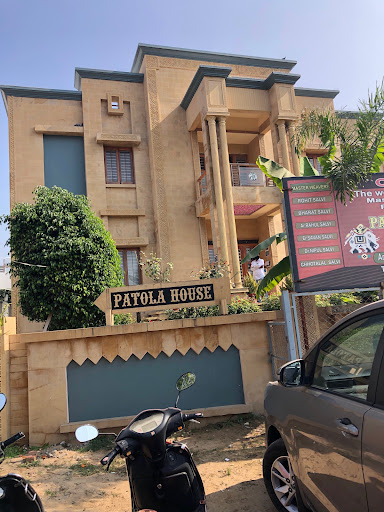
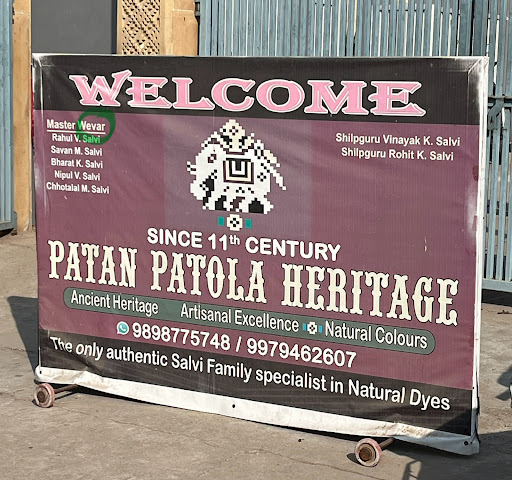
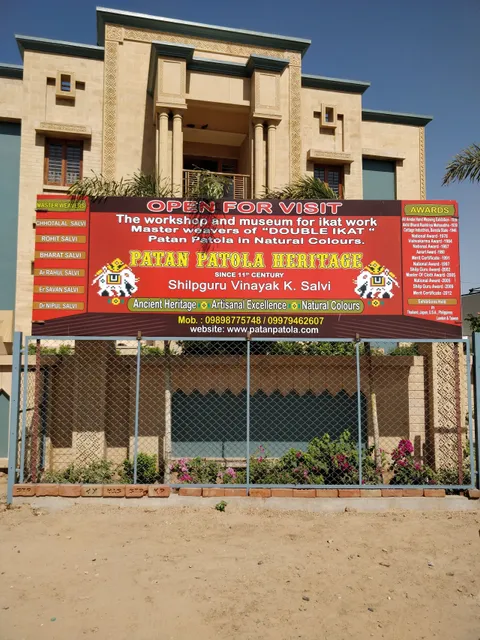
The Sanskrit word tapasya, which roughly translates into penance of visceral intensity and frit through years (decades, even centuries) of meditation, may describe the karmic reality of Patan’s Salvi family .We belong to a community of double Ikat weavers. After 15 years of methodical planning on real estate, finance and architecture, and 300 years after our ancestors began to informally document details of the complex weaving technique of Patola weaving, we opened the doors to a private museum in our hometown Patan in north Gujarat in September 2014. This is a vibrant example of seemingly impossible dreams coming true, exemplified by the gleam in the eyes of the youngest weavers in the family- Savan and Rahul Salvi- and our proud uncles, Bharat and Rohit Salvi. Called the Patan Patola Heritage with a board outside including the names of the family’s National Award winners, like Rahul’s late father Vinayak Kantilal Salvi, this is the only such Patola museum in the world. Over 3,000 sq. Of space and three floors, it documents the history of the Patan Patola, a textile that combines techniques of tyeing ,dyeing and weaving. The oldest piece is a tattered red vintage Patola sari wrapped in white muslin and stored in a discreet drawer, the most enticing artefacts are century old artisanal sketches on yellowed and aged paper, made by our ancestors, that document the process of making the Patan Patola. Ikat, an Indonesian word that means to tie, knot or bind, describes a textile which is handwoven after the warp or weft of the fabric is tied and resist dyed for intricate patterns. A single Ikat, where the warp or the weft is tied and then dyed, is practised in various cultures quite prominently in Indonesia, Thailand and Uzbekistan. Double Ikat can also be found in Japan, Guatemala, and in the Indonesian islands of Bali and Kalimantan, but the more complex, Patan Patola variant of double Ikat originated in India. Both the warp and weft are first tied, then resist dyed with extreme precision to retain the dyed designs on the field of the sari as well as on the motifs, without any seeping or blurring . It is the mother of all Ikat techniques. Historically known to have originated in India during the reign of King Kumarpal of the Solanki dynasty in the 12th century, it is treated with reverence by textile scholars as an extraordinary example of weaving. Its samples most of them in the form of a sari hang in every textile museum in the world. Three years back, when this writer met the Salvi family for a book project, they appeared trapped between the weight of a unique inheritance and self generated pressure to “do something for Patola and for Patan”.Strongly insular (they guard their legacy with a do – or – die passion) and ideologically resistant to political intervention, government support and celebrities wanting to wear their saris at fashion vents, the Salvis wanted to chart a distinct path of textile conservation and self conservation. They had been showing their loom and explaining the technique to the hundreds who visit their house every year, but wanted to formalize this ritual. The family’s award winning weavers , as well as Bharatbhai, now a veteran, have also been around the world exhibiting their work at craft exhibitions from Japan to the US. We wanted to conserve and display the Patan Patola legacy without taking financial help or favours from any organization, private or public. W would rather spend every bit of our earnings to conserve the craft mastered...

   Read more
avatar
5.0
2y

Patola is a double ikat woven sari, usually made from silk, made in Patan, Gujarat, India. The word patola is the plural form; the singular is patolu.

Patola' (ritual heirloom cloth) from Gujarat, India, late 18th or early 19th century

A loom using to weave Patolas in Patan

Patan patolu, 1725–1800. This fine heirloom was likely woven for export to Sumatra, where the Gujarati patolas strongly influenced local ikat designs

The weave

To create a patola sari, both the warp and weft threads are wrapped to resist the dye according to the desired pattern of the final woven fabric. This tying is repeated for each colour that is to be included in the finished cloth. The technique of dyeing the warp and weft before weaving is called double ikat. The bundles of thread are strategically knotted before dyeing.2 Patola saris from Surat, Ahmedabad and Patan are renowned for their colourful diversity and geometrical style.

History

Silk weavers of the Salvi caste from the state of Maharashtra chose Gujarat as the home for their renowned patola fabric. It is believed that salvis went to Gujarat in the 12th century with the intention of acquiring the patronage of the Chaulukyas Rajputs, who ruled all of Gujarat and parts of Malva and south Rajasthan at the time, with Anahiwad Patan as the capital. Legend says that over 700 patola weavers came to the palace of Raja Kumarpal, on the personal request of king himself. The Solanki(Chalukya) rulers used to dress in patola silk themselves on special occasions.[citation needed]

It is broadly accepted belief that these Salvis originally belonged to the region, which now lies at the middle of the present day Marathawada and Vidarbha divisions of Maharashtra state. The art of Patola weaving is an ancient one. According to some historians, the art of Patola weaving was known also in the 4th century in “Ajanta” caves, which resembles the tie-dyes technique of patola. Ajanta Caves were patronized by the Vatsagulma branch of the Vakataka dynasty, which controlled a vast area of Deccan during the 3rd, 4th & 5th centuries A.D. Vatsagulma is presently the 'Washim' district of the Vidarbha Division of Maharashtra.

After the decline of Solanki empire, salvis founded a rich trade in Gujarat. Patola saris quickly became a sign of social status among Gujarati women and girls, especially as part of stridhan, items that a woman can claim as her. These art of patan is more than 850 years old.

Patola has had a huge importance as status clothes in Southeast Asia where it was imported from at least the Middle Ages. Local elites in far eastern locations such as Timor and Maluku Islands strove to acquire patola or patola imitations, which were often provided by European merchants in the early-modern era. Patola motifs were frequently taken over by indigenous weaving traditions

Design and patternEdit

There are four distinct patterns which are woven primarily in Gujarat by the Salvi community. In Jain and Hindu communities, double ikat saris with entire designs of parrots, flowers, elephant and dancing figures are generally used. In Muslim communities, saris with geometric designs and flower patterns are typical, being worn mostly for weddings and other special occasions. Maharashtrian Brahmins wear saris woven with plain, dark coloured borders and body and a bird design...

   Read more

avatar
5.0
6y

This is the musium of sample of clothes made from patola.

The Patola is a double ikat woven sari, usually made from silk,1] made in Patan, Gujarat, India.[2] The word patola is the plural form; the singular is patolu.[3] They are very expensive, once worn only by those belonging to royal and aristocratic families. These saris are popular among those who can afford the high prices.[4 Velvet patola styles are also made in Surat. Patola-weaving is a closely guarded family tradition. There are three families in Patan that weave these highly prized double ikat saris. It is said that this technique is taught to no one in the family, but only to the sons. It can take six months to one year to make one sari due to the long process of dying each strand separately before weaving them together.Patola was woven in Surat, Ahmedabad and Patan.Highly valued in Indonesia, became part of the local weaving tradition there.

:: Process ::

To create a patola sari, both the warp and weft threads are wrapped to resist the dye according to the desired pattern of the final woven fabric. This tying is repeated for each colour that is to be included in the finished cloth. The technique of dyeing the warp and weft before weaving is called double ikat. The bundles of thread are strategically knotted before dyeing.

Patola saris from surat, Ahmedabad and Patan are renowned for their colorful diversity and geometrical style.

:: History ::

Silk weavers of the salvi caste from the states of Karnataka and Maharashtra chose Gujarat as the home for their renowned patola fabric. It is believed that salvis went to Gujarat in the 12th century with the intention of acquiring the patronage of the Chaulukyas Rajputs, who ruled all of Gujarat and parts of Malva and south Rajasthan at the time, with Anahiwad Patan as the capital. Legend says that over 700 patola weavers came to the palace of Raja Kumarpal.[6] The ruler used to dress in patola silk himself on special occasions.[citation needed]

After the decline of the Solanki empire, the salvis founded a rich trade in Gujarat. Patola saris quickly became a sign of social status among Gujarati women and girls, especially as part of stridhan, items that a woman can claim as her own property within a...

   Read more
Page 1 of 7
Previous
Next