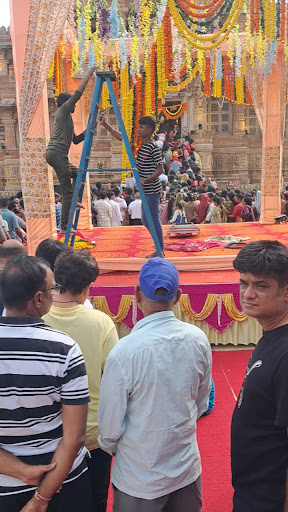
Pls take benefit of dhajaji donation
Advantage of political anarchy was taken by the rules of Idar state, Shamlaji came under the rule of Idar. Wars were fought between the Muslim and Idar rulers. In 1520 A.D. sultan Muzffar shah conquered this territory. The Idar ruler signed a treaty with the Muslims and regained this territory.
After 1550 A.D owing to the contacts of Vallabhacharyaji Mahaprabhuji, the rulers (emperors) of the Lodi Dynasty adopted a liberal policy towards Hinduism. Devotees and Acharyas preached Krishna bhakti, Shri Vallabhacharyaji Visited Dwarka, Dakor, Sidhpur and Shamlaji in 1565 and rejenuvated the places of Pilgrimages.
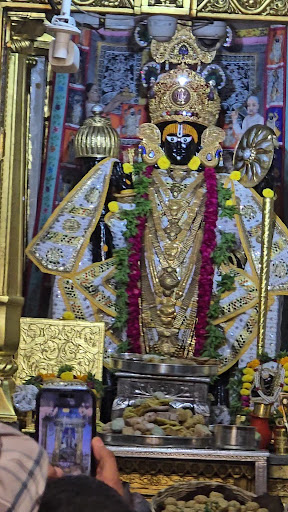
Emperor Aurangzeb destroyed so many temples as a result of this religious fanatism. Shamlaji Tirth (a place of worship) was not an exception to this. Though the Maharaja of Idar, the Thakores and the Rajputas fought very bravely, they could not match the fully armed Moghul Army. They hid in the adjoining hills. The Muslim Army burnt the village of Shamlaji and destroyed the Shamlaji Temple of the Tirth. The Army entered Shamlaji Temple and cut off the nose and ear of the Garuda Idol and destroyed the outside idols. Miraculously. Waps coming out them fought like an army and drove away the Muslim soldiers. People return and hid the image (Idol) of Shamlaji in the Karambuj pond. They migrated. Only the Adivasis continued cultivating. During the course of time. One Advasi came acros the idol while ploughing the land. The Vaishnavas started worshipping the idol according rites of the Vaishnava Dharm (religion).
Gujarat came under the rule of the Maratha Power during the 18th Century. In 1812 this territory was placed under the rule of Mahikantha Agency. King of Ider was attracted towards Shamlaji in the temple. He installed the image (idol) of Shamlaji in the temple Round about 1860. A.D. this territory was placed under the rule of Sabarkantha Agency. In 1948 this territory was put under the rule of the Bombay state. In 1955 A.D. a separate state of Gujarat was created and this territory was named as the Sabarkantha District.
During the British Rule, Shri Kesharisinhji, the rule of Idar State, formed a committee of the Vaishnavas for the regular management (administration) of this temple.
The burden of maintenance was put on the Shoulders of banias of villages surrounding Shamlaji and the responsibility of protecting the place was brought on the Jagirdari Thakores. Some village, land, wells etc., were gifted to the temple. During the course of time, the devotees of Modasa, Sardoi and Tintoi were appointed for the administration.
The Shamlaji Vishnu Mandir was registered vide Trust No. A-22 in Samvat 2008 under the charity trusts act (The Bombay public Trusts Act, 1950). At present, a Trust is...
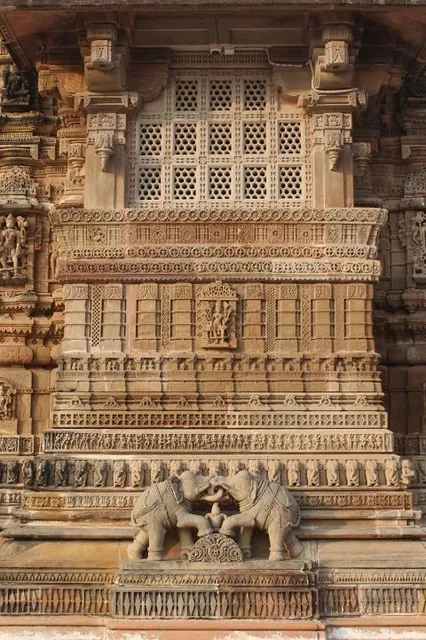
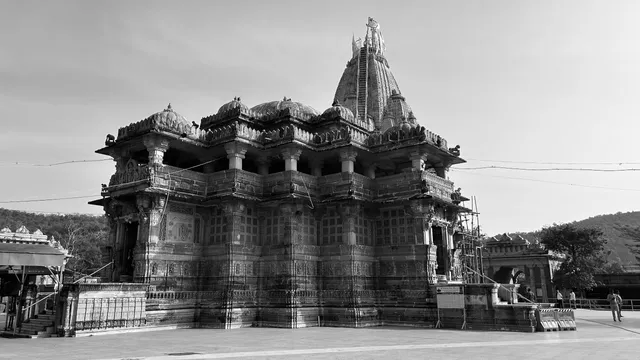
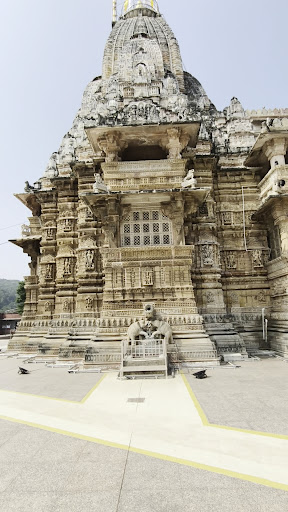
Read moreShamlaji no medo, also spelled Shamalaji, is a major Hindu pilgrimage centre in Aravalli district of Gujarat state of India. The Shamlaji temple is dedicated to Vishnu or Krishna. Shamlaji was an important Hindu centre in the 6th century, probably the home of a sculpture workshop whose creations are found as far away as Mumbai, where the Parel Relief was found. Most of the ancient sculpture found at Shamlaji, in blueish schist, has now been removed to museums, especially to Mumbai and Vadodara. Shamlaji temple is located on the banks of the Meshvo river in the valley surrounded by well wooded hills. It is also referred to as Dholi Dhajawala due to white silk flag fluttering on top of the temple. Built of white sandstone and brick it is surrounded by a wall with a gateway. It is of two stories, supported on pillars, and a canopy with arches on each side. The lower courses of richly carved stone are of great age. Above them runs a frieze with an unintelligible pattern, and, above this, running right round the building, a fringe of elephants' heads and forequarters carved in stone. Above this is a very ranch worn frieze full of figures in bass-relief, men on horseback with bows, and animals. The elephant is a very frequent emblem. Besides the fringe frieze above mentioned, there are, on the outer wall, between every two angles, larger figures of semi-rampant elephants standing out in relief, and, in front of the entrance, stands on either side of the doorway a gigantic cement elephant. Above the shrine, a pyramid-based tower rises into a spire like a high-shouldered cone with flattened sides. The forepart of the roof consists of a number of small domes springing from a flat roof, or rather of a flat trabeate roof, with domes here and there, the largest being in the centre. Outside at all the angles of the roof are figures of animals and the gargoyles. On walls, there are some scenes from the epics Mahabharata and Ramayana. Of the two inscriptions, one is to the left in the upper story and bears date 94 AD...
Read moreSamlaji Temple is indeed a remarkable and revered Vishnu temple, nestled within the serene and picturesque surroundings of a forest, making it a truly special and divine place of worship.
One of the standout features of Samlaji Temple is its historical and spiritual significance. As a Vishnu temple, it holds immense importance for followers of Hinduism, and devotees flock to this sacred site to seek blessings and pay their respects to Lord Vishnu.
The temple's location within the embrace of nature adds to its allure. Surrounded by lush greenery, dense trees, and a tranquil forest atmosphere, the temple offers a peaceful and harmonious ambiance for devotees to connect with the divine and experience a sense of serenity.
The natural setting also enhances the spiritual experience of visiting Samlaji Temple. As visitors approach the temple through the forest, they can immerse themselves in the beauty of nature, creating a sense of awe and reverence as they enter the sanctum sanctorum.
The architecture and design of the temple are a testament to the rich heritage and craftsmanship of the region. The intricate carvings, ornate pillars, and traditional motifs showcase the grandeur and splendor of Indian temple architecture.
Additionally, the temple is likely to have facilities for visitors, such as prasad distribution, resting areas, and devotee amenities, ensuring a comfortable and fulfilling experience for those who visit.
The temple's serene and scenic location also makes it an ideal spot for spiritual retreats, meditation, and spending moments of introspection amidst nature's bounty.
In conclusion, Samlaji Temple is truly one of the best Vishnu temples, blessed with a magnificent location within the embrace of a forest. With its spiritual significance, architectural splendor, and serene natural surroundings, it offers a divine and tranquil experience for devotees and visitors alike. For those seeking a soulful and serene spiritual journey, Samlaji Temple is undoubtedly a must-visit...
Read more