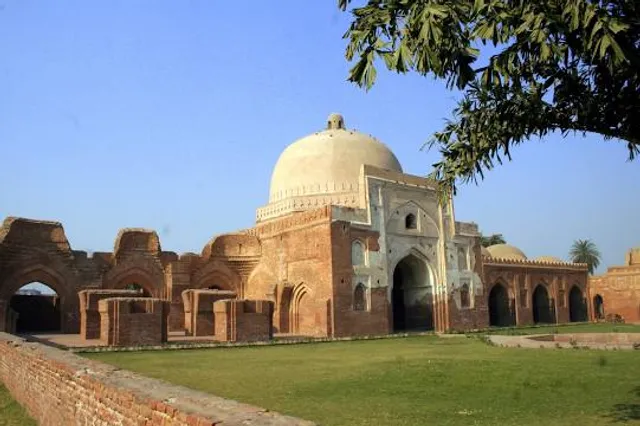
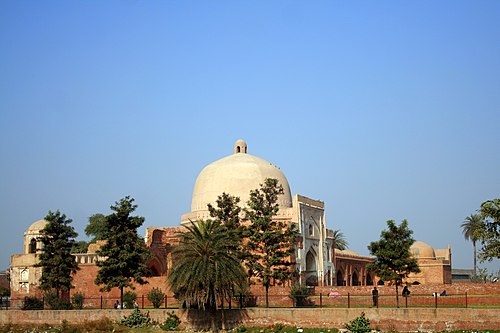
The Kabuli Bagh Mosque in Panipat was built in 1527 by the emperor Babur to mark his victory over Sultan Ibrahim Lodhi at the first Battle of Panipat in 1526. The mosque located in Panipat is named after Kabuli Begum, Babur's wife. That's really awesome place to visit there.... We can go there and relax here...... It's really awesome to visit there Location Panipat, Haryana, India Geographic coordinates 31°22′08″N 75°22′52″E Affiliation Islam District Panipat Province Haryana Country India Year consecrated 1527 Ecclesiastical or organizational status Mosque Leadership Babur Architectural description Architect(s) Babur Architectural type Mosque Architectural style Islamic Completed 1527 Materials Marble The main building was built in 1527. Emperor Babur of Timurid dynasty defeated Sultan Ibrahim Lodhi in the first Battle of Panipat in 1526 at Panipat.2 It was the first conquest of the Mughals over Hindustan.4] A descendent of Tamerlane(Taimur Lung) who built this monument as a show of victory of the Mughals over the Pathan rulers of India. He built the Kabuli Bagh mosque in 1527.[1
Addition of Gates and Garden (1) Edit In 1527, the gate and the garden surrounding it were built.[4]
Addition of Gates and Garden (2) Edit In 1557, when Babur's son Humayun defeated Sher Shah Suri near Panipat in, he added a masonry Platform to it and called it "Chabutra" Fateh Mubarak, bearing the inscription 934 Hijri (1557 CE). These buildings and the garden still exist under the name of Kabuli Bagh called so after Babur’s wife – Mussammat...
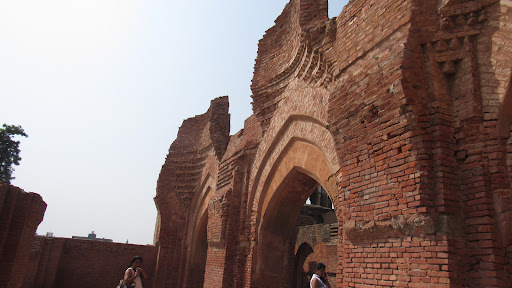
Read moreThe mosque built with bricks and stucco plaster within a compound wall faces north. The corners of the mosque have towers of octagonal shape on the northwest and south west directions.
Its entry gate built with bricks and red sandstone has an enclosed "bracket type lintel" opening of which is shaped like a large arch; its spandrels have ornamentation, enclosed in rectangular panels provided with arched recesses. The prayer hall is large and measures 53.75 by 16.5 metres (176 by 54 ft) , and is covered by a large dome.
There is a Qibla, a niche in the prayer chamber wall which is oriented towards Mecca. This central bay is visible even from the outside through its wide entrance opening. The mihrab here has an epigraph which includes the "Throne Verse from the Quran".
The prayer chamber is flanked on either side by "three-bayed triple-aisled side wings". The front face of the mosque is high and is made up of panels which have stucco work of lime plaster. Each of the two wings have nine bays and each bay is topped by a hemispherical dome founded on low cylindrical tholobates. The parapet wall has Persian inscriptions. A Chabutra-i-Fateh Mubarak is a masonry platform which surrounds the mosque, which was built during the reign of Humayun to mark his victory over Salim Shah. There is also a northern stone gate in...
Read moreSuch a historic place but very meagerly maintained and isolated. It is said that this Masjid is the first Mughal structure of the Mughal Dynasty.
After the arrival of Babar in India as he defeated Ibrahim Lodi at the first battle of Panipat, he built this tomb in the memory of her wife Kabuli Begam in 1526-1527 AD.
First, the architecture is really impressive. The red stones were still intact to the grounds. The prayer hall was locked. Nobody was allowed to go inside. The central hall looked big but it was locked too which proves that no tourists visit this place.
It didn't, at all, look a tourist spot. Only some history geeks like me visit such isolated place. The guards outside interrogated us like we are going to repeat the Ayodhya here. We were equipped with some camera gears and backpacks. They took it otherwise. Later they allowed us to enter.
Drunkards and locals fill this place. Students play PUBG inside the tomb. They climb walls and take selfie. Walls are engraved with love messages of Rahul Loves Rani.
Overall, I took this pain to jot down my experience because I wish this place would uplift and attract people around its walls since this is a historic place. I reiterate, this is the very first Mughal structure of...
Read more