The Shalimar Bagh, also known as the Shalimar Garden, is one of the most famous Mughal gardens in Srinagar, Kashmir. It is an exquisite example of Mughal landscaping and architecture and holds deep historical and cultural significance.
History of Shalimar Garden:
Mughal Era (1620 - 1630): Shalimar Garden was built during the reign of the Mughal Emperor Jahangir in the early 17th century, between 1620 and 1630. The garden was constructed for Nur Jahan, Jahangir’s beloved wife, who is believed to have played a significant role in its design. The garden was originally designed to serve as a royal retreat for the Mughal emperors, offering a blend of natural beauty, relaxation, and serenity in the cool climate of Kashmir. Design and Architecture: The Shalimar Garden is a stunning example of Mughal Persian-style garden architecture, which follows the traditional “charbagh” (fourfold) pattern, symbolizing the four rivers of paradise. The garden is divided into four main parts, with terraced levels leading down to a central water channel, which was designed to flow through the garden, symbolizing the concept of eternal life. The water features, fountains, cascading waterfalls, and channeled streams are key elements of the garden’s design. The garden is renowned for its harmonious blend of nature and architecture. Marble pavilions, ornate tilework, and flowerbeds contribute to its beauty, making it one of the most picturesque spots in Kashmir. Name and Symbolism: The name “Shalimar” is believed to be derived from the Persian word for “abode of love” or “palace of love,” reflecting the romantic and tranquil atmosphere the garden was meant to evoke. It is also often called Shalimar Bagh, with “Bagh” meaning garden in Urdu. Post-Mughal History: After the decline of the Mughal Empire, Shalimar Garden continued to be a symbol of Kashmir’s cultural heritage. It saw some changes under the rule of various regional rulers, including the Sikh and Dogra dynasties. However, much of the garden’s original design and beauty have been preserved through the centuries, even as it continued to be used by successive rulers as a royal garden. Restoration and Preservation: Over time, the Shalimar Garden underwent several changes, including periods of neglect and damage. During British colonial rule, some alterations were made, but much of the garden’s original Mughal charm was retained. In recent years, restoration efforts by the Indian government have focused on preserving the garden and its cultural heritage, ensuring that it remains a major tourist attraction. Cultural and Symbolic Significance: Shalimar Garden has become one of the most iconic landmarks of Srinagar and is considered one of the finest Mughal gardens in India. It embodies the grandeur of the Mughal era and represents the blend of Persian and Kashmiri architectural styles. The garden is often a metaphor for Kashmir’s beauty and serenity, frequently depicted in art, literature, and poetry. Tourism and Present-Day: Today, the Shalimar Garden is a UNESCO-protected site and is open to the public. It remains one of the most visited tourist attractions in Srinagar, particularly for those interested in Mughal architecture, gardening, and Kashmir’s rich cultural history. The garden is a favorite spot for visitors during the spring and summer months when its flowers are in full bloom, and the fountains are in operation.
Key Features of Shalimar Bagh:
• Terraced Layout: The garden is arranged on three descending terraces, each featuring beautifully laid-out lawns, pathways, and fountains. • Water Features: A key feature of the garden is its waterworks, including a central water channel, fountains, and cascading waterfalls. • Pavilions: At the top terrace, there is a marble pavilion (also called the “Sheesh Mahal”) where the Mughal emperors and their queens would sit to enjoy the view. • Floral Layout: The gardens are filled with a variety of flowers and trees, including tall chinars and decorative plants, contributing to the...
Read moreShalimar Bagh is a Mughal garden in Srinagar, Jammu and Kashmir. Linked through a channel to the northeast of Dal Lake. It is also known as Shalimar Gardens, Farah Baksh, and Faiz Baksh. The other famous shoreline garden in the vicinity is Nishat Bagh, 'The Garden of Delight'. The Bagh was built by Mughal Emperor Jahangir in 1619. The Bagh is considered the high point of Mughal horticulture. It is now a public park and also referred to as the "Crown of Srinag. Shalimar Bagh was built by Mughal Emperor Jahangir in 1619. He enlarged the ancient garden in 1619 into a royal garden and called it 'Farah Baksh' ('the delightful'). In 1630, under Emperor Shah Jahan’s orders, Zafar Khan the governor of Kashmir extended it. He named it ‘Faiz Baksh’ ('the bountiful'). It then became a pleasure place for the Sikh governors of the province.
During the rule of Maharaja Ranjit Singh, the marble pavilion was the guest house for European visitors. Electrification of the premises was done during Maharaja Hari Singh’s rule. Thus, over the years, the garden was extended and improved by many rulers and called by different names, but the most popular name ‘Shalimar Bagh’ continues to this day.
During the Mughal period, in particular, Emperor Jahangir and his wife Nur Jahan were so enamoured of Kashmir that during summer they moved to Srinagar with their full-court entourage from Delhi at least 13 times. Shalimar Bagh was their imperial summer residence and the Royal Court. They crossed the arduous snowy passes of the Pir Panjal mountain range on elephants to reach Srinagar. befitting setting for the Bagh.
The Shalimar Bagh is well known for chini khanas, or arched niches, behind garden waterfalls. They are a unique feature in the Bagh. These niches were lighted at night with oil lamps, which gave a fairy tale appearance to the waterfalls. However, now the niches hold pots of flower pots that reflect their colours behind the cascading water.
Another unusual architectural feature mentioned is about the doors of the Baradari. In the garden complex, the Baradari had four exquisite doors made of stones supported by pillars. It is conjectured that these stone doors were ruins from old temples that were demolished by Shahjahan. The garden also provided large water troughs where a variety of fountains were fixed.
It has been aptly described by a chronicler glowingly:
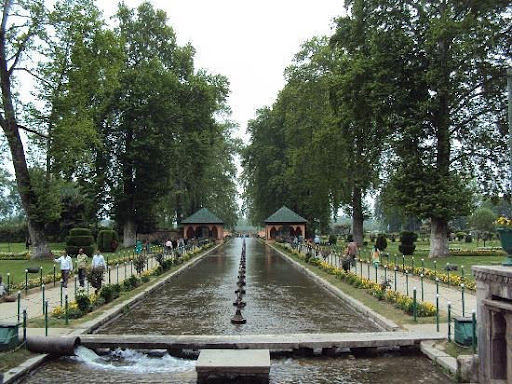
A subtle air of leisure and repose, a romantic indefinable spell, pervades the royal Shalimar: this leafy garden of dim vistas, shallow terraces, smooth sheets of falling water, and wide canals, with calm reflections broken only by the stepping stones across the streams.
Even in later years, during Maharaja's rule, the gardens were well maintained and continue to be so even now as it is one of the prominent visitor attractions around the Dal Lake.
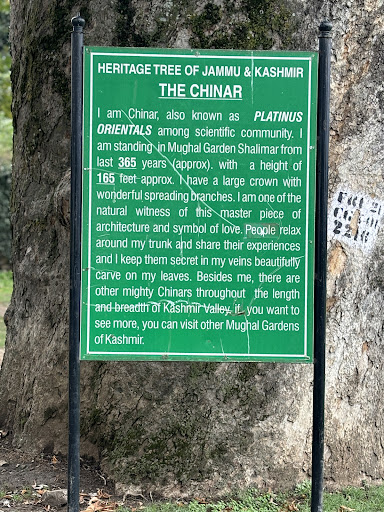
The garden is considered to be very beautiful during the autumn and spring seasons due to the colour change in leaves of the famed Chinar trees.
The gardens were the inspiration for other gardens of the same name, notably the Shalimar Bagh, Delhi in Delhi (built in 1653, which now also has an upscale colony) and Shalimar Gardens in Lahore, Pakistan built by Emperor Shah Jahan in 1641.
The black pavilion built during the early part of Jahangir's reign (1569–1627), in the top terrace of the Shalimar Bagh, has the famous inscription in Persian, which says:
اگر فردوس بر روے زمین است همین است و همین است و همین است Agar Firdaus bar rōy-e zamin ast, hamin ast-o hamin ast-o hamin ast.
This is a couplet wrongly attributed to the Persian-language poet Amir Khusrau, But written by a Persian poet 'Orfi Shirazi during his visit to Kashmir, which is inscribed on many buildings in the Indian subcontinent.
TypeMughal garden. LocationSrinagar, Jammu and Kashmir. Coordinates34°8′32.48″N 74°51′46.48″E. Area12.4 hectares (31 acres). Opened1619 A.D. FounderJahangir. DesignerJahangir. Owned byJammu and Kashmir Tourism Department. Operated byJammu and Kashmir Tourism....
Read moreShalimar Garden Shalimar Bagh is a Mughal garden in Srinagar, linked through a channel to the northeast of Dal Lake, on its right bank located on the outskirts of Srinagar city in Jammu and Kashmir, India. Its other names are Shalimar Garden, Shalimar Bagh, Farah Baksh and Faiz Baksh, and the other famous shore line garden in the vicinity is Nishat Bagh. The Bagh was built by Mughal Emperor Jahangir for his wife Noor Jahan, in 1619. The Bagh is considered the high point of Mughal horticulture. It is now a public park. This time it’s also called as crown of Srinagar.

History Emperor Jahangir built his celebrated Shalimar Bagh, his dream project to please his queen. He enlarged the ancient garden in 1619 into a royal garden and called it ‘Farah Baksh’ (‘the delightful’). He built it for his wife Nur Jahan (‘light of the world’). In 1630, under Emperor Shah Jahan’s orders, Zafar Khan the governor of Kashmir extended it. He named it ‘Faiz Baksh’ (‘the bountiful’). It then became a pleasure place for the Pathan and Sikh governors who followed Zafar Khan.
During the rule of Maharaja Ranjit Singh the marble pavilion was the guest house for European visitors. Electrification of the premises was done during Maharaja Hari Singh’s rule. Thus, over the years, the garden was extended and improved by many rulers and called by different names, but the most popular name ‘Shalimar Bagh’ continues to this day.
During the Mughal period in particular, Emperor Jahangir and his wife Nur Jahan were so enamoured of Kashmir that during summer they moved to Srinagar with their full court entourage from Delhi at least 13 times. Shalimar Bagh was their imperial summer residence and the Royal Court. They crossed the arduous snowy passes of the Pir Panjal mountain range on elephants to reach Srinagar
Layout The layout of the garden is an adaptation of another Islamic garden layout known as the Persian gardens. This garden built on a flat land on a square plan with four radiating arms from a central location as the water source. It needed to be modified to suit the hilly terrain and availability of a well, which could be diverted from a higher elevation to the planned gardens. Modifications involved the main channel running through the garden axially from top to the lowest point. This central channel, known as the Shah Nahar, is the main axis of the garden. It runs through three terraces. This layout left out the radial arms and the shape became rectangular, instead of a square plan of the Chahar Bagh.
The garden, as finally laid out, covers an area of 12.4 hectares (31 acres) built with a size of 587 metres (1,926 ft) length on the main axis channel and with a total width of 251 metres (823 ft). The garden has three terraces fitted with fountains and with chinar (sycamore) tree-lined vistas. The Shahnahar is the main feeder channel to all the terraces. Each one of the three terraces has a specific role.
The garden was linked to the open Dal Lake water through a canal of about 1 mile (1.6 km) length and 12 yards (11 m) in width that ran through swampy quagmire. Willow groves and rice terraces fringed the lake edge. Broad green paths bordered the lake with rows of chinar trees. The garden was laid in trellised walkways lined by avenues of aspen trees planted at 2 feet (0.61 m) interval. Visit...
Read more