Amarnath Temple is a Hindu shrine located in the Pahalgam tehsil of the Anantnag district of Jammu and Kashmir, India. It is a cave situated at an altitude of 3,888 m (12,756 ft),1] about 168 km from Anantnag city, the district headquarters, 141 km (88 mi) from Srinagar, the summer capital of Jammu and Kashmir, reached through either Sonamarg or Pahalgam. It is an important shrine in Hinduism.The cave, located in Sind Valley, is surrounded by glaciers, snowy mountains and is covered with snow most of the year, except for a short period in the summer, when it is open to pilgrims. In 1989, pilgrims numbered between 12,000 and 30,000. In 2011, the numbers reached a peak, crossing 6.3 lakh (630,000) pilgrims. In 2018 pilgrims numbered 2.85 lakh (285,000). The annual pilgrimage varies between 20 and 60 days.The Amarnath cave, abode of the Mahamaya Shakti Pitha, is one of the 51 Shakti Pithas, the temples of the Indian subcontinent that commemorate the location of the fallen body parts of the Hindu deity Sati.The book Rajatarangini (Book VII v. 183) refers to Krishaanth or Amarnath. It is believed that in the 11th century CE, Queen Suryamati gifted trishulas, banalingas and other sacred emblems to this temple.[14] Rajavalipataka, begun by Prajna Bhatta, contains detailed references to the pilgrimage to Amarnath Cave Temple. In addition, there are further references to this pilgrimage in many other ancient texts.Pilgrims visit the holy site during the 45-day season around the festival of Shravani Mela in July–August, coinciding with the Hindu holy month of Shraavana.[38] The Amarnath Yatra pilgrimage occurs when the iced stalagmite Shiva lingam reaches the apex of its waxing phase through the summer months.[39] The period of July–August is a popular time for the pilgrimage.[40[42] The beginning of the annual pilgrimage is marked by pratham pujan (transl. first prayer).The route is motorable up to Chandanwari, which will become motorable up to Sangam after construction of NH501 Chandanwari-Baltal Highway which includes Khanabal-Baltal Tunnel (Sheshnag Tunnel) under the Mahaganus Top (Ganesh Top), see "Transport" section above.[51] Once completed, all the route will become motorable except the last 3 km from Sangam to Amarnath cave.The time frame, during which the pilgrimage remains open, depends on the formation of iced lingam. For example, in 1995 the pilgrimage remained open for 20 days. From 2004 to 2009, it remained open for 60 days. During the following years, it remained open for between 40 and 60 days.[45] In 2019, the Yatra remained open for 46 days from 1 July to 15 August.Devotees travel on two main routes which are partially motorable and partially foot-track near to the holy cave: the shorter but steeper 13 km northern route from Baltal Basecamp, and the longer but easier and busier 43 km Pahalgam-Chandanwari basecamp route.It runs from Baltal basecamp to Domail – 2 km, Barari – 5 km, Sangam (T-section for South route via Pahalgam-Chandanwari) – 4 km, Amarnath cave - 3 km. This track is motorable till Baltal and Baltal-Amarnath foot track takes one to two days return trip. Once the NH501 from Pahalgam-Chandanwari to Baltal is completed, including Sheshnag-Sangam tunnel under the Mahaguns Top (Ganesh Top), this route will become motorable except the last 3 km from Sangam to Amarnath cave. This shorter route is just about 14 km long, but has a very steep gradient and is quite difficult to climb. The route is along the Amarnath valley and all along the route one can see the Amaravati river (a tributary of Chenab) which originates from the Amarnath Glacier.Amarnath Mahatmya identifies a number of locations on the pilgrimage route to the Amarnath cave: Shurahyar, Shivpora, Pandrethan, Pampore, Javati, Awantipur, Barsu, Jaubror, Belihar, Wagahama, Chakreshwar (Tsakdar), Hari Chandar, Sthalwat (Thajwor), Suryai Gohwat (Sriguphvara), Lambodari, Sirham, Bodrus, Bala Khelyan, Ganish, Mammaleshwar, Bhrigupati Kshetra, Nila Ganga, Pissu Hill (Pissu Top), Sheshnag, Wavjan,...
Read moreOne of the place which all Indian's should visit before life ends. Adventures and pilgrimage journey Amarnath Yatra Very very awesome feel when you will reach at holi cave, you can reach from Srinagar 02 way for holi cave one track is baltal and one track is Pahalgam, My journey start with my didi and jijaji from delhi to Srinagar by flight arrival at 10:30 At srinagar Airport our representative meet in airport and go for local sight seeing like Shankra Charya Temple and Nishat bhag , chasme sahi beautiful temple, each garden entry ticket Rs.20/- Per Person , Nice view from Garden superb garden, then we proceed to Baltal via Sonmarg distance 90 Kms. Time Taken 02 and half hours, Driver drop to us Baltal Parking and just walking step to Shrine board camp, Shree Amarnath Shrine board (SASB) is good for stay, cost is rs. 300/- Per Person , per bed and Rs. 1200 for room which is four bed in side, Nice view form camp, here are lot of lanagr and bhandara which is very delicious food, we have take dinner and over night stay at SASB camp, next day Early morning after bath and tea proceed to Shree Amarnath there are many langar and bhandara on the way baltal to Shree amarnath distance 14 Kms. on the way point domail and barari and Holi cave, We have try to go for walking but just 01 Kms walking we feel we can't go walking because strait mountain and way ar enot good it very critical way then we take pony and start our journey, pony is also risky because way are small just 2 and half feet very dangerous way,then we will finally reached holi cave feeling awesome, darshan of lord shiva linga, rest 1 hours at holi cave and then proceed to baltal and we decide to go walk and time take 4 and half hours we had reached at Shrine board camp, Over Night at Baltal, After breafast proceed to srinagar local bus but bus experience is very bed because bus take time 5 Hours from Baltal to Srinagar just 90 Kms. we had reached Pre booked hotel near at Dal lake Hotel Kohli, which cost @2000/- Per double room with breakfast and taxes hotel is good, then rest full day, evening go for shikara ride at dal lake enjoy shikara ride 1 hours, then back to hotel, near hotel good veg restaurant name is Krishna the dhaba and Delhi tha Dhaba both are good restaurant, Over Night at Hotel , Next day go for Gulmarg Sight seeing gulmarg also known for gandola ride and snow fall but month of august not snow fall but we can see snow at 2nd phase, and L O C, take car from hotel to gulmarg top point parking area there many escort and guide , pony riders but just you will pay Rs.100/- for pony parking to Gandola ride ticket counter not go for sight seeing with them, gandola ride ticket cost Rs.600/- for phase one and rs.800/- for pahse two both pahse cost is Rs. 1400/- lot of enjoy at phase 02 because 14000/- height and u can see L O C Pakistan mountain border and freezan lake, then back to down, go for parking area u can buy sweter and jacket winter cloth good cheap and best rate and then back to srinagar Hotel, evening go for market Lal Chouk in Srinager famous for shopping there are street and shopping complex ,then back to hotel Over Night at Hotel, Next day after breakfast proceed to Airport fly for jammu, tehn katra vaishnodevi mata, Jammu airport to Katra by Ac Bus time take 1 and half hours distance is 55 Kms. bus drop the bus Stand and there are take yatra parchi for vaishno devi without yatra parchi u can not cross banganga there are check post, banganga to vaishnodevi 14 Kms we go to walk 06 PM for Vaishno bhawan we will reach at 11PM at bhawan then rest and bath and go for daarshan Que just take 30 Minte we had reached front of Mata vaishnodevi feel awesome there are three pindi lke Maa Kaali and Maa Vaishnodevi and maa Sharswati ji, after darshan take some food from Shrine board and proceed to Bhairav nath temple which 02 Kms height from vaishno devi, after bhairav Darshan proceed to banganga and take auto reached Katra railway station which is nice...
Read moreAmarnath Cave Temple is situated in Jammu and Kashmir, India and it is said to be one of the holiest temple of Hinduism. Amarnath cave is located at an altitude of 12,756 feet, and it is reported to be 5000 years old, dedicated to Lord Shiva. It is said that the holy Amarnath cave was discovered by a shepherd named Buta Malik. It is believed that a Saint gave a bag full of coal to Buta Malik. When he opened the bag after reaching home, he found the bag full of gold coins. This made Buta Malik an utter surprise and he ran searching the saint to thank him but the saint was disappeared.
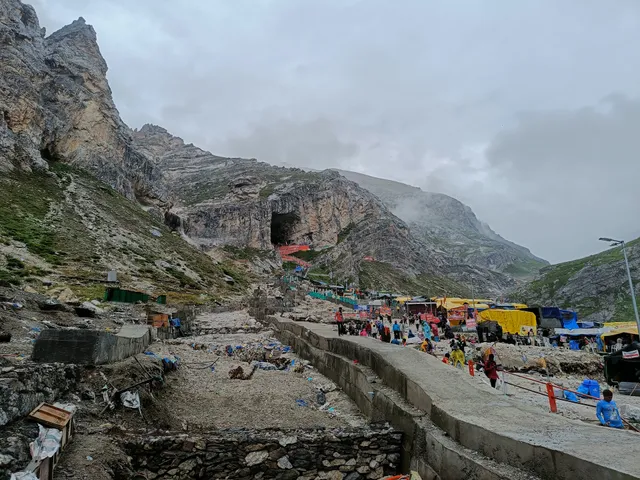
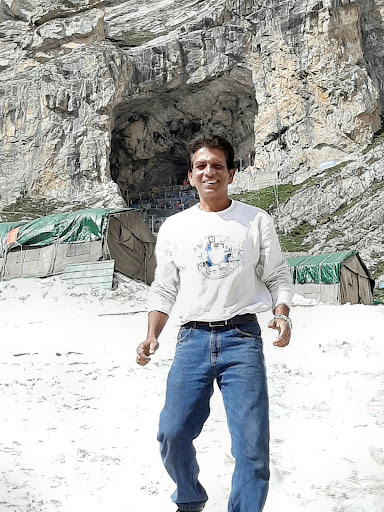
A distant view of Amarnath cave
On searching the saint, he found the holy cave and the Shiva Lingam. From then that place has become a sacred place for the Pilgrimage. Shiva lingam inside the cave is formed when the water falls from the roof gets assembled and it starts to freeze on the floor and grows up from the floor. The stalagmite formed is considered to be a Shiva Lingam and worshipped by the devotees. This temple will be opened for worship from mid-June or at the beginning of July till August.
A closeup view of ice Shiva Lingam at Amarnath cave shrine
Specialty
The main deity of this temple is Lord Shiva, in the form of Ice Lingam. It is believed that this is the place where Lord Shiva explained the secret of life and eternity to Goddess Parvati. To narrate the secret of immortality, Lord Shiva left all His belongings on the way, even His five elements (Earth, Fire, Water, Air and Sky). On the search of a secret place, He found Amaranth cave and entered inside the cave along with Goddess Parvati. Lord Shiva took His Samadhi on the deer skin and created Rudra named Kalagni and instructed him to set fire around the cave to destroy every living thing around the cave.
A remote view of Amarnath Cave
Then Lord Shiva started narrating the secret of eternity, but unknowingly, an egg remained protected under the deer skin on which the Lord Shiva was seated. But it was considered as non-living. Later, a pair of pigeons born out of this egg and became immortal as the secret was listened by them. It is reported that still the pilgrims can see the pigeon pair on the way towards the Amarnath temple. It is believed that the Shiva Lingam increases and decreases in its size indicating the different phases of the moon. There are two other ice formations exist in the cave which are believed to be Goddess Parvati and Lord Ganesha.
A file picture of night shelters at Baltal base near Sonarmarg 120 kms from Srinagar erected for the Amarnath yatra pilgrims.
Shri Amarnath Yatra
Shri Amarnath Yatra is organised in the month of Shravan and commences from Pahalgam & Baltal on specified dates. Situated in a narrow gorge at the farther end of Lidder valley, Shri Amarnathji Cave Shrine stands at 3,888 m and is 45 km from Pahalgam and 141 km from Srinagar. Though the original pilgrimage subscribes that the yatra be undertaken from Srinagar, the more common practice is to begin the journey from Pahalgam, and cover the distance to Shri Amarnathji and back in four or five days. Pahalgam is 96 km from Srinagar.
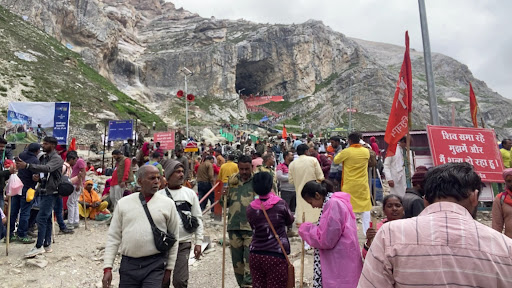
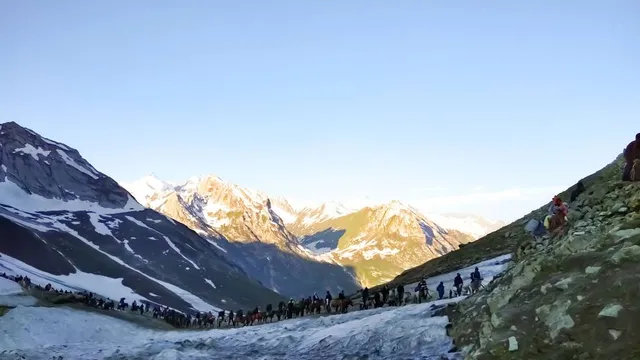
Amarnath pilgrims en route the holy shrine
In recent times the Baltal route via Sonamarg has also become very popular because of its short distance track (although very steep) to the Holy Cave of Shri Amarnathji. The base points for the pilgrim’s trek are picturesque Pahalgam and Sonamarg, a large tented township springs up to accommodate the pilgrims at both these locations. The conduct of the yatra is a gigantic task in which the Jammu & Kashmir State Government takes the assistance of the security departments for providing security and helping to keep...
Read more