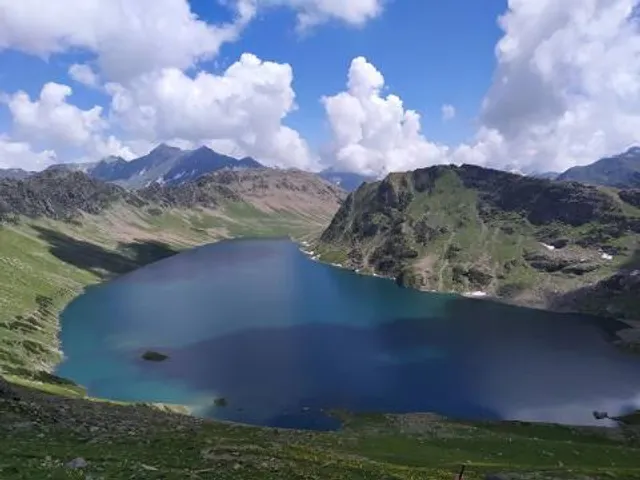
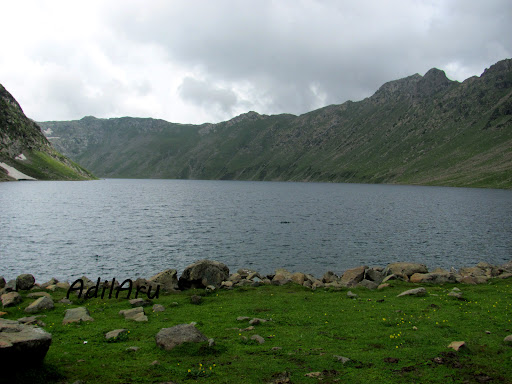
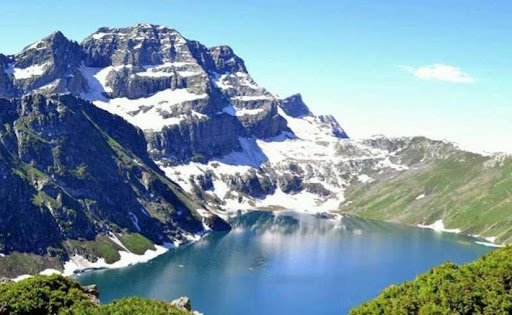
The Tarsar Lake or Tar Sar is an almond-shaped, oligotrophic alpine lake situated in the Kashmir Valley, specifically in Aru, Anantnag district, Jammu and Kashmir The Tarsar Lake is dominated by the peaks of the Kolahoi mountain some 20 km to the east. The lake is separated by a mountain with a minimum peak elevation of 4,000 metres (13,000 ft) from another lake of the same nature known as Marsar Lake, which is in the vicinity of Dachigam National Park. Together these two lakes are referred to as the twin sisters.The Tarsar Lake is drained by an outlet stream which falls into the Lidder River at Lidderwat, 15 km to the east. Being the nearest seasonal settlement, Lidderwat is located on the trek route to the lake from Aru, Pahalgam. The Marsar Lake on the other hand drains out and flows in the opposite direction of the Tarsar Lake The Tarsar Lake is accessible only during the summer preferably from June to Mid September; during the winter, the treks are closed because of the heavy snowfall. It can be reached from Srinagar, via a 102 km motorable road which leads through Anantnag and Pahalgam to the Aru trekking camp. The alpine meadow of Lidderwat lies at the halfway point of the two-day trek to the lake and happens to be mostly the basecamp for most of the trekkers. One could visit the lake and come back to his basecamp at Lidderwat in the same day.
An alternate route leads through Ganderbal and a trekking starting point at Surfraw in the Sind Valley. Due to the steepness of the trek, it is preferable to approach the lake by the Aru-Lidderwat trek and return via the Surfraw-Sind Valley trek.On this route, walkers may see the Uppar portion and Nallah of Surfraw (Soraf Raw) village. Another accessible route to Tarsar and Marsar is a place called Nage-Baren via Tral.
The other route least tread is via Dachigam Srinagar. Trekking on this route leads to Marsar Lake first and then crossing a mountain of an elevation of some 4200m to the fish shaped Tarsar...
Read moreNo matter how beautifully you capture the photos of this lake, none of them will do justice to the real beauty. The almond-shaped lake is one of the most beautiful lakes in Himalayan region. We were a group of 10 friends from Kashmir University South Campus MSc. Mathematics batch 2019. We started our three day trek on Saturday September 18 2021 from Aru Pahalgam, it took us 2½ hours to reach lidderwath and we set up our camps there. Next day on 19 September we started further trekking at 7 am from lidderwath and reached this beautiful lake at 11am. After eating some food we decided to trek further to the top to get the whole view of Tarsar lake and some views of Marsar lake. It took us 1 hour and 10 minutes to the top and after reaching there we took some photographs. Surprisingly some mobile phones got the signal in Jio and we made few calls to our family and close ones. We'd to reach back to lidderwath so we started to decend, it took us half an hour to reach back to Tarsar camping site and extra 3 hours to the lidderwath camping site. It was and amazing and memorable, we were not equipped with useful trekking equipments and enough food. But all the boys pushed themselves beyond limit and we made the whole trek from lidderwath to Tarsar top and back within 10 hours. I would like to mention the names of my friends who were the part of this trek. Asif Ahmad, Umar Shah, Parvaiz Koli(the most energetic and active person), Majid Shahzad, Samiullah (Sameer), Aabid Ahmad, Aijaz Ahmad ( ist among all to reach Tarsar 30 minutes before), Towkeer Gani Rather, Nisar Ahmad & me ( Shoaib Muzaffer). I'll miss you all guys. Hope to se you on another...
Read moreThe Tarsar Lake is dominated by the peaks of the Kolahoi mountain some 20 km to the east. The lake is separated by a mountain with a minimum peak elevation of 4,000 metres (13,000 ft) from another lake of the same nature known as Marsar Lake, which is in the vicinity of Dachigam National Park Together these two lakes are referred to as the twin sisters The 16th-century Kashmiri ruler Yusuf Shah Chak mentioned the twin lakes in his poetry, writing to his beloved: When I remember the two tresses of the comely beloved, Tears begin to flow from my eyes like streams from Tarsar and Marsar The Tarsar Lake is drained by an outlet stream which falls into the Lidder River at Lidderwat, 15 km to the east. Being the nearest seasonal settlement, Lidderwat is located on the trek route to the lake from Aru, Pahalgam. The Marsar Lake on the other hand drains out and flows in the opposite direction of the Tarsar Lake During the winter, the Tarsar Lake freezes and is covered by heavy snow; it has floating ice even in the summer. The basin of the lake is surrounded by a sheet of alpine flowers. The geum, blue poppy, potentilla and gentian are relatively common. Hedysarum flowers are found in late spring throughout the area around the lake During summer there are breeding colonies of migratory birds, including bar-headed geese, lammergeyers, high-flying choughs, Himalayan golden eagles, cinnamon sparrows and black bulbuls. The basin of Tarsar and the adjoining Dachigam National Park constitute one of the most important habitats of the Kashmir stag (hangul), ibex, musk deer, snow leopard, Himalayan brown bear and in the higher reaches, the...
Read more