A contemporary gallery is commercial or privately funded and usually has a second-tier status positioned between the first-tier status of a national, state-run or corporate museum, and the third-tier of minor galleries which include artist-run galleries, retail galleries, and artist's co-operatives.
Commercial galleries are for-profit, privately owned businesses dealing in artworks by contemporary artists. Galleries run for the public good by cities, churches, art collectives, not-for-profit organizations, and local or national governments are usually termed Non-Profit Galleries. Many of these, such as the Tate Gallery have an aspect of charity and can be arranged around a Trust or estate. Galleries run by artists are sometimes known as Artist Run Initiatives, and may be temporary or otherwise different from the traditional gallery format.
Contemporary art galleries are often established together in urban centers such as the Chelsea district of New York, widely considered to be the center of the American contemporary art world. Most large urban areas have several art galleries, and most towns will be home to at least one. However, they may also be found in small communities, and remote areas where artists congregate, e.g. the Château de Montsoreau-Museum of Contemporary Art (Montsoreau) in France, the Chinati Foundation (Marfa) in United States, the Taos art colony (Taos) in New Mexico and St Ives, Cornwall; (Hill End), (Braidwood) and (Byron Bay) in New South Wales Contemporary art galleries are usually free and open to the public; however, some are semi-private, more exclusive, and by appointment only.
Exhibitions Edit Curators often create group shows that say something about contemporary issues or a certain theme, trend in art, or group of associated artists. Galleries often choose to represent artists exclusively, giving them the opportunity to show regularly. Some have a narrow focus while others are more eclectic.
Although primarily concerned with providing a space to show works of visual art, art galleries are sometimes used to host other artistic activities, such as music concerts, poetry readings, or performances, which are considered performance art and at other times theater. While many galleries exhibit painting and sculpture of all types and movements like Abstract expressionism, Pop Art, Photo realism, Color Field, Minimalism, Lyrical Abstraction, Realism, and Postminimalism etc. Conversely, some works of contemporary art are not shown in a gallery. Land art, performance art, internet art, mail art and installation art and other emerging forms also often exist outside a gallery due to being site-specific. Documentation of these kinds of art such as photographic records, are often shown and sold in galleries however, as are preliminary or process drawings and collages (such as those generated by Christo as part of the proposal to governing bodies when applying to install land works). British artist Richard Long manages to combine his core intentions by linking the materials used in his land art, to make gallery art. Andy Goldsworthy...
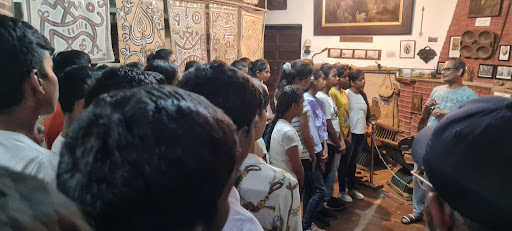
Read moreSanskriti Museum, located in Hazaribagh, Jharkhand, is a unique cultural and educational institution that showcases the rich heritage and history of the region. Here are some key facts about the museum:
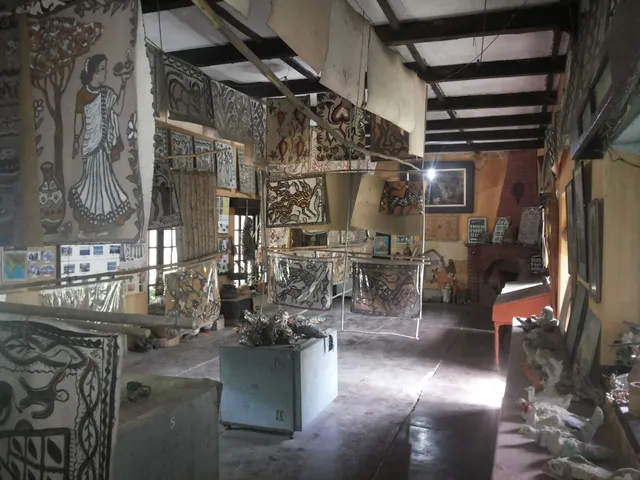
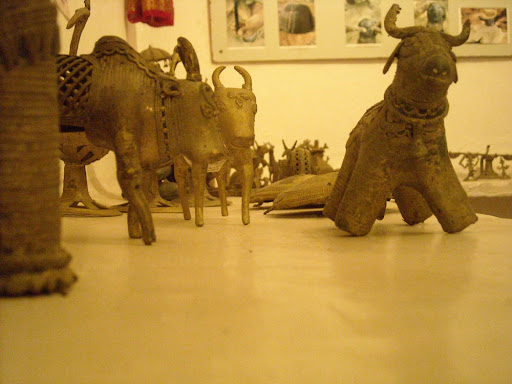
Cultural Heritage: The museum aims to preserve and promote the cultural heritage of Hazaribagh and the surrounding areas. It features a collection of artifacts, sculptures, and items that reflect the traditions, art, and lifestyle of the local communities.
Diverse Exhibits: Sanskriti Museum houses various exhibits, including traditional clothing, handicrafts, agricultural tools, and household items used by different communities in the region. These exhibits provide insights into the cultural diversity and historical evolution of the area.
Educational Purpose: The museum serves as an educational resource for students, researchers, and visitors interested in learning about the local culture and history. It aims to raise awareness about the importance of preserving cultural heritage.
Art and Craft: The museum showcases local art and crafts, promoting traditional skills and craftsmanship. It often features works by local artisans, helping to support and revive traditional practices.
Community Involvement: Sanskriti Museum emphasizes community involvement and often organizes workshops, exhibitions, and cultural events. This engagement fosters a sense of pride among locals regarding their heritage.
Location: Situated in Hazaribagh, the museum is easily accessible to both residents and tourists. Its location makes it a valuable addition to the town's cultural landscape.
Promoting Tourism: The museum plays a role in promoting tourism in Hazaribagh by attracting visitors interested in exploring the region’s cultural and historical significance.
Sanskriti Museum is a noteworthy institution that not only showcases the rich heritage of Hazaribagh but also actively engages the community in preserving and promoting its...
Read moreSanskriti Museum & Art Gallery, hazaribag was founded by Bulu Imam in 1991, after he discovered the first rockart of hazaribag district at Isco, subsequently bringing to light over dozen meso-chalcolithic rockarts, including the prehistoric archaeology of the North Karanpura Valley in Jharkhand.
The Sanskritic Museum displays a comprehensive collection of Paleolithic to neolithic stone tools, microliths, and bronze to Iron age artifacts, including potteries and Buddhist antiquities from around the Hazaribagh region. It also has an ethnological gallery dedicated to the Birhors, Santhals, and Oraons along with monographs complied on their Life, Folklore, Songs, Ethnobotany, available in the museum research archives, and library. It also has a gallery of local crafts and textile, and an art gallery over about 200 Khovar (marriage art) and sohrai (harvest art) paintings of Hazaribagh exhibited and displayed.
The museum is presently housed in his private building which used to be the Tea Garden District labour Association building in the early 20th century (1919), in a 3 acres campus with a grove of trees.
The Sanskriti museum has a small library and a research archive, along with photographic and visual documentations to back up the exhibits in the museum. The library has several published papers, books, magazines and newsletters related to the Museum and Art Gallery in its Resource Archives...
Read more