Awesome 👍 longitudinal profile as a waterfall. The energy of all rivers is directed toward the achievement of a relatively smooth, concave-upward, longitudinal profile; this is a common equilibrium, or adjusted condition, in nature.
Even in the absence of entrained rock debris that serves as an erosive tool of rivers, it is intuitively obvious that the energy available for erosion at the base of a waterfall is great. Indeed, one of the characteristic features associated with waterfalls of any great magnitude—with respect to volume of flow as well as to height—is the presence of a plunge pool, a basin that is scoured out of the river channel directly beneath the falling water. In some instances the depth of a plunge pool may nearly equal the height of the cliff causing the falls. Its depth depends not only on the erosive power of the falls, however, but also on the amount of time during which the falls remain at a particular place. The channel of the Niagara River below Horseshoe Falls, for example, contains a series of plunge pools, each of which represents a stillstand, or period of temporary stability, during the general upriver migration of the waterfall. The significance of this profile will be discussed below, but in general it may be said that the fate of most waterfalls is their eventual transformation to rapids as a result of their own erosive energy.

Niagara Falls
The lack of permanence as a landscape feature is, in fact, the hallmark of all waterfalls. Many well-known occurrences such as the Niagara Falls came into existence as recently as 11,700 years ago, when the last of the great ice sheets retreated from middle latitudes. The oldest falls originated during the Neogene Period (23,000,000 to 2,600,000 years ago), when episodes of uplift raised the great plateaus and escarpments of Africa and South America. Examples of waterfalls attributable to such pre-Pleistocene uplift (that occurring more than 2,600,000 years ago) include Kalambo Falls, near Lake Tanganyika; Tugela Falls, in South Africa; Tisisat Falls, at the headwaters of the Blue Nile on the Ethiopian Plateau; and Angel Falls, in Venezuela.

Paulo Afonso Falls
Available data suggest that the falls of greatest height are seldom those of greatest water discharge. Many falls in excess of 300 metres exhibit but modest flow, and, in some cases, only a perpetual mist occurs near their bases. By way of contrast, the Khone Falls of the Mekong River in southern Laos drop only 22 metres, but the average discharge of this cataract is about 11,330 cubic metres per second. In general, considering height and volume of flow jointly, it is understandable that Victoria, Niagara, and Paulo Afonso, among others, have each been proclaimed “the world’s greatest falls” by various explorers and authorities.
The height and volume of flow of selected waterfalls of the world are given in the table. longitudinal profile as a waterfall. The energy of all rivers is directed toward the achievement of a relatively smooth, concave-upward, longitudinal profile; this is a common equilibrium, or adjusted condition, in nature.
Even in the absence of entrained rock debris that serves as an erosive tool of rivers, it is intuitively obvious that the energy available for erosion at the base of a waterfall is great. Indeed, one of the characteristic features associated with waterfalls of any great magnitude—with respect to volume of flow as well as to height—is the presence of a plunge pool, a basin that is scoured out of the river channel directly beneath the falling water. In some instances the depth of a plunge pool may nearly equal the height of the cliff causing the falls. Its depth depends not only on the erosive power of the falls, however, but also on the amount of time during which the falls remain at a particular place. The channel of the Niagara River below Horseshoe Falls, for example, contains a series of plunge pools, each of which represents a stillstand, or period of temporary stability, during the general upriver migration of the waterfall. The...
Read more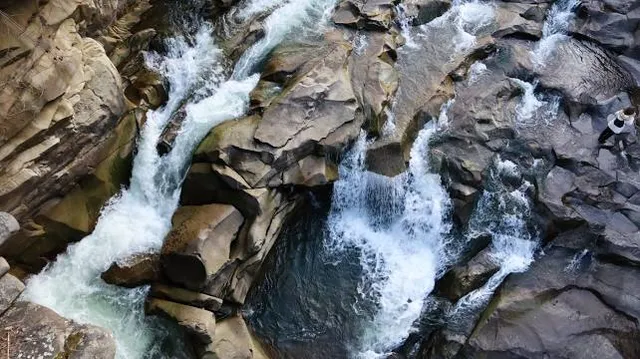
 Learn more insights from Wanderboat AI.