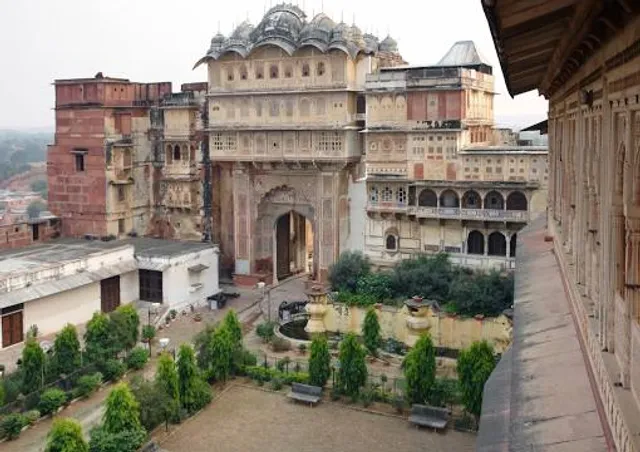
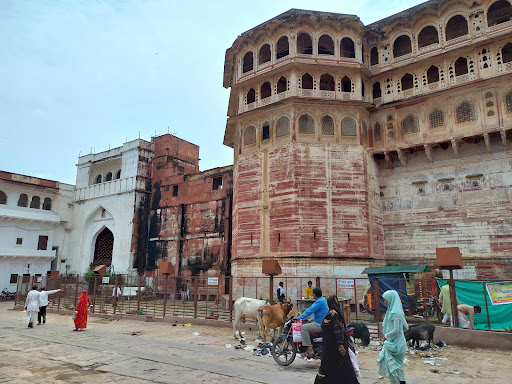
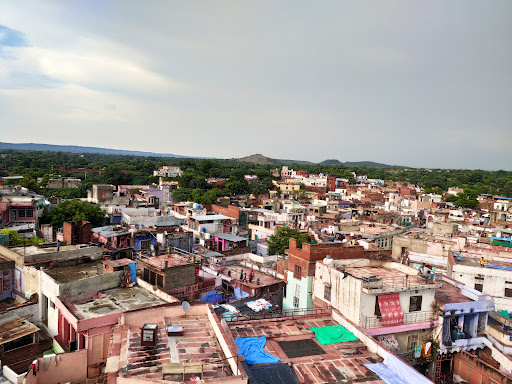
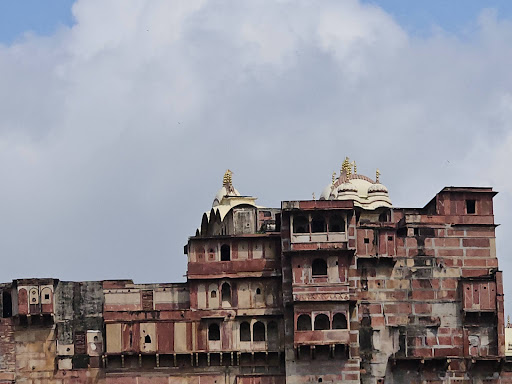
Situated at a distance of about 160 km from the Jaipur Airport, inside the walled city of Karauli is situated the former residence of its Yaduvanshi rulers, referred to as the City Palace. Built by Arjun Pal, founder of Karauli in the 14th century, the city palace appears as a grand spectacle overlooking the equally colourful bazaars of Karauli.
Interestingly, the rulers of the region believed they were descended from the hallowed cowherd, Lord Krishna. A Yadav clan of mercurial Rajputs, they refused to use ‘Singh’ as a surname or title since they felt it was trifle insensitive to use the term that translated into a lion, for a bloodline that considered themselves the protectors of cows. Therefore, the surname that did seem appropriate was ‘Pal’, which implies protectors of cows, was adopted.
Sandstone, belonging to the Vindhyan supergroup from the Proterozoic age, a building material that adorns much of North-India’s heritage is mined close by, and therefore its extravagant use is seen here. This sandstone adorns the palace in its several hues of red, white and off-white.
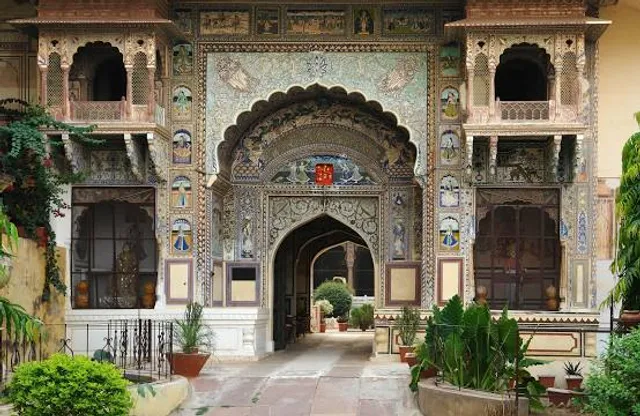
Large chattris and jharokhas, with bangladhar roofs ending in tapering chajjas, a characteristic feature of the palaces of Rajasthan, adorn the palace. Intricate lattice work with sculpture, stucco work and wall paintings complete the picture in this impressive residence. Windows in painted glass add to the ambience of the interiors.
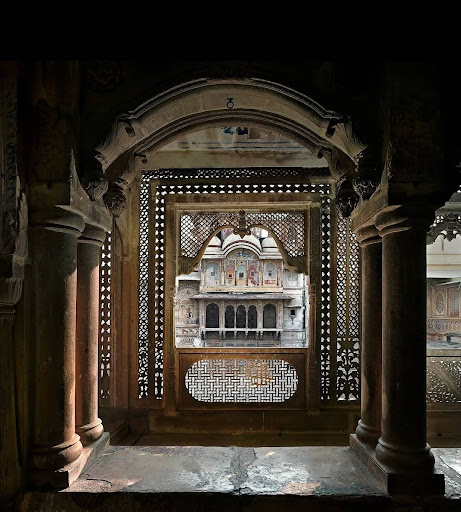
Weather control in the desert heat was given due importance in the palace architecture of Rajasthan. Techniques for cooling palaces and forts by cross ventilation as in jaalis, jharokhas, wind towers etc. were applied. Shading devices were also effectively employed. Jaalis or window lattices were fashioned out of the sandstone itself and worked like apertures in walls, providing appropriate amounts of sun, wind and light, facilitating both view and ventilation. Jaalis helped in lowering the temperature since they increased the velocity of the wind by compressing the air passing through the mesh. Jaalis were thus an important element in the 14th century City Palace of Karauli.
Inlet and outlet areas in the halls were located opposite each other for a cooling effect, while other rooms were cooled by the chimney effect. The latter is where cool air enters at lower levels and absorbs the heat of the room, becomes lighter, rises and exits through windows or ventilators in the upper portion. These elements are visible at the entrance gates as well as within the palace.
Within, the Diwan-i-Aam has attractive work on the walls with floral patterns in bright colours. This hall’s upper floor has marvellous jaali work on the walls from where Ranis could watch over the proceedings in the hall. The Rang Mahal is well-known for its magnificent coloured glass jharokhas and mirror work that spread ambient light into the living quarters. Barahdwari, a hall for entertainment, is lined with portraits...
Read more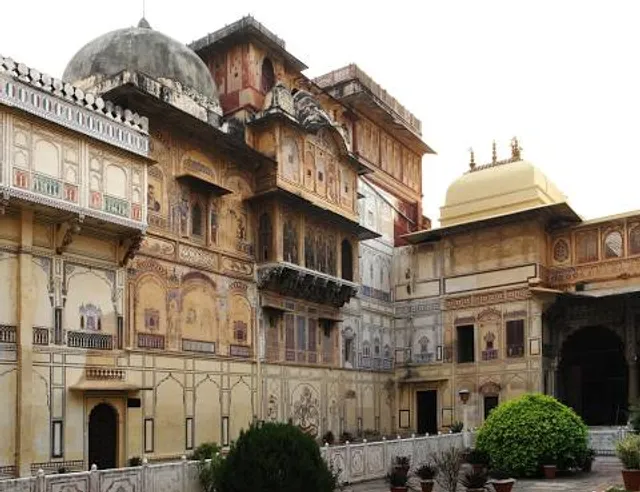
 Learn more insights from Wanderboat AI.