This wonderful temple is the abode of Lord Vishnu. The temple is also known as God’s Own House. The hills of Harihareshwar, Pushpadri, Harishinachal and Bramhadri surround this place. Harihareshwar also boasts of clean and pristine sandy beaches. The place is also gaining importance as a popular tourist destination. The main deity Harihara is a union of Gods Vishnu and Shiva. The attributes of Shiva are visible in the right hand and Vishnu in the left hand.
Harihareshwara Temple – History and Mythology
The Harihareshwara temple has an interesting history. It is said that the demon Guha appeased the creator of the universe and got a “vardan” or boon. As per this boon, neither Shiva (Hara) nor Vishnu (Hari) could destroy him single handedly. Guha started torturing the gods in Indralok as well as human beings in the prithvilok and it became difficult for everyone to withstand his devastation. As both Shiva and Hari could not destroy him on their own, they had to unite and take the form of Harihara to destroy Guha. It is said that this incarnation took place close to Kudalore where the rivers Haridra and Tungabhadra meet.
Harihareshwara temple – Architecture
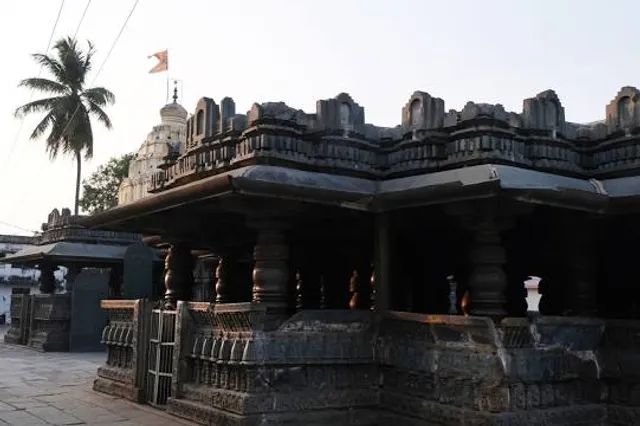
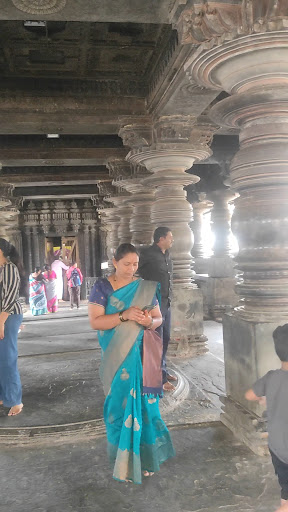
The architecture in the Harihareshwara temple resembles that normally used by the Hoysala dynasty. The mantapa or hall as it is called is square in shape. The pillars and the ceiling have exclusive architecture and decoration like lotuses. The Hoysalas used soapstone for building the temple. There is a lot of repair work which is being carried out here and the Vimana is being replaced with mortar and brick ceilings. The temple houses contemporary Kannada inscriptions and you will find them quite interesting.
The carvings on the pillars of the temple are quite intricate and lovers of history will admire each and every detail of the temple. Great care has to be taken to depict the stories and teachings.
Harihareshwara Temple – Facts
The Harihareshwara temple is rightly described as the Kashi of South India. The ‘Harihar’ or “Pushpadri’ hill is situated on the seashore.The temple was constructed during the era of Shivaji Maharaja.The sculptures and carvings clearly reflect the era of Bajirao Peshawa who ruled in the year 1723.
Other places of interest close to Harihareshwar:
Tourists will love visiting the Harihar hill that is located on the seashore.The Kalbhairav temple is yet another ancient temple close to the Harihareshwara temple.Bagmandal was home to the Peshawas and is a popular tourist spot.The Bankot Fort is an ancient fort and one can get to see the interesting events here.Shrivardhan is a beautiful pristine beach close to Harihareshwar. Tourists will love the soothing and peaceful atmosphere here.
How to get to Harihareshwara Temple
There are three modes of getting to Harihareshwara – by road, rail and air. The months from January to April are ideal for visiting the place.
Mumbai airport is the closest to Harihareshwara. If you intend coming down by rail, then you need to get down at Mangaon railway station. Harihareshwar is about two hundred and fifteen kilometers from Mangaon.The trains that ply on the Konkan route halt here. By road, one has to take the Mumbai Goa highway. It is equidistant from Pune and Mumbai.On reaching Shrivardhan, you can go in for local transport which is available in the form of six seater jeeps, rickshaws. There are local taxis available which are slightly expensive. Private buses also ply...
Read moreGood hindu temple but poor maintenance... The ancient Harihareshwara Temple, dedicated to the deity Harihara, stands as a testament to the rich cultural and religious heritage of India. Located in Harihar, Karnataka, this architectural marvel dates back to the 12th century, during the rule of the Hoysala Empire, known for their exquisite craftsmanship in temple construction.
The temple's name itself, "Harihara," is derived from the combination of two Hindu deities: "Hari" representing Lord Vishnu and "Hara" representing Lord Shiva. This unique feature symbolizes the fusion of Shaivism and Vaishnavism, two major sects of Hinduism, embodying the inclusive nature of Indian spirituality.
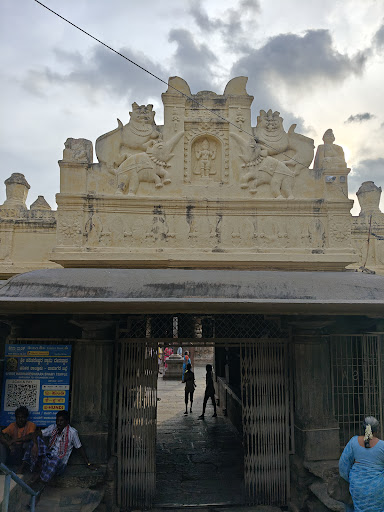
Architecturally, the Harihareshwara Temple is a masterpiece of Hoysala architecture, characterized by its intricately carved sculptures, ornate pillars, and stunningly detailed artwork. The outer walls of the temple are adorned with sculptures depicting various episodes from Hindu mythology, including scenes from the Ramayana, Mahabharata, and the lives of various gods and goddesses.
The most striking feature of the temple is its Vimana (tower), which rises majestically above the sanctum sanctorum. The Vimana is embellished with miniature shrines, decorative motifs, and sculptures of celestial beings, showcasing the Hoysala artisans' impeccable skill and creativity.
As one enters the temple complex, they are greeted by a large courtyard, flanked by smaller shrines dedicated to other Hindu deities. The main shrine houses the presiding deity, Harihara, in a unique form where one half of the image represents Lord Shiva, and the other half represents Lord Vishnu, symbolizing the synthesis of these two divine energies.
Devotees flock to the temple throughout the year to seek blessings, offer prayers, and participate in various religious ceremonies and festivals. The annual celebrations during Maha Shivaratri and Vaikuntha Ekadashi attract a large number of pilgrims from far and wide, adding to the temple's vibrancy and spiritual significance.
Over the centuries, the Harihareshwara Temple has withstood the test of time, surviving invasions, natural disasters, and the passage of empires. Its enduring presence serves as a beacon of faith and devotion, inspiring generations of worshippers and scholars alike.
In addition to its religious and cultural significance, the temple also serves as an invaluable historical and architectural treasure, attracting scholars, historians, and tourists eager to marvel at its beauty and unravel its mysteries.
In essence, the Harihareshwara Temple stands as a living legacy of India's rich heritage, a testament to the enduring power of spirituality, artistry, and devotion that continues to captivate hearts and minds...
Read moreHarihareshwara Temple is a Hindu temple situated in Harihar, Karnataka state, India. The temple was built in c. 1223–1224 CE by Polalva, a commander and minister of the Hoysala Empire King Vira Narasimha II. In 1268 CE, Soma, a commander of King Narasimha III of the same dynasty made some additions. The temple houses the deity Harihara, a fusion of the Hindu gods Vishnu and Shiva. The image of the deity is a fusion of the right vertical half of Shiva and left vertical half of Vishnu. The image holds in its right hand, the attributes of Shiva and in the left hand, those of Vishnu.
According to a Hindu legend, a demon named Guha (or Guhasura) once lived in these parts and a considerable surrounding region, from Uchchangi Durga in the east, Govinahalu in the south, Mudanur in the west and Airani in the north was under his control. Guha successfully appeased Hindu god Brahma with his penance and obtained a boon, by virtue of which, it would be impossible for either Hari (Vishnu) or Hara (Shiva) to singly kill him. Guha then became a regular tormentor of gods and humans alike. In order to overcome Brahma's boon and eliminate Guha, Vishnu and Shiva together took the form of Harihara (a fusion), came down to earth and killed the demon. The descent of the incarnation on earth is said to be at nearby Kudalur, at the confluence of the rivers Tungabhadra and Haridra.
The temple is constructed in a staggered square mantapa (hall) plan, typical of Hoysala constructions. Therefore, the outer wall of the mantapa shows many projections and recesses. The wall of the mantapa is a parapet wall resting on which are half pillars that support the outer ends of the roof (cornice). The ceiling of the open mantapa is adorned with artistic decoration such as lotuses. The ceiling is supported by lathe turned full pillars. The material used for the temple is soapstone (also called potstone). The original tower over the shrine (Vimana) is missing and has been replaced in modern times with one of brick and mortar. Preserved within the temple premises are several...
Read more