Many of know this place with the name of astoor tomb
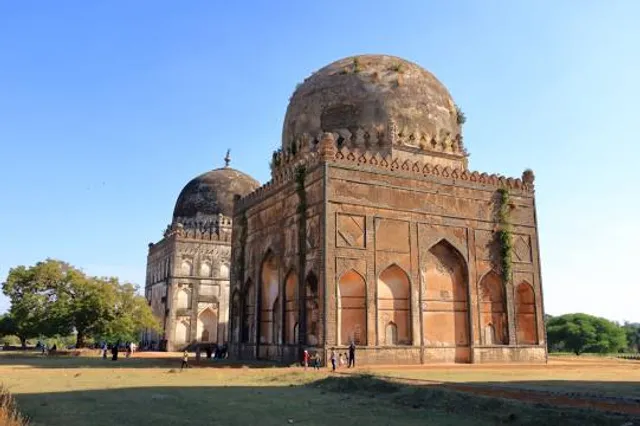
This the best historical monument of bahmani Ashtoor is an important centre of Indo-Saracenic monuments. Like the Egyptian pharaohs, the Bahamani kings were fond of building magnificent tombs to house themselves after death. Twelve imposing mausoleums are located at Ashtur east of Bidar. Of these, the tombs of Ahamad Shah and Alauddin Shah II stand out due to their grandeur.
Major tombs in Ashtoor
Tomb of Ahmad Shah Al Wali Bahamani: Ahmad Shah Al Wali Bahamani’s tomb is built in square layout in a vast lofty building with thick walls. Tomb of Ahmad Shah’s Queen: Has floral designs, religious texts and ceilings decorated with paintings. Tomb of Sultan Allauddin Shah II: Has lots of tile work as well as blue, green and yellow paintwork. Three tall entrance arches and a square hall are key features of this tomb. Tomb of Sultan Humayun: Built with black trap masonry, Humayun’s tomb is super thick but split open due to a lighting strike. Tomb of Malika-i-Jahan: Mallika was the wife of Sultan Humayun Shah. Her tomb has entrance arches elegantly decorated with stucco work Chaukhandi of Hazrat Khalil Ullah: Saint Khalil-Ullah was the preceptor of princes Ahmad Shah and Allauddin. His tomb is a two storied building erected on a high platform. Other tombs: Tombs of Sultan Nizam Shah, Sultan Muhammad Shah III, Muhammad Shah Bahamani, Sultan Wali-Ullah and Sultan Kalim Ullah. How to reach: Ashtoor is 690 kms from Bengaluru and 8 kms from district capital Bidar. Bidar is the nearest airport and railway station. Taxi can be hired in Bidar to...
Read moreTomb of Allaudin Shah II
Allaudin Ahmad I (AD 1436-1458) was a relatively weak ruler: he failed during his regin, to control many afaqi uprisings. He did however, build a large hospital, employing both local and Persian doctors the proceeds of which went to maintaining patient care. Allaudin was also known to be an excellent orator. His tomb is one of the grandest in the Bahamani necropolis It resembles that of Ahmad Shah in that it is constituted by a square base and capped by a dome, but in this case the parapet is embellished with a trefoil pattern. The façade is constituted by five arched recesses of unequal height, symmetrically distributed to the sides of the tallest, central arch. In contrast to earlier monuments, and reflecting Persian influences, the arches are tall and graceful and resemble those of Mughal architecture. Unusual decorations adorn the interior of the tomb, such as the numerous niches on the walls and the diagonal panels above them. Traces of polychrome tile-work, with elaborate colour schemes and designs, can also be observed on the higher portions of the walls, but vandals have destroyed the majority over time. Some of the black stone margins are decorated in great detail with rope and key-pattern designs, while others are plain, polished black stone. It is evident that there was once painting on the interior of the dome of which...
Read moreAshtur tombs of Bahamani dynasty rulers is a necropolis. A guide meets you at the gate who claims to be the direct descendant of the Bahamani Dynasty. He will show the monuments with half real & half cooked up stories & improper facts. I know this as I am a avid reader of history. The tomb of the Ahmed Shah Wali is the most important with biggest dome, intricate paintings on the walls & ceiling and perfect geometry in construction. His dargah is revered by both Muslims & Hindus as a saintly king. He had ruled for a short period of 13 years during which time he shifted his capital from Gulbarga to Bidar. Due to his nature of allowing Hinduism to coexist at that time he was thought to be reincarnation of Allama Prabhu (contemporary of famous social reformer Lord Basaveshwara of 13th century & Chairman of the Anubhava Mantap religious parliament and birth place being Akkalkot in Maharashtra). The annual Urs has a tradition of a Jangam from Veerashaiva mutt of Gulbarga doing a padayatra to reach here and offer Pooja along with the Chadar laying by the Muttawali of the Dargah. The broken dome of another king forms a...
Read more