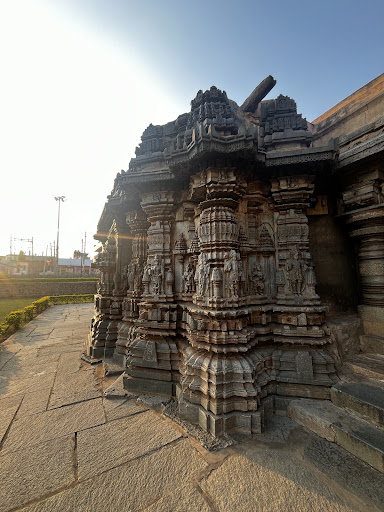
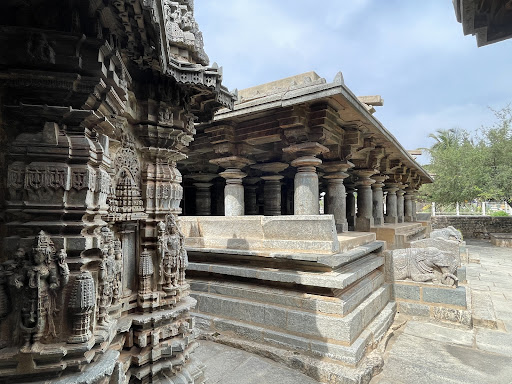
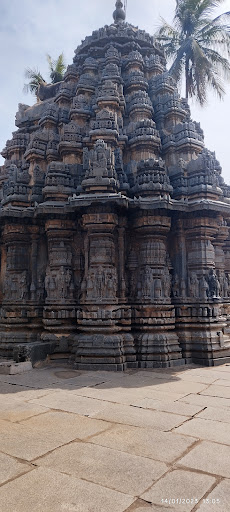
The Ishvara temple was constructed using soapstone.6] It is modest in size, yet with a sophisticated architecture because of its ground plan: a 16-point star-shaped mantapa (hall) and a stellate shrine with each corner distinct.[1 According to Dhaky, a scholar of temple architecture and history, the temple "ranks among the most notable of the Hoysala times".[2] Foekema calls it "exceptionally intricate".[8]
The temple faces east. It has an open navaranga and a mukha-mantapa with a round dome on top, likely one with a seated Nandi (now missing). This open mandapa is supported on 21 pillars, of which 8 are towards the middle and decorated, while the outer 13 pillars have a pair of elephants near their base.[3] There is a square outer porch.[3] The open mantapa (mandapa, hall), is a deep concentric joist-and rafter ceiling with a inverted lotus, states Dhaky, and this is so crafted that it successfully simulates a timber appearance.[2] The architect provided an integrated stone bench along the sides of the open mandapa for pilgrims to gather and sit.[8] Inside is another closed gudha-mantapa.[9] The gudha-mandapa is a 20 feet by 20 feet square.[2] The ceiling of this closed mantapa is supported by four lathe turned pillars.[8]
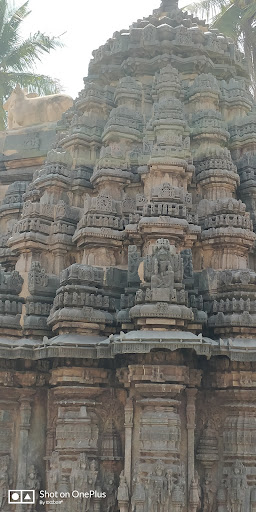
The square sanctum (garbhagriha) enshrines a Shiva linga. Its doorway is beautifully carved with five sakhas with scrolls, geometric patterns and standing lions. The lintel lalitabimba has Gajalakshmi. Above it is a panel with (left to right): Vishnu, Kartikeya (also known as Subramanyam, Murugan, Skanda), Shiva in the middle flanked with lions, Ganesha and Brahma.[3] The sukhanasi above the sanctum has a Nataraja (Tandavesvara) with musicians near him.[3] The vimana has five storeys (pancatalas). It is based on a rotating circular plan with two pallavis – bifacial-equilateral and stellate, together they compose the dramatic and charming symmetry of the superstructure, states Dhaky.[2] The jangha section below are flanked by kuta-stambhas and contain Hindu deities. This scheme wraps around the walls of the gudha-mandapa, to enhance the visual aesthetics of the temple. The reliefs therein include various forms of Shiva, the Saptamatrikas (seven mother goddesses), the avatars of Vishnu, Ganesha, Surya, Parvati, Lakshmi and Sarasvati – thus, presenting the galaxy of Hindu legends and traditions.[2] The walls thus display 120 reliefs, of which 62 are female and 58 are male.[3]

Rear view of the Ishvara temple at Arasikere
The outer wall of the vestibule shares the same decoration as the outer wall of the shrine, but is inconspicuous because it forms a short continuation between the wall of the shrine and that of closed mantapa.[8] The outer wall of the shrine is stellate, but the star points are not identical, rather they form three different kinds of star points, making the design complicated and unusual.[9] The lower half of the outer wall of the shrine and the outer wall of the closed mantapa share the same architectural articulation. The open hall, with its 16-pointed star plan is unusual. The central ceiling in the closed mantapa and the vestibule are decorated elaborately.[9]
Both the interior and exterior of the temple shows high workmanship. The elegantly decorated ceilings, the domical ceiling of the open mantapa, the sculptures of Dwarapalakas (door keepers) in the closed mantapa (also called navaranga), the wall panel images numbering a hundred and twenty (on pilasters between the aedicules–miniature decorative towers) carved on the outer walls are noteworthy,...
Read more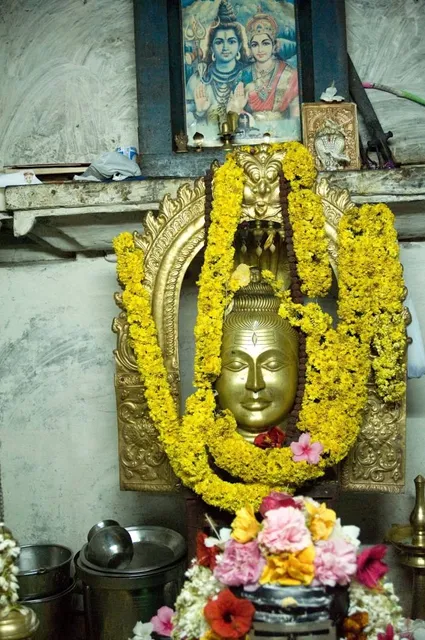
 Learn more insights from Wanderboat AI.