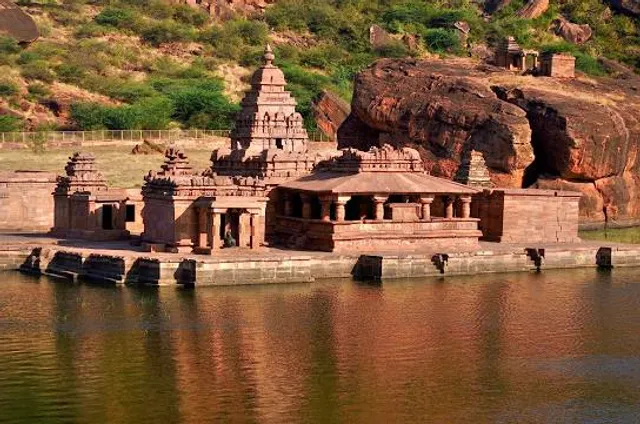
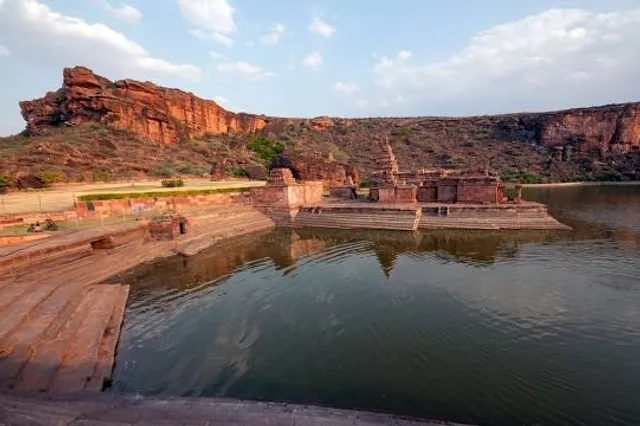
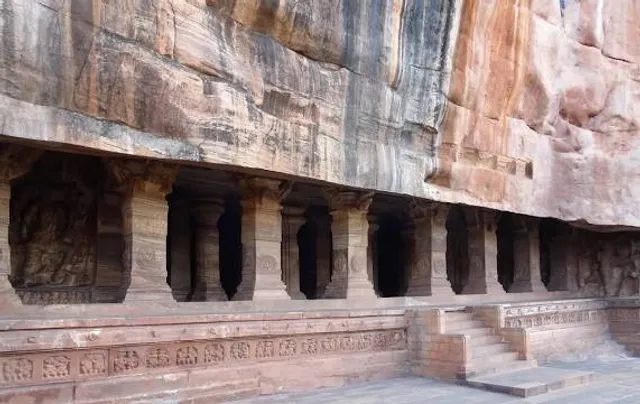
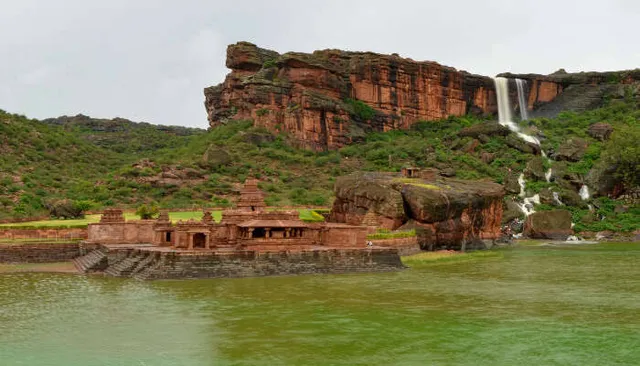
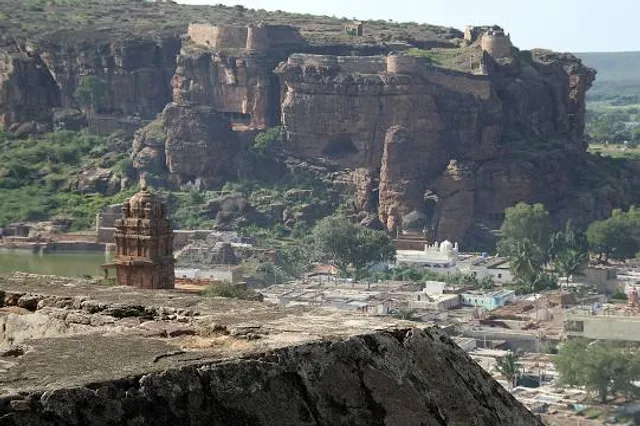
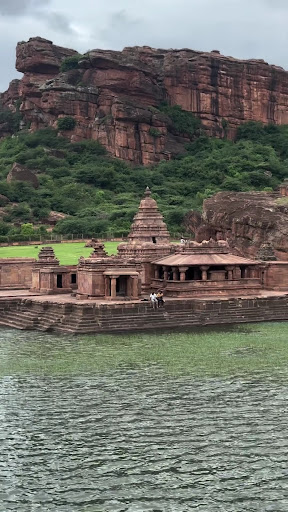
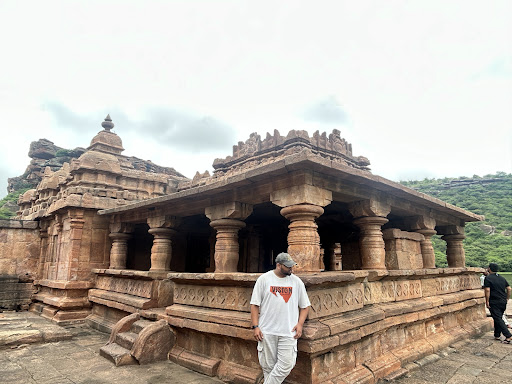
Bhutanatha Group of Temples, Badami, Karnataka The Bhutanatha group of temples is a cluster of sandstone shrines dedicated to the deity Bhutanatha, in Badami town of Karnataka state, India. There are two major temples here. Temple No.1, on the east side of the lake, called the Bhutanatha temple has a superstructure that resembles early South Indian style or North Indian style with its open mantapa (hall or Veranda) extending into the lake, while the smaller Temple No.2 on the north-east side of the lake, sometimes called the Mallikarjuna group of temples, has a stepped superstructure, commonly found in Kalyani Chalukya constructions. The inner shrine and mantapa (hall) of Temple No.1 were constructed in the late 7th century, during the reign of the Badami Chalukyas. While the outer mantapa, facing the Badami tank, was completed during the rule of the Kalyani Chalukyas of the 11th century. Hence the Bhutanatha temple contain architectural forms from different periods. Studies show that these Kalyani Chalukya architects could have belonged to the same early phase workshop, that later built the nearby Yellamma temple and the Mallikarjuna group of temples. In the inner hall of the Bhutanatha temple, a heavy architrave above the columns divides the hall into a central nave and two aisles. The pillars are massive and the bays in the ceiling of the nave is decorated with lotus rosette. Perforated windows bring dim light into the inner mantapa.On either side of the foot of the shrine doorway is an image of goddess Ganga on her vehicle, the makara, on the right, and on the left, that of goddesses Yamuna riding the tortoise. There is no dedicatory block upon the lintel to indicate to which deity the initial dedication was for. The Shiva linga in the shrine appears to be a later addition after the original deity in the sanctum was removed. The temple is unfinished and at the base of the superstructure (Shikhara), are vestiges of Jain architecture. The image niches on the wall of the shrine and the hall are now empty though some decorative elements like makharas (mythical beast) with long tails still remain. To the north of the hall is a small shrine which was originally consecrated for Vishnu. Following later Jain modifications, the temple was eventually taken over by the followers of Lingayatism who built an outer hall and installed a Nandi (vehicle of Shiva) and a Shiva linga inside...
Read moreVisiting Sri Bhootanaatha Gudi at the Badami Caves Temple was a truly mesmerizing experience that left me enchanted and spiritually rejuvenated.
From the moment I stepped onto the sacred grounds, I was greeted by an aura of tranquility that enveloped the entire temple complex. The ancient architecture of Sri Bhootanaatha Gudi seamlessly blended with the natural beauty of Badami, creating a serene ambiance that instantly transported me to a different realm.
The intricate carvings adorning the temple walls were a testament to the craftsmanship of the artisans who dedicated their skills to this divine abode. Each sculpture told a story, weaving together the rich tapestry of history, culture, and spirituality. The detailed depictions of deities, mythological figures, and celestial beings left me in awe of the artistic brilliance of the ancient sculptors.
The sanctum sanctorum of Sri Bhootanaatha Gudi emanated a palpable energy, inviting devotees and visitors alike to immerse themselves in the spiritual essence of the place. The rhythmic chants and melodious hymns added to the ethereal atmosphere, creating a perfect setting for introspection and prayer.
What sets Sri Bhootanaatha Gudi apart is not only its historical significance but also the peaceful coexistence of nature and spirituality. The temple's location, nestled amidst the picturesque Badami Caves, offers breathtaking views that complement the divine experience. It's a harmonious blend of architecture, history, and natural beauty that captivates the soul.
The friendly and knowledgeable temple staff further enhanced my visit, providing valuable insights into the temple's history and significance. Their passion for preserving the cultural heritage of Sri Bhootanaatha Gudi was evident in the way they shared stories and anecdotes, creating a more profound connection between the visitor and the temple.
In conclusion, a visit to Sri Bhootanaatha Gudi is not just a pilgrimage; it's a journey through time and spirituality. I left with a heart full of gratitude and a mind at peace, carrying the positive energy of this sacred place with me. I highly recommend this divine oasis to anyone seeking solace, cultural enrichment, and a profound...
Read moreJust one word. WOW Please visit it at least once. You will fall in love with this place.
Dedicated to Lord Shiva, the Bhutanatha Temple is one of the two major shrines of the Bhutanatha Group of Temples that extends up to the Agastya Lake. The deity is worshipped here in the Bhutanatha avatar (god of souls). Built in sandstone, the temple has an open mandapa (hall) that reflects the South Indian Dravidian and North Indian Nagara styles of architecture. The inner shrine is believed to have been built by the Chalukyas in the 7th century. At the back of the temple, the avatars of Lord Vishnu and Jain figures are carved. Another attraction near the temple is the Badami cave temples that are a group of four cave temples. These are a fine specimen of architecture and are dedicated to Lord Shiva, Lord Vishnu and Lord Mahavira.
Boothanatha Temple is the most striking structure of Badami and the prime promotional element of Badami Tourism. The temple is surrounded by water on three sides. The temple was constructed in the early 8th century by Chalukyas. Constructed in Dravidian style, the temple emerges into the Agastya Lake and becomes inaccessible during peak monsoons when the water level in the lake reaches the full capacity. The temple has a pillared mukha mandapa, sabha mandapa, and inner sanctum with a Shiva image. The main temple is accompanied by several small shrines on the northern and eastern ends.
The form of Bhoothnath is said to be the combination of the God of Soul, Spirit, and the Ghost. The temple all dark inside has an image of Shiva in an angry form. The Bhoothnath monuments constitute the early modes and phases of South Indian temple architecture. It is one of the top places to visit in Badami.
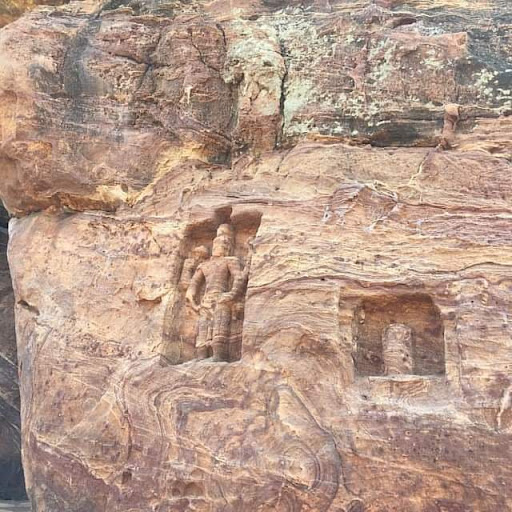
When you walk further south from Boothanatha Temple, there are few more striking monuments carved into the hillock. The first one is a bas-relief of Lord Narasimha, Varaha, Durga, Ganesha, Trimurthies along with several gods carved out from the hill. Further south from here towards the lake has a small stone structure with a wonderfully carved image of Lord Vishnu in sleeping posture. The main carving is executed on...
Read more