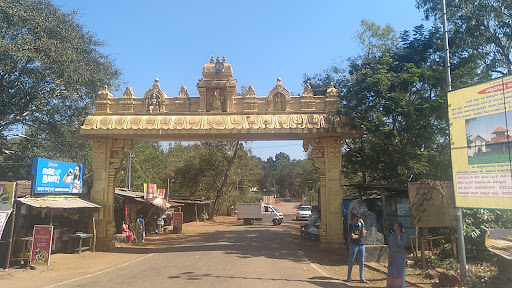
Shri Idagungi Maha Ganapati Temlpe . Tirth Kshetra dedicated to the god Ganesha. Idagungi town in Uttar Kannada , Karnataka, Bharat( India). Idagunji where the temple is located is a small village on the west coast of India close to the Sharvathi River which joins the Arabian Sea. It is close to Manki (Mavinakatte) and is about 14 km from Honnavara, 20 km from Kumta ,65 km from Gokarna, and 5 km from a road which branches from the National Highway NH66 Bharat (India), towards the west coast. Honnavara, the capital of the taluk in which Idagunji lies, and the nearest railway station is Manki railway station.
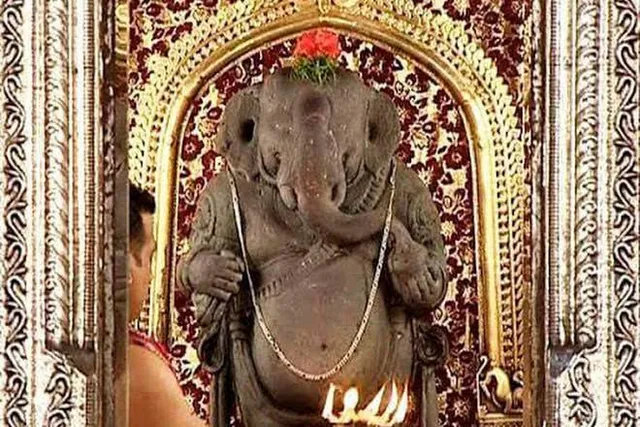
During the last phase of Dwapara, a sage ( Hrishi )by name Valakhilya was performing penance on the banks of river Sharavathi. The going proved tough due to many obstacles for the learned sage. The ommiscient sage( Hrishi) Narada happened to pass by that way once and the sage Valakhilya narrated his difficulties to him. Narada suggested that all hurdles could be overcome by the worship of Vighneshwara. Sage( Hrishi) Valakhilya was convinced and he requested Narada to help him in securing the presence of Ganapathi on the bank of Sharavathi from his abode in Kailasha. Sage Narada too in his wisdom thought that in view of the fast approaching Yuga of Kali, the holi precence of such a deity was a must on the banks of river Sharavathi. He made a pilgrmage to Kailasha and placed his request before the supreme power, Shiva and his consort Parvati. In their magnanimity they graced this part of the world by sending their son Ganapathi to the Sharavathi valley to bless the greet sage Valakhilya. The light of the Kailasha thus came to this valley and bless the land with his divine presence and to remain here forever in course of time the symbolic icon was carved by Vishwakarama the divine sculptor and consecrated at Idagunji. The image of Ganapathi has its own speciality in that instead of one it has two tusks and insteed of four hands only two hands. The sacred has a granite bell and does not have the serpent like around the big belly with a necklace around the neck and the delicate hairlike stand scarved in stone at the back of the head. It is really an imposing lovely statue. Its age is assessed to be more than two thousand years. The devotees goes into meditative state in a most natural way by concentrating on the image. It has the fame of showering grace on the devotees who aspire for such a grace. The Pilgrim centre is a live one. The importance of the temple is attributed to a legend, occurring at the end of the Dvapara Yuga (the third Hindu epoch or era) before the onset of Kali Yuga (the present epoch or era). Every one feared the advent of Kali Yuga, as the god Krishna was about to leave earth for his divine abode at the end of Dvapara Yuga. Sages ( Hrishi )started performing austerities and prayers seeking Krishna's help to overcome all impediments of Kali Yuga. Sages led by Valakhilya started rituals in Kunjavana, a forest area on the banks of the Sharavati River in Karnataka which joins the Arabian Sea. At the request of the sages, Narada selected a site for the rite on the banks of the River Sharavathi, at Kunjavana, seeking Ganesha's intervention. Even the Hindu Trinity (the gods Brahma, Vishnu and Shiva) had visited this place in the past to bring an end to the demons who were involved in destroying the earth. The gods had even created the sacred lakes Chakratirtha and Brahmatirtha at that time. Narada and the otherHrishi created a new sacred pond called Devatirtha. Narada invited the gods and requested Ganesha's mother Parvati to send Ganesha. The rites were performed and hymns recited extolled Ganesha. Pleased by their devotion, Ganesha consented to remain at the site to help them conduct the rituals without any trouble. On this occasion, one more lake was also created and named as Ganesha-tirtha to fetch water to the temple. The same location is now called the Idagunji, where the Ganesh Temple was built by the devotees around 4th-5th century CE. Car parking is free ,we have to walk 300 Mt...
Read moreDuring the last phase of Dwapara, a sage by name Valakhilya was performing penance on the banks of river Sharavathi. The going proved tough due to many obstacles for the learned sage. The ommiscient sage Narada happened to pass by that way once and the sage Valakhilya narrated his difficulties to him. Narada suggested that all hurdles could be overcome by the worship of Vighneshwara. Sage Valakhilya was convinced and he requested Narada to help him in securing the presence of Ganapathi on the bank of Sharavathi from his abode in Kailasha. Sage Narada too in his wisdom thought that in view of the fast approaching Yuga of Kali, the holi precence of such a deity was a must on the banks of river Sharavathi. He made a pilgrmage to Kailasha and placed his request before the supreme power, Shiva and his consort Parvati. In their magnanimity they graced this part of the world by sending their son Ganapathi to the Sharavathi valley to bless the greet sage Valakhilya. The light of the Kailasha thus came to this valley and bless the land with his divine presence and to remain here forever in course of time the symbolic icon was carved by Vishwakarama the divine sculptor and consecrated at Idagunji. The image of Ganapathi has its own specialty in that instead of one it has two tusks, and instead of four hands only two hands. The sacred has a granite bell and does not have the serpent like around the big belly with a necklace around the neck and the delicate hairlike stand scarved in stone at the back of the head. It is really an imposing lovely statue. Its age is assessed to be more than two thousand years. The devotees go into meditative state in a most natural way by concentrating on the image. It has the fame of showering grace on the devotees who aspire for such a grace. The Pilgrim centre is a live one. The importance of the temple is attributed to a legend, occurring at the end of the Dvapara Yuga (the third Hindu epoch or era) before the onset of Kali Yuga (the present epoch or era). Everyone feared the advent of Kali Yuga, as the god Krishna was about to leave earth for his divine abode at the end of Dvapara Yuga. Sages started performing austerities and prayers seeking Krishna's help to overcome all impediments of Kali Yuga. Sages led by Valakhilya started rituals in Kunjavana, a forest area on the banks of the Sharavati River in Karnataka which joins the Arabian Sea. During this period, he encountered many obstacles in performing the sacrifice and was very disturbed. He, therefore, sought the advice of the divine sage Narada, seeking suitable ways to tackle the problem. Narada advised Valakhilya to seek the blessings of Ganesha – the remover of obstacles – before restarting his sacrifice.2
At the request of the sages, Narada selected a site for the rite on the banks of the River Sharavathi, at Kunjavana, seeking Ganesha's intervention. Even the Hindu Trinity (the gods Brahma, Vishnu and Shiva) had visited this place in the past to bring an end to the demons who were involved in destroying the earth. The gods had even created the sacred lakes Chakratirtha and Brahmatirtha at that time. Narada and the other sages created a new sacred pond called Devatirtha. Narada invited the gods and requested Ganesha's mother Parvati to send Ganesha. The rites were performed and hymns recited extolled Ganesha. Pleased by their devotion, Ganesha consented to remain at the site to help them conduct the rituals without any trouble. On this occasion, one more lake was also created and named as Ganesha-tirtha to fetch water to the temple. The same location is now called the Idagunji, where the Ganesh Temple was built by the devotees around...
Read moreShri Idagunji Mahaganapathi Temple, located in the serene village of Idagunji near Honnavara in Uttara Kannada district of Karnataka, is a highly revered temple dedicated to Lord Ganesha. With a sacred legacy believed to be over 1,500 years old, it holds immense spiritual significance among devotees, especially those embarking on new beginnings or seeking removal of obstacles. The temple is part of the revered pilgrimage route along the west coast of India and attracts lakhs of pilgrims throughout the year. The legend behind the temple’s origin dates back to the end of Dvapara Yuga, when Sage Valakhilya was performing intense penance on the banks of the Sharavathi River. Faced with several impediments, he sought the counsel of Sage Narada, who advised invoking Lord Ganesha. Pleased by the prayers, Lord Ganesha agreed to reside in this place, thereby blessing the land with his divine presence, which eventually led to the consecration of this temple. The unique idol of Lord Mahaganapathi here is in a rare dvibhuja (two-armed) form, holding a lotus bud and a modaka. Unlike other depictions, this idol does not have a mouse as a vahana and is adorned with a sacred thread and a necklace of bells, which distinguishes it from other Ganesha shrines. Devotees visit the temple to offer prayers before starting new ventures, marriages, or travels, and a unique practice includes placing chits on the deity’s feet to seek divine approval for matrimonial alliances. The atmosphere inside the temple is filled with divine serenity, chants, and the fragrance of fresh flowers and incense. The temple timings are generally from early morning till noon and again in the evening till night. The best time to visit is between October and March when the weather is comfortable and ideal for travel and pilgrimage. Major festivals such as Ganesh Chaturthi and Sankashti Chaturthi are celebrated with great devotion and attract large gatherings. The temple is located approximately 14 km from Honnavara and is well-connected by road, making it easily accessible from major towns and pilgrimage centers like Murudeshwar and Gokarna. A visit to Shri Idagunji Mahaganapathi Temple—ಶ್ರೀ ಇಡಗುಂಜಿ ಮಹಾಗಣಪತಿ ದೇವಸ್ಥಾನ—is a spiritually fulfilling experience, filled with devotion, tradition, and the divine blessings of Lord Ganesha, the remover of...
Read more