Sooper
The Kollam–Sengottai branch line (formerly known as Quilon–Shencottah or Quilon–Chenkotta line) is a railway line in South India which connects Kollam Junction in Kerala state and Sengottai (also spelled Shencottah, Shenkottai, Chengottai, Chenkottai, Senkottai) in Tamil Nadu. The Quilon–Shencottah railway line was the first railway line in the erstwhile Travancore state and is more than a century old. The Kollam–Sengottai section is part of the Kollam–Chennai metre gauge rail route commissioned by the British in 1904. The line has been completely converted to broad gauge and is now fully operational from Kollam Junction to Shengottai
The Punalur-Sengottai section is part of the 325-km Kollam- Sengottai-Tenkasi- Tirunelveli- Tiruchendur gauge conversion project and part of the Tenkasi- Virudhunagar trunk route to Chennai. The gauge conversion of the Sengottai- Tiruchendur section has been completed and is open to traffic.
Kollam - Punalur sectionEdit
The Kollam Junction -Punalur metre gauge railway line to broad gauge conversion works foundation stone was laid in 1998 at Punalur. Services on the Punalur-Kollam metre gauge section were withdrawn on 1 May 2007, to facilitate the gauge conversion work. The gauge conversion took almost 11 years to complete after the foundation stone was laid. The 44 km line was converted to broad gauge and inaugurated on 10 May 2010. Passenger train services connecting Punalur to Kollam, Madurai, Guruvayur, Kanyakumari and Palakkad Junction are currently operational in this route.[2]
Punalur - Sengottai sectionEdit
To facilitate the gauge conversion work on the Punalur-Sengottai section, train services on the section were withdrawn in September 2010. The 49.2-km Punalur-Sengottai section gauge conversion works were completed in December 2017 and the line was commissioned in March 2018. The inaugural Tambaram-Kollam special train (06027) ran through the section on 31 March 2018. The inaugural TBM-QLN special train was later extended to Chennai Egmore (MS) and then regularised w.e.f. 04.03.2019 where the inaugural run of the regular daily express train was flagged off. The regular train is 115 years old and re-started after 19 years. The train MSQLN EXP has train numbers 16101(MS-QLN)/16102(QLN-MS). The inaugural special run of the regular train had 06101 as the number and had a total of 14 coaches with 8 SL coaches &...
Read moreGet
Destinations
›
India
›
Kerala
›
Kollam
›
Pathimoonnu Kannara Bridge


Pathimoonnu Kannara Bridge
Kollam - Thirumangalam Road, Kerala 691308, India
Viewpoints
Bridge
About Pathimoonnu Kannara Bridge
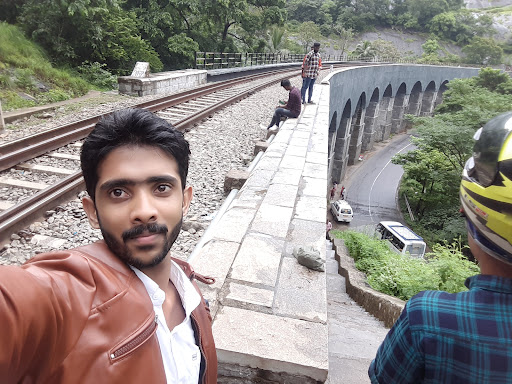
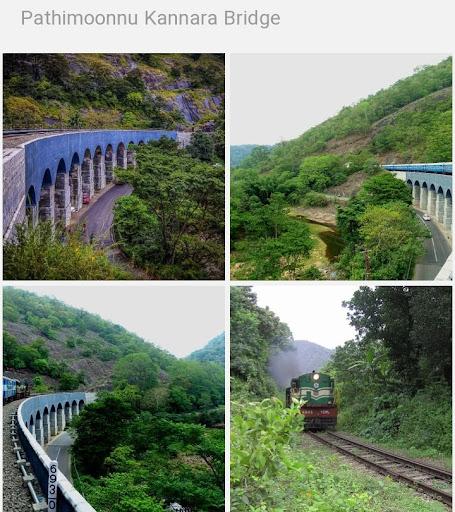
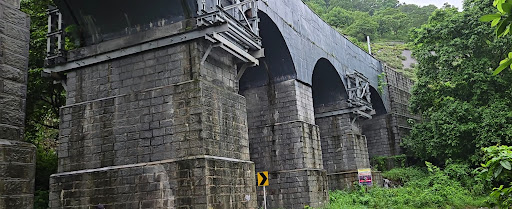
The 13 Kannara bridge or 13 Arch Bridge (Pathimoonu Kannara Bridge) is a 108-year-old bridge from the British era consisting of 13 arches. It is a major landmark on the Kollam-Sengottai railway line. The bridge connects two hillocks and stands on thirteen granite pillars each almost a hundred feet tall. The bridge is sandwiched by the Kollam-Thirumangalam National Highway on one side and the River Kazhuthurutti on the other. It is 102.72 meters (337.0 ft) long and 5.18 meters (17.0 ft) tall.
The 13 Kannara Bridge or 13 Arch Bridge (Pathimoonu Kannara Bridge) is a 108-year-old bridge from the British era consisting of 13 arches. It is a major landmark on the Kollam-Sengottai railway line.
The bridge connects two hillocks and stands on thirteen granite pillars each almost a hundred feet tall. The bridge is sandwiched by the Kollam-Thirumangalam National Highway on one side and the River Kazhuthurutti on the other. It is 102.72 meters (337.0 ft) long and 5.18 meters (17.0 ft) tall.
The Bridge was built by the British in 1904 to transport goods from Kollam (Quilon) to Madras and is part of one of India’s oldest mountain rail lines. The bridge was constructed with just rocks, limestone and jaggery (in the Surki method). This rail route was once one of the major routes that connect Kollam (Quilon) with Chennai for the trading of crops and spices. The rail journey through this rail line is still one of the most scenic because of its route through dense forest, long tunnels, with many steeps, and downs. The meter gauge that was originally in place is now replaced by a broad gauge railway in order to accommodate newer, standard...
Read moreThe bridge was built during the British colonial period in 1904. It is known for its 13 arches, which are made of laterite stones and bricks. The bridge showcases the engineering skills of that era, combining functionality with aesthetic appeal.Location: It is situated near the town of Punalur, which is a key location in the Kollam district. The bridge crosses the Kallada River, facilitating transportation and connectivity in the region. Pathimoonnu Kannara Paalam played a crucial role in the development of the area's transportation infrastructure during the British rule. It was part of the railway line connecting Kollam to Sengottai in Tamil Nadu, enhancing trade and movement between the two states.Architectural Style: The bridge is an excellent example of colonial architecture, reflecting the blend of traditional Indian construction techniques with British engineering methods. The arches not only provide strength and stability but also contribute to the bridge's picturesque appearance. Over the years, the bridge has become a symbol of the region's historical and cultural heritage. It attracts tourists and history enthusiasts who are keen to explore Kerala's colonial past and architectural achievements. Although modern infrastructure has developed around it, Pathimoonnu Kannara Paalam remains a popular site, both for its historical value and as a scenic spot. It stands as a testament to the ingenuity and craftsmanship of the builders...
Read more