Padanilam Temple is believed to be swayambhu(orginated its own). Its actual history and the facts about how worship started there are unknown. Padanilam has been the administrative centre of Nooranad and it has the history of intense conflict between various karakal (territories) around the temple. This was for gaining control over the temple administration and thereby controlling the entire village. Due to this pada (battle/conflict), the place is said to have got its name. It is believed that the army troops of Kayamkulam Kingdom was camped near the temple for protecting the kingdom from the attack of neighbouring kings. During this period, the village had some chieftains and their supporters. They include Noorukodi Unnithans, Kadackal Kuruppans, Vettathasaans and Vettadickal Kuruppans. Kayamkulam Raja withdrawed his troop about four centuries ago. This initiated tensions between the chieftains for control of the village. Thus they divided into south and north, starting battle. The south side consisted of Noorukodi Karuppans and Kadackal Kuruppans. The other side had Vettathasans and Vettadickal Kuruppans with them. Twenty-two karakal supported their respective sides. During the battle, many soldiers of both the sides died in large numbers. They were buried in the chira near the temple. Even from very earliest of times, this temple was a blessing for the people in the surrounding areas. It is also believed that the battle was between Marthanda varma King on one side and Kayamkulam King on the other. The twenty-two karakals of Nooranad took side with the two kings. The common people started worrying about the devastation of the war and approached the Pazhoor Panamana Thampuran to find a solution to end the war. He tried to intervene but the parties were not in a position to stop. He made a tent in the eastern part of the temple and started fasting unto death. But that also did not deter the warring parties. But when he was on the verge of death due to the fast, they fearing the Brahmanasaapam, agreed to stop war. They demarcated the boundary in the north-south direction and stopped the war in the name of Parabrahma, the presiding deity of the temple.
Temple Specialities
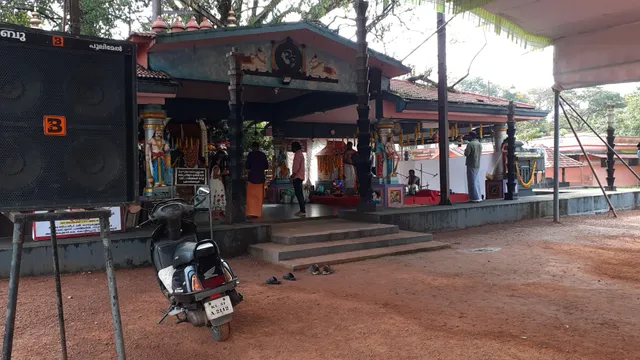
The temple has no protective walls or roofs
The priests are not necessarily Brahmins.
The temple neither opens nor closes. The rituals like Nada thurappu(opening of the temple in the dawn) and Nada adakkal(closing of the temple during night) is not there in this temple.
Non-Hindus are permitted to enter the temple and can even take part in all the celebrations related to temple including Shivarathri kettukazhcha. Religious unity is a trademark of Padanilam and it upholds the real culture of India.
Bhasma(holy ash) is given to devotees instead of Sandalwood paste.
There is no proper idol in the temple. Only a stone image of OM and is placed under natural roof formed by tree leaves.
Devotees can stay in the temple compound for the first 12 days of the month vrischikam for doing bhajan for Lord Parabrahman.For this purpose special huts are made in temple premise and devotees lead a holy life these days.The number of huts are increasing year by year.
The temple is one of the Idathaavalam of Sabarimala Dharma Sastha Temple.The temple provides resting place for Ayyappa devotees coming from various places.Lots of Pamba special service buses are passing through Padanilam.Temple authority is providing dried ginger coffee and light food for...
Read morePadanilam Parabrahma Temple (പടനിലം പരബ്രഹ്മ ക്ഷേത്രം ) is situated at Padanilam in Mavelikara taluk of Alappuzha district in Kerala, India. It is one of the major temples in erstwhile Travancore state. Padanilam is the cultural center of Nooranad region. The temple is situated 17 km east of Kayamkulam and 7 km south west of Pandalam. The temple is dedicated to Lord Parabrahma, also known as omkaram. Padanilam Temple is believed to be swayambhu. Its actual history and the facts about how worship started there are unknown. Padanilam has been the administrative centre of Nooranad and it has the history of intense conflict between various karakal (territories) around the temple. This was for gaining control over the temple administration and thereby controlling the entire village. Due to this pada (battle/conflict), the place is said to have got its name. It is believed that the army troops of Kayamkulam Kingdom was camped near the temple for protecting the kingdom from the attack of neighbouring kings. During this period, the village had some chieftains and their supporters. They include Noorukodi Unnithans, Kadackal Kuruppans, Vettathasaans and Vettadickal Kuruppans. Kayamkulam Raja withdrew his troops about four centuries ago. This initiated tensions between the chieftains for control of the village. Thus they divided into south and north, starting battle. The south side consisted of Noorukodi Karuppans and Kadackal Kuruppans. The other side had Vettathasans and Vettadickal Kuruppans with them. Twenty-two karakal supported their respective sides. During the battle, many soldiers of both the sides died in large numbers. They were buried in the chira near the temple. Even from very earliest of times, this temple was a blessing for the people in the surrounding areas. It is also believed that the battle was between Marthanda varma King on one side and Kayamkulam King on the other. The twenty-two karakals of Nooranad took side with the two kings. The common people started worrying about the devastation of the war and approached the Pazhoor Panamana Thampuran to find a solution to end the war. He tried to intervene but the parties were not in a position to stop. He made a tent in the eastern part of the temple and started fasting unto death. But that also did not deter the warring parties. But when he was on the verge of death due to the fast, they fearing the Brahmanasaapam, agreed to stop war. They demarcated the boundary in the north-south direction and stopped the war in the name of Parabrahma, the presiding deity of the temple. Other festivals in the temple include:
Vrischika mahotsavam, which is celebrated during the first 12 days of the Malayalam month of vrischikam. The ending day of the festival is called Panthrand Vilakk. Each year during vrischika mahotsavam, temple administration gives the Parabrahma Chaithanya Award to notable personalities for their contributions in their respective fields.[4] Irupathiyettamonam Mandala Chirappu Sapthaha yajnam Many marriages are also conducted in this temple, because marriage in this temple is...
Read moreIn the early centuries of Christ, Buddhism and Hinduism were the major religions of India. Brahminical influence in Kerala around the 20th century has led to the development of Hinduism. According to the Dravidian faith that existed then, The people believed that the gods were in Kavas. The Kavas that existed at that time became temples. In the belief that the gods exist in the banyan trees, our ancestors protected the banyan trees as Devatha trees Rock idols were placed as symbols of God under the banyan tree and prayed with lamps. Centuries ago, the entire area was dense forest As time changed, these areas became the administrative seat of the king of Kayamkulam. At that time, there was a dispute between the two princely states There was a battle between the two princely states Being the battlefield. This place was called the padanilam. The war lasted for several years because both sides did not agree to the defeat Finally, Finally to end the war the pazhoormana thampuraan Come into the battlefield If the war did not end. He decided to starve until death. The war ended As a result of the efforts of the Thampuran great teacher of the two sections After the settlement of the war. Thampuran made a illam in padkkeduthukavu And settled there. At that time the people were suffering from extreme poverty and morbidity in the country All of this hurts the thampuraan At that time, an elderly Brahmin came to his dream every day And he said: What! If the destroying banyan trees are protected, there will be prosperity in this land Thampuran who regularly saw the same dream thampuraan was called to the famous astrologist at that time and asked for a reason for the dream vision. So it was clear that Lord Shiva was the divine presence in the banyan tree. After that, there was a lot of Renovation activities here under the guidance of Pazhoor Thirumeni. After a long time, this kava became a temple. The eighteen stone lights around the temple represent the right of the eighteen territories, Kara koodal An important event in this temple. This ceremony is a reminder of the past war. The main festival is Mahashivaratri here is one of the largest kettukazcha in madhya thiruvithaamkoor This is modern times The people of different caste and religion come...
Read more