Vararuchi and Mezhathol Agnihothri
Note: In almost all the accounts on Vararuchi and Mezhathol Agnihothri, the name of Aazhvaancheri Thampraakkal is referred to. But according to historical evidences, Mezhathol Agnihothri and Aazhvaancheri Thampraakkal are not contemporaries. Also, Aazhvaancheri Mana is not seen in the list of seven families selected by Mezhathol Agnihothri to perform 99 Yaagams (See the article "Classification" in this site to know more about it). VARARUCHI: This is the story of Vararuchi, a great Brahmanan Scholar in the King Vikramaadithyan's court, (around 300 AD) highly learned in all the Saasthrams (sciences). He is said to be the son of famous Govinda Swamy and the author of "Vaakiam" and "Paralpperu", two treatises in "Jyothissaasthram" (Astronomy), both of which were then popular in the Kerala region.
One day, King Vikramaadithyan asked Vararuchi as to which is the most important verse, and in it, the most important phrase, in the entire Ramayanam epic. When he was unable to answer correctly, the king ordered him to come back with the correct answer in 41 days. Vararuchi approached many scholars but still could not come up with the correct answer. On the night of 40th day, as he was resting under a banyan tree, he got a clue to the answer from two spirits which had come there in the form of Kaalameni birds to visit two spirits of the forests who were residing on that tree. According to them, the most important verse was the advice given by Sumithra to Lakshmanan, when Sri Raman, Seetha and Lakshmanan started for forest exile.
"Ramam Dasaratham vidhhi, maam vidhhi Janakaatmajam Ayodhya mataveem vidhhi, gaccha thaatha yattha sukham"
(Consider Raman as if he were their father Dasarathan, Seetha as mother and the forest as Ayodhya; may the journey be a...
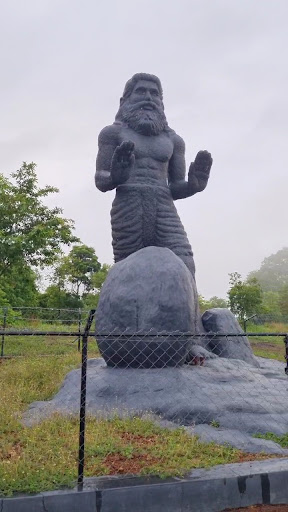
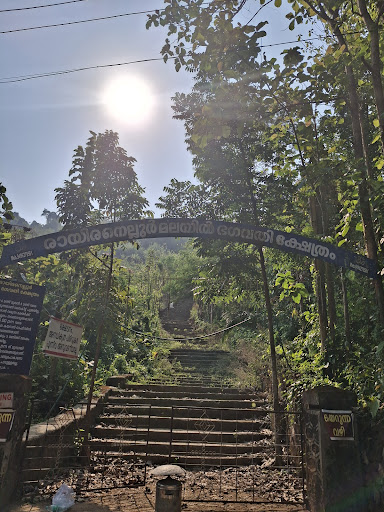
ย ย ย Read moreRayiranellur Malayil Bhagavathy Temple, situated atop the 500-meter-high Rayiranellur Hill near Pattambi in Palakkad district, Kerala, is a revered site where mythology and spirituality converge. This temple is intrinsically linked to the legend of Naranathu Bhranthan, a mystic from the "Parayi Petta Panthirukulam" folklore, known for his daily ritual of rolling a boulder uphill only to let it roll back down, symbolizing life's cyclical nature. According to lore, on the first day of the Malayalam month of Thulam (mid-October), Goddess Durga appeared before him, leading to a profound philosophical exchange. Impressed by his wisdom, the Goddess blessed him, and this event is commemorated annually as thousands of devotees ascend the hill to seek her blessings. The temple, accessible via a concrete path with steps or a more rugged trail, offers panoramic views of the surrounding landscape, including Pattambi town. Within the temple premises, visitors can find the footprints of Bhoomi Devi and a perennial spring that flows even during the harshest summers. A statue of Naranathu Bhranthan stands nearby, and devotees often circumambulate it after offering prayers. The temple operates from 6:00 AM to 8:00 AM on weekdays and extends until 9:00 AM on Sundays, making early morning visits ideal for experiencing its...
ย ย ย Read moreOne of the beautiful hill Temple in Kerala. Might be a rigorous climb to top for those who are not physically fit. However, it is a nice experience. Malayalam month Thulam 1 st is the festival day, everyone climbs to the top with so much festivity in that particular day.
Usually not that much visitors there in normal days. Ways to the temple is confusing from the main path as because of the nature of the village roads and beacuse of the lack of any proper sign boards. The sight from the top is very majestic. We can see the nearby Koppam & Thiruvegappura towns from the top. This hill has many stories attached with Narayanathu branthan. This is the place where he used to bring rocky stones from the downside with so much labour and he just pushes it from the top wasting all his efforts and philosophically laughs at his work and thus indicates the meaningless of this life.
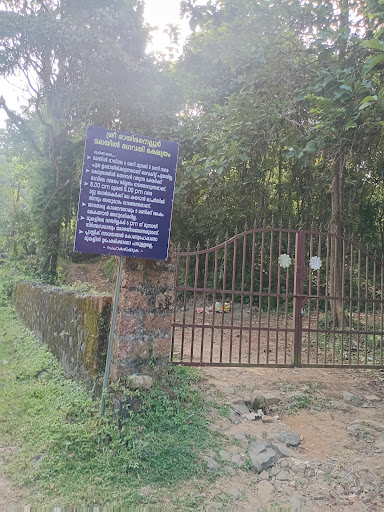
There are two ways to top, one is concreted and having good steps which leads us to top clearly. Other is a wild path, filled with stones and bushes. It is always safe to take the first path. As there is not that much visitors and security officers it may not be safe to go there in usual days with family without proper...
ย ย ย Read more