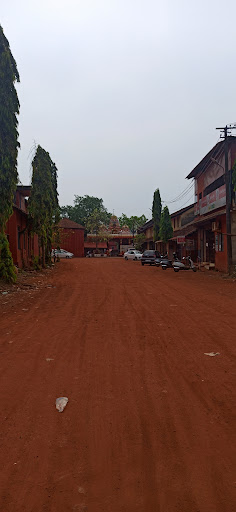
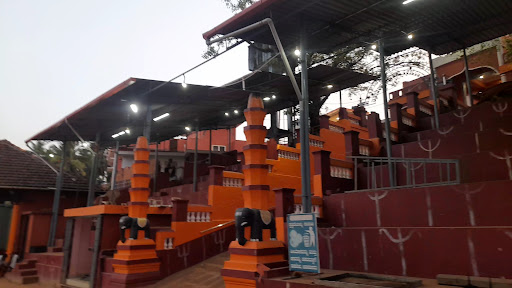
MANJULAKSHETRA or MANJESHWARA is the name derived from the deity “SRI MANJARISHA” or Srimath Anantheshwara of the sacred Manjeshwar Temple. Considered as the most ancient existing temple of the Gowda Saraswat Brahmins, the known history of the Temple dates back to 8th century A.D. The Temple was last renovated in 1799 – 1804 A.D. after it was demolished by a nearly ruler. H.H Srimath Vibhudendra Tirtha Swamiji, the then Peetadhipathi of the Kashi Math Samsthan took the initiative in resurrecting the Temple and re-installing the presiding deity Shri Bhadra Narasimha. MANJESHWAR or Manjulakshetra with its Puranic background is celebrated for its Temple dedicated to Srimad Anantheshwara, that is Shri Shiva accompanied by Shesha or Anantha. Evidently, the town derives its name from the presiding Deity Srimad Anantheshwar changed into “Madanantheshwar” and then into Manjeshwar by efflux of time and long usage. The image of Lord Shiva is believed to be an “Udbhava” or “Swayambhoo” (Self emergent). Besides the image of Shiva, there are in the temple images of Lord Narasimha and Subramanya, the latter Deity rarely worshipped in South Canara. Originally in the Madras State but now in Kerala, Manjeshwar is situated 17 Kilometers south of Mangalore on the Cochin – Mangalore section of the Southern Railway, the Temple is about a Kilometer and a half from the Railway Station, being easily accessible by metalled road. By road, it is about 23 Kilometers south of Mangalore on the National Highway 66. The nearest Airport is Mangalore.
The Sanctum Sanctorum The Sanctum Sanctorum (Sri Garbhagriha) has two parts. One can be seen by devotees and the other hidden behind the Altar(Simhasana). The entire Simhasana is built over an anthill called Rohini or Ruvvani in Konkani.
Visible at the bottom is the granite Shivalinga of Srimath Anantheshwara after whom the temple is named. This Linga is considered self emerged (Swayambhoo). The period of its discovery is not known. On the second rung are two Deities of Nagaroopi Subramania- one is ancient and the other recently installed. At the centre is Sri Bhadranarasimha – the presiding Deity in standing position flanked by Sridevi and Bhudevi- His consorts. Visible at the top are the idols of Sri Vittala, Sri Vedavyasa, Sri Laxminarasimha, Sri Keshava, Sri Krishna, Sri Karalanarasimha and others. Many other idols are partially visible Including the Utsavamurthy of Utsava Narasimha. These are indicated in the diagram.
Manjeshwar, the northern tip of Kerala, bordering Karnataka, is a small coastal village in Kasargod district. Though the sleepy town has not witnessed any significant development like its neighbouring Mangalore or Kasargod, or failed to lure many tourists through its serene beaches, it has succeeded in finding a place in spiritual as well as...
Read moreManjeswar is a small town on the sea shore in the northern extremity of Kerala . It houses one of the most important temples of the gowda Saraswath Brahmins who migrated from Goa to various places in the west coast.. The temple houses three Gods, Anantha(Or Adhi Sesha) , Iswara( Shiva) and Narasimha. It is believed that the siva temple was existing there for thousands of years and was consecrated there by sage Virupaksha. Over years due to natural happenings the building of the temple got completely broken down. At that time a Gowda Saraswath Brahmin called Ranga Sarma was travelling south from Goa along with a statue of Anantha. He accidentally came across this temple , and stayed there and rebuilt it. He also consecrated the statue of Adhi sesha along with Lord Shiva , making it an Anantheswara temple. It is believed that Lord Shiva himself consecrated the idol of Narasimha in the temple. Lord Mukhyaprana, Lord Rudra, Devi Laxmi, Lord MahaGanapathy and Lord Garuda are the other deities in the Temple. An image of Lord Subrahmanya also has been installed in the temple in a place in a slightly lower elevation but with lot of serpent holes. Just behind the idols in the sanctum sanctorum, there is an ant hill made of white mud. Mud from this hill is taken and distributed as Prasada in the temple. This is supposed to have curative properties and in spite of centuries of distribution , the mud does not seem to get exhausted. There is a small pond in the temple called Sesha Theertham. Devotees believe that by taking bath in its waters skin diseases would be completely cured. The descendents of Ranga Sarma used to act as oracles of the temple and used to give predictions and answer the queries of the devotees. This practice has been discontinued after 1935. It is also believed that Shiva Ganas surround the temple. The chief of them called Jogi Gana is consecrated on the North eastern corner of the temple. People offer Coconuts to Jogi Gana. When things are misplaced or lost , they come to the temple of Jogi Gana and promise to make offerings of coconuts once the property is recovered. On the sixth phase of moon(Sashti ) in the waxing phase a chariot festival is held in the temple. This coincides with...
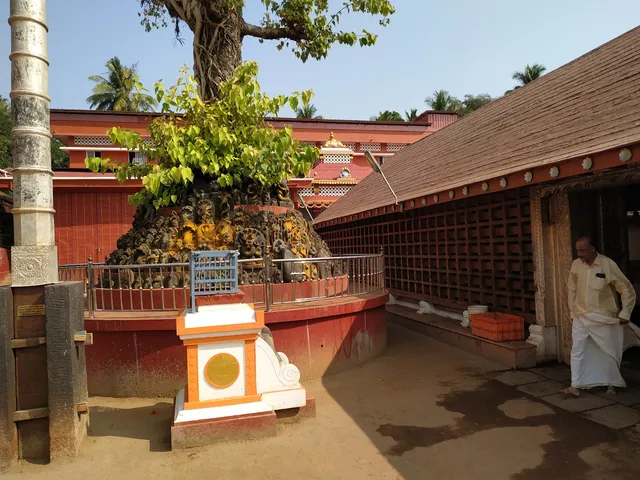
Read moreSrimath Anantheshwar Temple at Manjeshwar which is managed by GSB community for centuries . A nice place to visit in the evening and offer prayer. Anantheshwara a Mystical Temple in kasargod Kerala worships Lord Ananta and 3 significant divine energies of Lord Subrahmanya, Lord Narasimha and Lord Shiva.. all arranged in an ascending order with the form of the Infinite Serpent God Ananta.This Temple is one of the intriguing Snake Temples of the country majority of them located in southern Indian states of Kerala, Karnataka,Tamil Nadu and Andhra pradesh.To enter the Temple you have to descend through a steepy flight of stairs taking you downwards as if one is really entering the nagaloka or the serpent kingdom what we know as the pataloka,before we enter the temple on the left hand side we find a huge ashwattha tree with lots of serpent relics made out of stone enshrined all around the tree.As we enter the temple the energy of mysticism deepens and feel a fountain of negative energy housed in our subconscience being sucked up to the fore by the guardian dieties enshrined in the Temple.Suresh Bhatt the head priest of the temple was very affable and Badri Bhatt a poojari of the Ganeshji shrine established within the Temple has mastered the rituals of snake worship in its different advents and forms, enjoyed him leading a number of Konkan priests performing different snake worship for me.Enjoyed the energies and experience in this Temple, therefore...
Read more