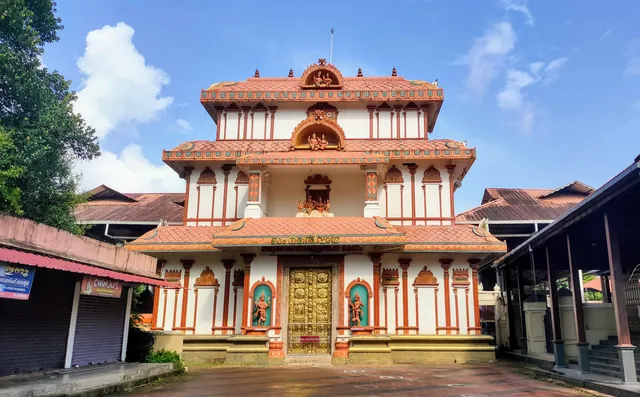
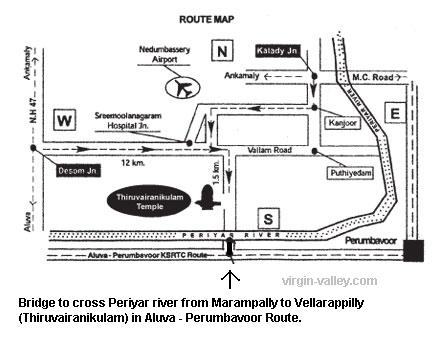
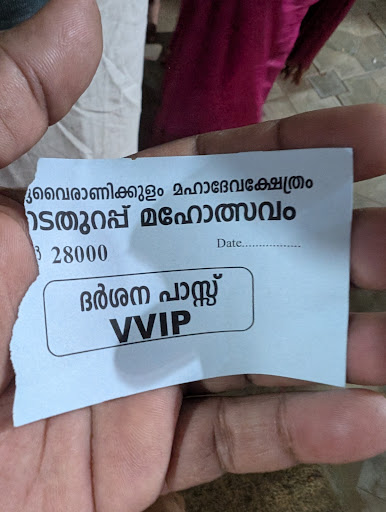
The devi's nada is open only once a year. A real experience. Devi sharanam! This temple of Shiva is situated near a village called Srimoola nagaram, in the banks of Periyar, near the town of Alwaye
The temple consists of two temples-One dedicated to Lord Shiva facing east and the other dedicated to Goddess Parvathi which is facing west. The peculiarity of this temple is that while Lord Shiva’s temple is open all round the year, the temple of Parvathi is open only for 12 days in a year. There is an interesting story behind this practice.
It seems the Shiva temple was not here but in a place called Iranikkulam near Irinjalakkuda. An old Namboodiri from Srimoola nagaram who was a devotee of the God Shiva used to daily cross the river and walk a long distance to pray to this God. There was a boatman called Chathan, who used to keep a boat and who used to help the Namboodiri to cross the river. Chathan was one among those 12 famous children of Vararuchi about whom the legend of the "Parachi Petta Pandheeru Kulam" is about. When the Namboodiri became very old, one day he cried before Lord Shiva and told him, “Oh God, this is my last visit. I simply cannot come and see you again.”
That day while returning home, the Namboodiri felt that his umbrella was unusually heavy. But as soon as he crossed the river and got down, it became very light. Chathan,, the boat man told the Namboodiri that Lord Shiva had come along with him in the umbrella and as soon as he got down, had occupied some place in the village. Next day, a lady grass cuter, when she was cutting the grass, happened to cut a stone upon which the stone started bleeding.The women was terribly freightened and ran about three kilometers and died out of shock at that place. Chathan told all people that the stone she cut was God Shiva of Iranikkulam. A temple was built there for Lord Shiva and it was called Thiruvairanikkulam. They also built a temple for Goddess Parvathi. The place where the grass cutter fell is today called Varanattumadam. In this place annually a special Pooja called Irukki Pooja is conducted. After the pooja, puffed rice is given as Prasadam. People believe that by taking this puffed rice all diseases would be cured. The stone boat of the Chathan is still preserved in this temple.
Initially, it seems the priest used to keep all ingredients for making the offerings to God (Naivedyam) inside the temple premises of Goddess Parvathi and then close the doors. After some time, the fully cooked Naivedyam was prepared by Goddess Parvathi and kept ready in her temple. One day a devotee peeped through the Window to see what was happening in side the Parvathi temple and he saw that Goddess Parvathi herself was cooking the Naivedyam. The Goddess got very angry after this incident, and asked the priest to close her doors for ever. All the devotees wailed and requested her to pardon the act of the ill conceived devotee. The goddess pardoned him but gave permission for her door to be opened only for 12 days in a year.
Her temple gate opens on the Thiruvadira festival day. A minstrel singer called Brahmani amma sings about the Goddess before her gates are opened.Recently the only member of that family called Sridevi refused to sing at the festival. Thereafter, her husband became terribly sick and the goddess came in her dreams and pointed out that she was insulting the Goddess by not singing. Sridevi realized her mistake and started singing again in the festival. Not only her husband was cured but she was also blessed with divine powers.
Since any body with prayer for marriage or child birth who visit the Goddess Parvathi during those 12 days, gets their prayers fulfilled. Large number of devotees from all parts of Kerala visit the temple during...
Read moreThere is a certain relation between the history of Akavoor Mana and the temple formation. Akavoor Manaparambu (the land of Akavur Mana) lies in the Airanikulam village. Brahmins of the Mana were regarded as rules during that period. Years later, a conflict erupted in the family and a section of them moved to Vellarapilly village. But the Brahmins often visited Lord Mahadeva, then known as Airanikulathappan and Sree Parvathi. It is during this period that Akavoor Chathan came to the Mana as a dependent.
Seeing one of the Brahmins desiring to visit the Mahadeva Temple, Akvoor Chathan made a boat of granite and used it to transport the Brahmin to the temple. Years went by and the Brahmin grew old. One day, after his prayers at the temple, he cried to Mahadeva: "Oh my Lord! I have grown too old to come and see you. What shall I do now?" Soon he started his way back home. He lifted his Olakuda (an umbrella made of palm leaf), and found it heavier than it really was, and he told Akavoor Chathan about this experience. But Akavoor did not speak a word. Tavelling on the boat, Brahmin had the call of nature. Akavoor Chathan immediately moved the boat to a nearby land. Then he took his umbrella and to his surprise it seemed very light now. Still Akavoor Asked the Brahmin not to worry about it. After reaching the Manakkal land, the Brahmin got out of it and Akavoor Chathan overturned the boat and it rested in the mud. Even today one see a granite stone there lying upside down. It came to be known as Chathan Stone.
The place mentioned above is where the Thiruvairanikkulam Temple is situated. Earlier it used to be a forest, Pulaya women (women of low caste) used to go there to cleanse the forest. Once, one of the women happened to use the granite stone to sharpen her sickle. All on a sudden, blood started flowing out of the stone and this Pulaya woman lost her mental balance and ran amok. It is said that she ran nearly three kilometers in a frenzy. All the land through which she ran was handed over to the temple authorities by the respective owners. The area is called Varanattu Madam. During the temple festival the poojas are first performed here. The main Irakki pooja is offered only at the temple and in this place. Nowhere else is this pooja offered. This indicates the concern Lord Mahadeva has for Varanattu Madam.
Soon Akavoor Chathan narrated the incident to the Brahmin. It was indeed Airanikulathappan who had appeared in the form of a stone. And as Lord Mahadeva came from Airanikkulathappan, this temple came to be known as Thiruvairanikkulathappan. Once it was known that both the gods were one and the same, the temple was built and the deity was installed.
The deity installation was done by Punalloor Brahmin. But the two families never used to visit the other family temple. As per this legend, Akavoor Manakkal Brahmin and Akavoor Chathan are considered to be behind the temple formation.
When the Brahmin put the umbrella down, Lord Mahadeva who was sitting on the top of it, stepped down and traveled underground to reach first the well and then made for the place where he appeared as Swayambhoo (self born). This is the main reason why we see a relationship between Mahadeva and the well. It is believed that if the holiness of the well is defiled, Mahadeva too is defiled by such an act. To the south of the temple well, one can see a cave that is believed to be the way by which Mahadeva appeared. The Arattu is also done on the shore of the river where Mahadeva stepped down from...
Read moreLegend associated with Goddess Parvathi's Sreekovil
Sree Parvathy Devi's Nada Thurappu Mahothsavam
Formerly it was believed that Goddess Parvathi used to prepare food for Lord Mahadeva in the Thidappilli (temple kitchen) when no one was permitted to be in the kitchen. However, once one of the Brahmins belonging to the Uranmakkar (people who have a right on the temple) set out to find out the secret.
Seeing the Goddess in her full attire, he shouted out: "Devi Amma, Devi Jagadambika". Goddess Parvathi saw him and grew angry with him. She said, "As you have deviated from your usual ways of carrying out the rituals, I am leaving". The Brahmin could not stand it. He cried out and implored the Goddess for mercy. The Goddess said, "From now on, I will make my presence felt only from the twelve days beginning from the Thiruvathira nakshathram in the month of Dhanu, Lord Mahadeva's birthday. And the devotees who see me one of these days will be blessed".
It is on this legendary epistle, that the Sreekovil of Goddess Parvathi remains closed. Unlike in other temples the deity is not given Jalabhishekam (a form of pooja in which water is poured over the Idol). Only turmeric powder is used instead of water.
Offerings / Vazhipadu of Thiruvairanikulam Temple
During the 12 days when the Sreekovil is open for the public, Goddess Parvathi is bathed in oriental silks, Pattu and Thali, turmeric powder, Swayamvara Archana (pooja performed to remove marriage hurdles), Valkannadi (a unique and expensive type of mirror found only in Kerala), Nelpara, Malarpara, Aripara, Sarkara para, offerings in the form of oil - lams, Thrimadhuram, Brhminipattu etc. by the devotees.
Till 1936-37, the poojas at the temple were offered by the heirs of Ponnallur Manakal Namboodiries. Later when there were no male heirs to this family, the pooja was taken over by Kunnath West Bhattathiris. From 1990 August 9 - August 14 Ashtabhakalasham was carried out under the Thantri Vishnu Bhattathiri as the chief priest, and under the guidance of Akavoor Manakal and with the help of Uranmakkar and the public.
By 20 February 1997, the cleansing ceremony, remedial measures and renewal work had begun under the Thantri Kaaimooka Raman Adathiripaadu. This was in view of the Ashtamagala Prashnam.
The temple festival which had long been delayed and neglected was brought back to life along with remedial poojas during February 28 - March 07 in the year 1998. This indeed was a new beginning. Deva Prashnam (a form of astrology by which the pleasure and displeasure of Gods are known) revealed that the devotees were once given Kanjivizhinju (Neivedyam) during Arattu days, and this would wash off all kinds of ill health. Nowadays the temple witness long queues for this Prasadam.
During Ashtamirohini (Lord Krishna's birthday) 8 days of festival are carried out, including Bhagava Sapthaham which is reciting the life story of Krishna.
Various other festivals like Pradishta Divasam (day of deity installation) during the month of Midhuna (Punartham star), Mandala festival (Lord Ayyappa festival from the Malayalam month of Vrischikam 1 - Dhanu 11), Vishu kani (festival related to Lord Vishnu during the Malayalam month of Medam 1), Naaga Pradishta (related to Naaga (serpent) installation during the Malayalam month of Ayilyam) and pooja related to Navarathri (this is auspicious day, when the books are kept for...
Read more