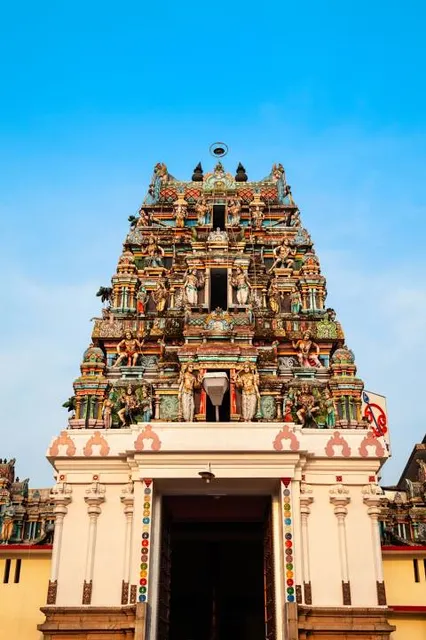
The Thiruvarppu Sreekrishna Temple is unique in many ways. Its antiquity (reckoned as 1,500 years) places it among the most important of Vaishnava temples. But what makes the the temple famous is the unique rituals and practices followed there. An inscription dates the present temple structure to 850 AD, while popular lore places its origins to still earlier centuries. It is no surprise that this temple too, like many temples in the central Travancore area, is connected to the southern sojourn of the Pandavas. Lore has it that the idol of Sreekrishna with four hands is the one worshipped by the Pandavas. The several popular legends about the origin of the temple all point to the fact that the idol was recovered from the lake and that it was kept in a "varppu" (a large, flat bronze vessel -- smaller ones are termed "uruli", while the really big vessels are called "varppu"), and hence the name of the temple. Sage Vilwamangalam, while sailing in a boat discovered the beautiful idol when probably the oar struck it. While deciding on a suitable place to consecrate it, he kept it in a large "varppu" belonging to Kunnamkari Menon, a local noble, who donated the land on which a temple was built.
What makes the temple strangely unique are the rituals followed here. The Lord consecrated here is in the aspect immediately after the killing of Kamsa. The fight with the demon king zapped Him of all his energy and he is in a hungry state-- the reason why the temple opens at 2 am, much earlier than virtually all other temples. Immediately after "abhishekam" (ritual ablution), the Lord's head is dried and then he is offered "Usha Payasam". Only afterwards is he fully dried and clothed and poojas are done. His hunger pangs are so strong that the temple stays open even during eclipses to see that he does not miss out on his early morning "naivedyam"-- a practice that is unique to the Thiruvarppu temple. Another feaure is that this is perhaps the only temple where it is permitted to offer "Pithru Tharpana" (libation offered to dead ancestors).
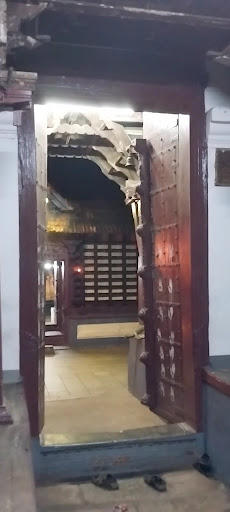
Built in the timeless Kerala style of architecture, the temple boasts of a square-shaped sanctum (the chief deity faces west) with a two-tier roof adorned with carvings and decorations. Sadly the misguided and over-zealous application of paint over the years has all but obliterated the fine details of the carvings. A notable feature is the pillared and tile-roofed walkway around the sanctum within the Nalambalam -- something that is not seen in other temples. (Of late, the temple admins elsewhere have come up with ugly constructions of steel and tin sheet to serve such a purpose. Perhaps it's time they took a cue from the artistry of the "thachans" of yore.) A unique addition, perhaps prompted by Royal preferences, is a compact "Koothambalam" in the north-west corner, a display of the thachan's artistry. Unfortunately it is in a state of neglect and disrepair. In the north-east corner we have a sub-deity, the Bhoothanatha, to whom is also given all the offerings made to the main deity. A unique practice here is that the Athazha Pooja is around 7 pm, only after which Deeparadhana is offered, with the temple closing immediately after that. An axe is kept near the sanctum to ensure that in case there is a delay in opening the sanctum door, there is the Lord's sanction to break it open with the axe, so that Pooja and Naivedyam could be offered on time . Truly a practice unique to this abode of Sreekrishna!
In the olden days the temple was the hub of a vast complex. Today roads and buildings have cut up the ancient master plan. To the west is "Kochambalam" ( "small temple"), which houses Goddess Devi. On the east, beyond the temple tank, are the small shrines of Ganapathy, Subramonya and Sastha. To the north is the large Siva temple, adjoining which is the abode of the high priests, the Swamiyar Madhom.
Thiruvarppu is distinguished by a grand assemblage of temples, which offers the traveller who is willing to go a little out of the way, a chance for time-travelling into...
Read moreThere is wrong information in web search showing the temple is open 23.58 hours.
As per Devasom board website ABOUT THE FESTIVAL (Legend/History/Myth) The myth behind this temple is connected with Mahabharata. When the Pandavas lived in the forest, Lord Krishna gave them his statue so that they can daily worship it. When Pandavas finished their sojourn in the forest and wanted to go back, the people of that area, requested for that idol. But after some time due to some reasons, they were not able to continue their worship and simply dropped the idol in the sea. After a long time a great sage was travelling by a boat in these parts and his boat became immobile and the sea dried. They were able to recover this idol. He took the idol with him and travelled to the east via Kunnam and Pallikkara and reached the present spot of the temple. He got down there along with the idol and found that a temple of Dharma Sastha was without any idol and hence he consecrated the idol in that temple. Another version is that the above divine person got down from the boat along with the idol but due to inclement weather he was unable to proceed. Hence he kept the idol in an Uruli, which he found near the tank and went away. Later when he came back, he found that the idol had got fixed to the Uruli. That Uruli belonged to an individual called Kunnan Kari Menon. As soon as he heard about this incident, he gave the land for temple construction and completed the temple with the help of a saint called Madappurathu Samiyar. Even today special Pushpanjali (offering of flowers) is done on behalf of the Asram of Madappurathu Samiyar in this temple. Another one is that the Pandavas deposited the idol they were worshipping along with their Akshaya Pathra in the sea, before leaving for their Agnatha Vasa. Some fishermen fishing in the Vembanad back waters at a place near Vechur (called Mangalathu Vila) recovered only the idol but not the vessel. They built a temple in a place called Chara Mangalam and consecrated the idol there. Soon various calamities occurred in their village and hence, they returned the idol to the backwaters. This time the idol fell directly into the original vessel itself. It was then that the divine person referred to earlier recover the idol as also the vessel. His boat travelled via Kunnam and Palikkara and was not able to travel further due to dense aquatic plants. The people of the area swam in to the water and made way for the boat to reach the shores. The idol in the vessel was kept in the shore temporarily in a structure called Valiya Madam. On that day they were able to offer to the God only tender mango pickles and tender coconut water. Later the idol was shifted to the present temple. During the Arattu, the idol is taken to Valiya Madam and Tender mango and tender coconut water is offered to it even today. The idol is of Lord Krishna who rests after killing Kamsa having Conch, Discus, Butter and Mace. Temple usually opens very early around 2 AM in the morning and is one of the earliest opening temples in Kerala. As soon as the temple is opened, a special offering called Usha Payasam also called as Thiruvarppu Usha (considered divine like Ambalapuzha Palpayasam) is offered to the deity. This is prepared using rice (5 Nazhi), jaggery (50 Palam), ghee (5 Thudam), 5 Kadalipazham (red banana) and 5 dried coconut. The method of preparation is very peculiar to this temple. Soon after Abhishekam, deity's hair is dried and Payasam is offered. After this offering only rest of the body of deity is dried. Along with the key to open the sanctum door in morning, the priest is also given an axe. It is generally believed that the deity cannot tolerate hunger (as he is exhausted after killing Kamsa) and if there happens to be a delay in opening the sanctum door with the key, the priest is permitted to break the door with axe. The festival is conducted to celebrate the divine presence of the deity...
Read moreThiruvarppu – a small village at 6-7 kms distance from Kottayam, is known for the Thiruvarppu Krishna Temple.The Thiruvarppu Krishna Temple dedicated to Lord Krishna is one of the renowned Vaishnava temples in Kerala.
The Thiruvarppu Krishna Temple is located on the coastal line of the Meenachil River in the Thiruvarppu village, and hence the name given to the temple.
Varpu refers to the cast which is used by smiths to make bell metal vessels.
This is an ancient temple known to be 1500 years old. An inscription on the temple indicates that the temple was constructed in 850 AD.
The architectural style of the shrine resembles the typical architecture of the temples found in Kerala.
The Flat Vessel One of the most popular beliefs about the temple coming into existence is the recovery of the idol of Lord Krishna having four hands, which was placed in an Uruli, a flat vessel made out of bell metal.
This story revolves around the Mahabharata. It is said that when Pandavas had to live for 14 years in the forest, Lord Krishna gave them his idol for worship. When the Pandavas had completed their Vanvasa, the residents asked for the idol which was worshipped by the Cherthalai. After sometime, as circumstances could not permit them to worship the idol, they dropped the idol in the sea.
After a long time, when a holy saint was crossing the river, his boat stuck at one point and the sea dried at that place, and the idol of Lord Krishna was discovered. He took custody of the idol and traveled towards the present location of the temple. The sage landed at the shore and found one temple without any idol and established the idol there which is now known as the Thiruvarppu Temple.
Another story says that the Pandavas after completing their Vanvasa, had submitted the idol of Lord Krishna and their Akshaya Patra to the seawater. Sometime later, some fishermen discovered the idol without the vessel and established it in a temple. Soon, natural calamities attacked the place and the idol was washed away by the water, this time it fell into the vessel. The sage, referred above, while crossing the sea, discovered the idol. On reaching the shore, the vessel with the idol inside was temporarily placed in Valiya Madam. On that day, they had only mango pickles and coconut water to offer to the Lord. Later, the idol was shifted at the present place. During Arattu, the idol is taken to the Valiya Madam and the practice of offering mango pickles and coconut water is still carried out.
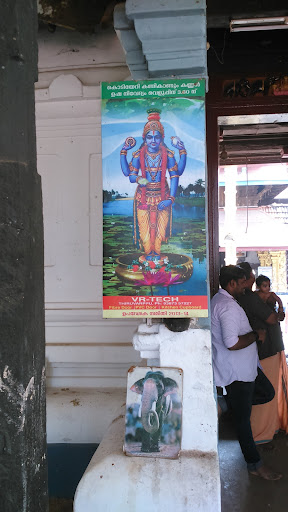
About Thiruvarppu Temple Also known as the Thiruvarppu Sree Krishna Swamy Temple, the idol of Lord Krishna established here has four hands, and the idol faces the west. The idol is correlated with Krishna after killing the Kamsa, very exhausted and hungry.
The Thiruvarppu temple also has a drum which is made out of bell metal. It is believed that Lord Krishna announced to kill the Kamsa on this drum. The temple also has a brass lamp which is made of 12 tiers; it was gifted by a Christian devotee.
The Thiruvarppu temple is especially thronged by devotees on Sundays and Thursdays.
The Thiruvarppu Temple follows the tradition of other Hindu temples of Kerala and has its own unique set of rituals and festivals.
Offerings at Thiruvarppu KrishnaTemple
Unlike the other temples, the Thiruvarppu Temple is opened in the pre-dawn hours at 2 am and is closed at 1 pm.; is re-opened for devotees from 5 pm till 7.30 pm.
The priest of the temple possesses an axe along with the keys to the temple. The locales believe that God cannot tolerate hunger, so if there is any delay in opening the lock of the temple, the priest has the authority to break open the door...
Read more