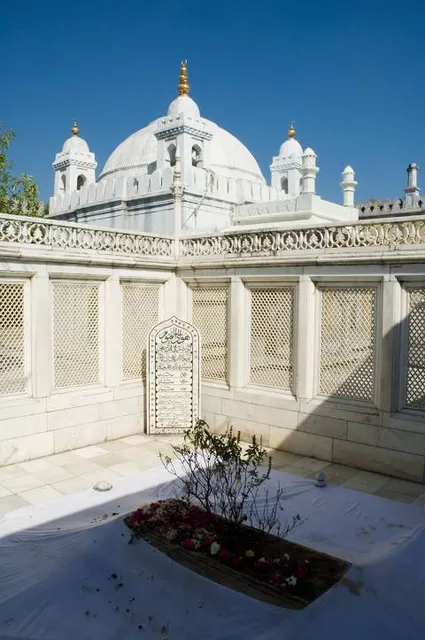
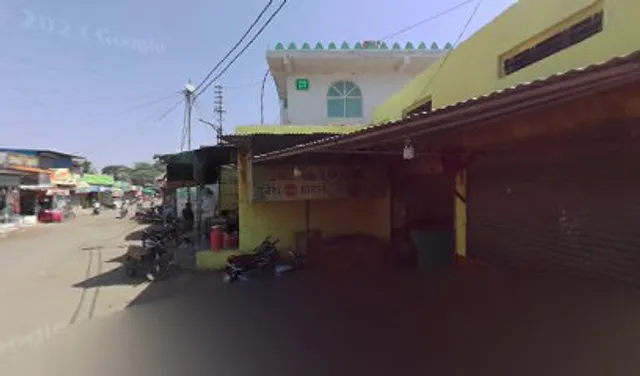
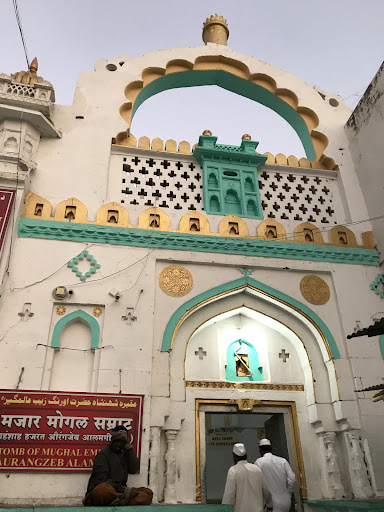
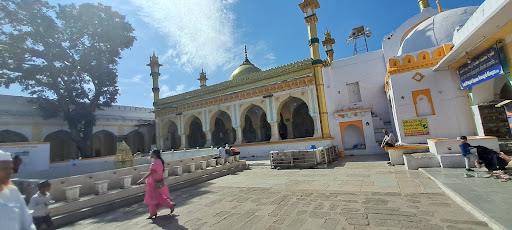
The Tomb of Aurangzeb, the last of the great Mughal emperors, is located in Khuldabad, Maharashtra, In notable contrast to other Mughal tombs, which are large monuments of Mughal architecture, including the Taj Mahal, at his own direction Aurangzeb is buried in an unmarked grave at the complex of the dargah or shrine of Sheikh Zainuddin.
Aurangzeb (1618–1707), who was the sixth Mughal emperor, ruled most of the Indian subcontinent for half a century until he died in 1707. According to his wish, he was buried near the dargah of Sheikh Zainuddin, his "spiritual guru". His great grand father emperor Akbar ruled 50 years.
Aurangzeb died in 1707 at Ahmednagar. His body was then carried to Khuldabad after his son Azam Shah and daughter Zinat-un-Nissa came. There is a platform over the tomb made of red stone, less than three yards in length. There is also a "cavity" in the middle which measures a "few fingers". The tomb has been covered with soil on which herbs grow. After his burial, he was given the posthumous title of "Khuld-makan" ("he whose abode is in eternity"). Lord Curzon later covered the site with marble and surrounded it with a "pierced marble screen". The tomb is roofed by "the vault of the sky". The gateway and the domed porch were added in 1760.
It is said that Aurangzeb paid for his burial place by stitching caps during his last years and that it cost only 14 rupees and 12 annas. The tomb is "remarkably simple in keeping with Aurangzeb's own wishes". Aurangzeb's full name is written on a marble plate located in one of the corners of the tomb.
The dargah also houses the tomb of the first Nizam, Asaf Jah I, his son Nasir Jung, and those of Aurangzeb's son Azam...
Read moreA seemingly regular, medium sized, well maintained Dargah campus. Mughal emporer Aurangzeb - one of the wealthiest king of his time - was laid down here on his wish to be laid down next to his preacher/teacher.
People with muslim faith visits here more frequently.
The place is feels less impressive after the experience with the group of people maintaining the place ends up in asking for money or personal financial favours from "visitors" after 1 to 2 minute explanation about the place that too after a call of putting money in donation box, rather they appoint paid guides through tickets which would avoid feeling of being cheated. Sorry but that was it felt.
Not impressed with place but got impressed by knowing "last thought process" of king Aurangzeb during his last illness days that - he wanted to get buried with his "hard earned" money through sewing the caps (and not Royal / Public Money which is principally of people's). He was recorded telling lot of time during his last days that "what he earned finally out of the life long wars throughout his life? he would carry nothing after death then why war ?". He had donated to many religious places of different faith which was relatively uncommon for him and places a contradiction to many history seekers.
His "mazar" was created through only 14 rupee and 75 paise of those times, funded through "his" hard earned money. The place is still ill constructed per his last wish.
Had he carried similar thoughts little early in his royal life, it would have given a different king to his people. At least he has left a great lesson for generations to come. May God bless his soul for realizing the...
Read moreA place that truly humbles you. The Tomb of Mughal Emperor Aurangzeb in Khuldabad is not just a historical monument, but a powerful reminder of the impermanence of this world and the humility that even the mightiest rulers must embrace in the end.
Unlike the grand tombs of other Mughal emperors, Aurangzeb's resting place is remarkably simple — no marble, no domes, no gold. Just a plain open grave covered with a simple white cloth. This wasn’t due to lack of resources — but by his own will, as he wished to be buried with the earnings of his own labor (he used to stitch caps and write Qur’ans).
This simplicity makes the site incredibly powerful. You stand there and realize: a man who once ruled almost all of India, who commanded armies and empires, lies here without luxury — by choice. It’s not just a grave, it’s a life lesson in humility, detachment, and the reality of akhirat.
The surrounding area is peaceful and spiritually rich. Located in Khuldabad, also known as the “Valley of Saints,” this area is home to the tombs of many great Sufi saints, including Hazrat Khwaja Burhanuddin Gharib (R.A.) and Hazrat Zainuddin Shirazi (R.A.), which adds even more spiritual significance.
The site is well-maintained, clean, and quiet. The caretakers are respectful and knowledgeable. You can sit there in silence, reflect on life, death, power, and submission to Allah. It’s a powerful experience.
Whether you’re interested in history, spirituality, or just deep reflection, this place is worth visiting. Aurangzeb’s tomb doesn’t shout — it whispers truth.
May Allah forgive his shortcomings, accept his good deeds, and grant him...
Read more