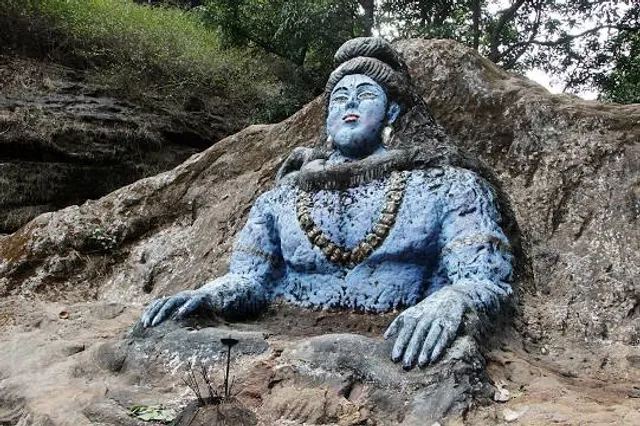
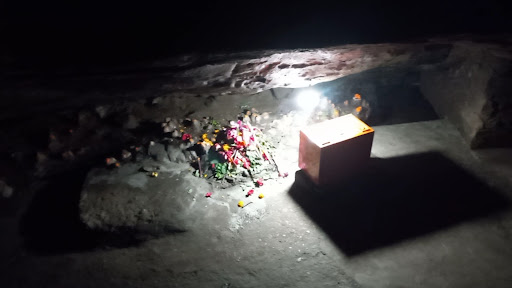
Jayashankar mahadev mandir is one of the major tourist place in panchmari. I personally get to impressed to visit here. And I recommend every person to visit here if they're visiting Panchmari.At a distance of 1.5 km from Pachmarhi Bus Station, Jatashankar or Jata Shankar is a cave temple located in Pachmarhi, Madhya Pradesh. Also called Jatashankar Cave Temple, it is one of the popular places to visit in Pachmarhi.
Situated in a deep ravine with enormous boulders perched above, the Jata Shankar Caves in Pachmarhi are considered sacred as it is believed to be the place where Lord Shiva concealed himself from the wrath of Bhasmasur. This is a beautiful limestone cave comprising stalactites and stalagmites that look like the matted hair of Lord Shiva, hence named Jata Shankar Cave. Besides, the ceiling of this famous shrine has a formation that closely resembles the mythological hundred-headed snake Seshnag.
The cave contains stalagmites which are revered as naturally formed lingams. In fact, there are 108 such natural lingams present in this cave. There are two different types of ponds fed by springs, found in the locality, one of cold water and the other one of hot water. Water in the cave flows from an unknown point as no one has ever seen or reached that starting point and hence this stream of water is popularly known as 'Gupt Ganga'. It is believed that the Jambu Dwip stream originates from this cave. There are idols of Lord Shankar and Goddess Parvati enshrined at a platform on the upper section of the cave.
Maha Shivaratri is the most important festival celebrated in this temple. It is usually observed during February or March. An annual fair is also held during the Shivaratri festival in the hill station of Pachmarhi that attracts a huge crowd.
Tourists need to walk about 1km and then climb down 150 steps leading to the cave temple. Besides, one can buy the local ayurvedic oils and shilajit that are being sold by vendors all along the route. Jatashankar (also Jata Shankar) is a natural cave and Hindu shrine located north of Pachmarhi, in Narmadapuram district, Madhya Pradesh, India. Jatashankar is located in a deep ravine with enormous boulders perched above. The cave contains stalagmites which are revered as naturally formed lingams. The cave serves as a shrine to the deity Shiva and is a popular destination for pilgrims. Jata means matted hair and Shankara is another name of Shiva. There are two ponds fed by springs found in the locality, one of cold water and the other one of hot water. The cave structure is said to resemble the hundred-headed Shesha, the...
Read morenatural cave temple situated in a gorge with enormous boulders perched above. Jata Shankar Dham as it is also known is considered by locals to be the second home of Lord Shiva with Kailash Parvat being the first.
Story:--- Legend has it that Bhasmasura wished to please Lord Shiva and performed penance observing very severe austerities. Lord Shiva became pleased with him and offered him a boon. The wicked Bhasmasura asked for a boon where the person on who’s head he were to place his hand would be reduced to ashes. Lord Shiva bound to His word awarded the boon. Suddenly, Bhasmasura decided to place his hand on Lord Shiva’s head. Lord Shiva quickly realizing the cruel intentions of Bhasmasura started running.
Lord Shiva escaped through a tunnel through Tilak Sindur near Itarsi and finally reached the remote cave of Jata Shankar in Pachmarhi. Seeing the widespread branches of the banyan trees between the mountains and the rocks, Lord Shiva hit upon the idea to spread His jata and lo! Jata Shankar came into existence.
On closer inspection, the jata is seen even today as the distinctive formations on the rock. The matted hair of Lord Shiva is so well-defined that it will leave you awestruck. There is a stunning naturally formed Shiva Linga inside the cave and above that appears to be an impressive snake-like formation (Sheshnaga, thousand-headed divine snake) in stone formed by the dripping water from the roof of the cave. This snake-like formation is believed to be Lord Shiva’s matted hair.
This place is considered to be a treasure trove of rare herbs of great medicinal value. People throng this cave on Maha Shivaratri with holy water from the Jambu river offered for abhishekham. The sanctity and serenity of this place is enhanced by the lush green vegetation, natural waterfalls and the timeless rocks of the hills that are privy to many secrets.
Credit:--Lakshmi subramanian ( thankyou ma'am for this wonderful...
Read moreJatashankar is a famous natural cave temple located in the Pachmarhi region of Madhya Pradesh, India. The temple is dedicated to Lord Shiva, and is located in a valley surrounded by tall mountains and dense forests. The name "Jatashankar" is derived from two words - "Jata" meaning locks of hair, and "Shankar" being another name for Lord Shiva.
The Jatashankar temple is known for its unique architecture, with a naturally formed Shiva lingam inside the cave that is said to be one of the oldest in the region. The temple is situated in a cave that is believed to have been formed by the force of a waterfall that once flowed through it. Visitors can witness the natural formation of the cave, with rocks and stalactites forming intricate patterns on the walls and ceiling.
To reach Jatashankar, visitors have to trek for about 2-3 kilometers through dense forests and rocky terrain. The trek is moderately difficult, but the stunning views of the surrounding landscape make it a worthwhile experience. Along the way, visitors can also explore other natural attractions such as waterfalls, streams, and wildlife.
Apart from the temple, visitors can also explore other attractions in Pachmarhi such as the Bee Falls, Dhoopgarh, and the Pandav Caves. The town is also known for its colonial-era architecture and is a popular destination for history buffs and architecture enthusiasts.
In conclusion, Jatashankar is a unique and picturesque temple located in the midst of stunning natural surroundings. The trek to the temple is an adventure in itself, offering visitors a chance to witness the natural beauty of the region. The temple's unique architecture and natural formation make it a popular attraction among tourists...
Read more