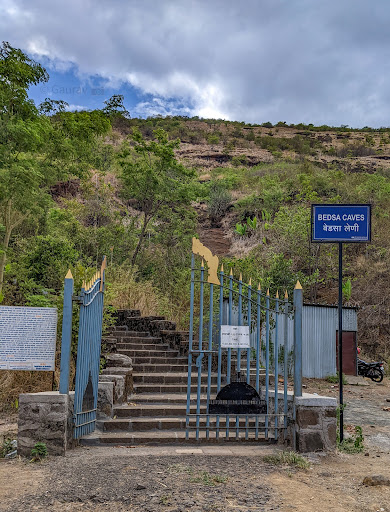
Bedase Caves also known as Bedsa Caves are a group of Buddhist rock-cut monuments situated in Maval taluka, Pune District, Maharashtra, India. The history of the caves can be traced back to the Satavahana period in the 1st century BCE. Bedsa Cave is a small monastic establishment with only fifteen excavations in all. An inscription at this place provides its ancient name as Markuta.
Cave 3 is a Chaitya or Dagoba. The top and front portion have fallen. The circular chamber has a stupa in its centre. This has four holes on its top and these were probably meant to receive the harmika, which was probably made of wood. On the back wall of the circular stupa is an inscription.
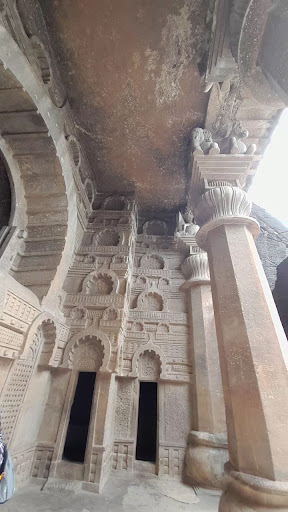
Cave 7 This is the great chatiyaghara, the best and the biggest of the rock excavations at Bedsa. Chaitya hall is remarkably perfect in architectural design. This chaityagruha contains important architectural elements of interest like the stone-screen wall in front of the hall, the verandah and the pillars with pot base animal capital type. The pillars has beautifully carved images of animals and riders. The verandah decorated with excellent in decorative sculptural work. No other chaitya hall of this time has such dwelling cells as seen in the back corners of the verandah with two benched cells. having an inscription in one line over the door. The complete absence of any figure of Buddha is one of the most decisive proofs of the early and Hinayana character of these caves. All the wood-work has disappeared somewhere in 1860.
Cave 11, The vihara at Cave 11 has a rather unusual form, with a main chamber shaped somewhat like a chaitya, with a rectangular plan with a rounded apsidal far end, and a vaulted roof. Quite unique in its kind, having an arched roof and circular at the back like a Chaitya. The vihara has 11 cells, all with benches or beds. Their doors are surmounted by Chaitya-arches. The entrance to the cave is now through a large opening.
Other caves Beyond the Vihara, and under steps that lead up to the left, is a small cell, and in the stream or nala beyond is a small open tank, 3 feet by 7, with sockets cut in the rock. This may be a bathing tank. On the other side of tank there is a small cave, This could be an open rest hall (matapa)...
Read moreI visited the Bedse Caves a week ago. It took 4 hours to get there from Mumbai and about 1 hour from the Lonavala bus depot. From the main point of Bedse village, it is 1 to 1.5 km away. You need to walk nearly 400 steps to reach the caves. There are not many facilities near the caves, so you need to bring your own water, food, and a trash bag. The condition of the stairs was very good.
Dating back to the 1st century BCE, these caves are part of a network of rock-cut caves in the region, including the more famous Karla and Bhaja caves. Though less frequented by tourists, the Bedse Caves offer a peaceful glimpse into Buddhist monastic life and ancient rock-cut architecture.
The Bedse Caves were built during the reign of the Satavahana dynasty, which ruled much of central and southern India. These caves served as viharas (monasteries) and chaityas (prayer halls) for Buddhist monks. The chaitya is notable for its large stupa, an important symbol in Buddhism representing the Buddha’s presence. The stupa is at the end of the prayer hall, which has a semi-circular shape, a common feature in early Buddhist architecture. The hall is supported by intricately carved pillars, demonstrating the skill of ancient Indian craftsmen.
The vihara, or monastery, includes simple living quarters for monks, reflecting their austere lifestyle. The Bedse Caves are decorated with various carvings and sculptures that show the artistic sensibilities of the period. The façade of the chaitya cave features intricate carvings of animals, like elephants and horses, as well as floral motifs. These carvings enhance the caves' aesthetic appeal and offer insights into the symbolic language of ancient Indian art.
One of the most striking features of the Bedse Caves is the presence of inscriptions in Dhamma lipi script, one of the earliest scripts used in India. These inscriptions provide valuable historical information about the patrons who funded the construction of the caves, often wealthy merchants and local rulers who supported the Buddhist monastic community.
Despite their historical and architectural significance, the Bedse Caves are relatively less visited compared to other cave complexes...
Read moreBedse Caves is one of a group of Buddhist rock-cut caves located in Maval taluka at Pune district in Maharashtra. These caves are quite ancient, their history can be traced back to the Satavahana period in the 1st century BC. Other caves in this area are Karla Caves, Patan Buddha and Bhaja Caves. Bedse Cave is about 22 km from Bhaja CavesThere are 400 steps to reach Bedse Caves. It is an easy climb that leads to the caves. Bedse Cave has two main caves. The best cave is the Chaitya which has a large stupa. In fact, it is a prayer hall – which is Cave No. 7 There is a narrow path leading to this cave.There are four big pillars in the front with pairs of animals on the upper side. The side walls are covered with latticework. The second cave is the monastery or vihara which is Cave 11. This cave was used for living, there are many small rooms in this cave.Adjacent to the Vihara cave there is another cave and there is also a small pool of water here, not much information has been found about these two caves. The caves facing towards the east, so it is advisable to visit the caves early in the morning, as the beauty of the carvings is enhanced in the sunlight.Bedse Caves Bedse Caves can be reached from Pune via Kamshet. On reaching Kamshet Chowk, take left. The road leads directly to the village of Bedse where the caves are located. Bedse Cave is about 10 km away from Kamshet. It can be reachable through Paud-Tikona via Peth-Pawannagar.Near the Bedse Caves, the famous tourist places are Lohagarh, Visapur, Tung, and Tikona Forts adjacent to the Pawana Dam. The best time to visit Bedse Caves is during the rainy season as the hills are filled with lush greenery at that time. Along with this, many small waterfalls are also formed which can be enjoyed only during the...
Read more