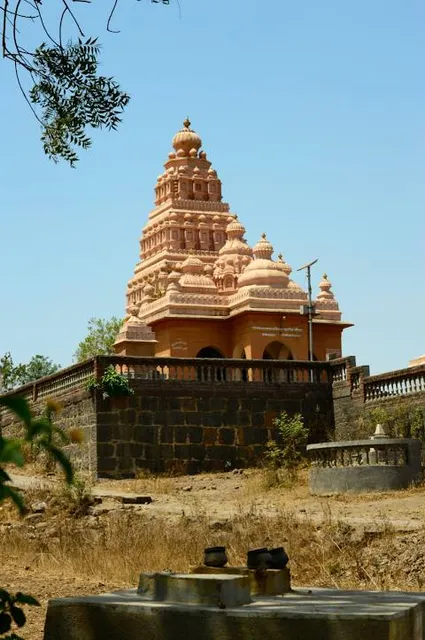
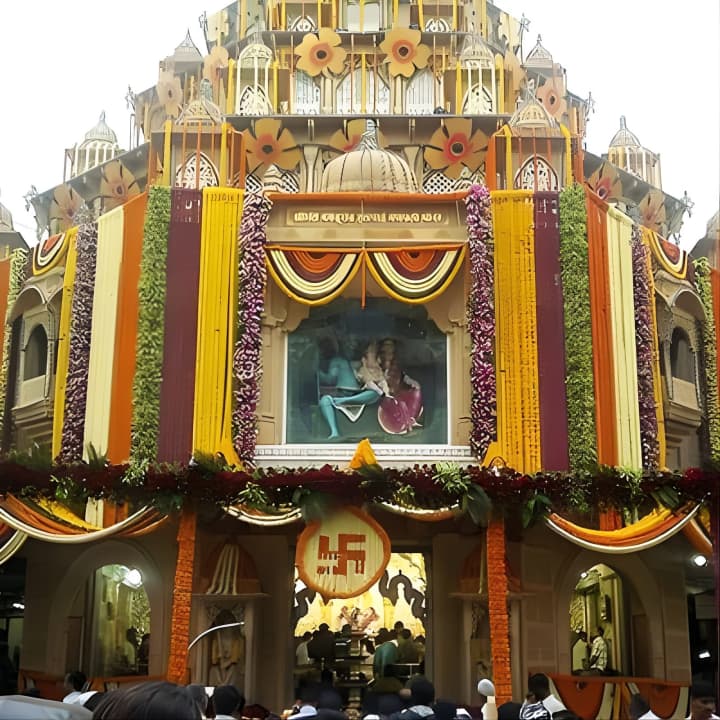
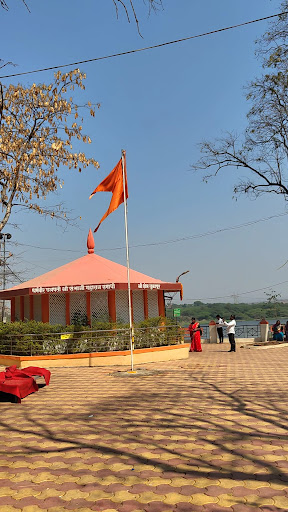
I recently had the chance to visit the Dharmaveer Chhatrapati Shri Sambhaji Maharaj Samadhi in Tulapur, and it was an experience that left me reflecting deeply. Situated on the outskirts of Pune, this sacred site is dedicated to one of the most courageous figures in Maratha history—Shambhu Raje, the son of Chhatrapati Shivaji Maharaj. The place itself carries so much historical weight, and I can honestly say it’s a spot that brings emotion, motivation, and a deep sense of respect.
The journey to the Samadhi is a bit of a ride through winding, single-lane roads, which can feel a bit rushed at times due to trucks and buses. But despite the bumpy ride, once you arrive, all that fades away. The area is peaceful, set at the Triveni Ghat, where the Bhama, Bhima, and Indrayani rivers meet. It’s a spot that holds significant meaning to the locals—this is where, according to belief, Sambhaji Maharaj was brutally tortured and killed after refusing to change his religion, his body reportedly being dismembered and discarded in the river. A few people gathered at the riverbank to perform his last rites, cementing the area’s place in history.
Walking through the entrance gate, you’ll immediately notice that the site is still under construction, which is a bit of a distraction, but the overall majesty of the place more than makes up for it. Inside, you’ll find two statues of Shambhu Raje. One is located within a small temple, where you can pay your respects in a calm, reflective space. The other stands tall outside, visible from the highway, a reminder of his strength and legacy. Both statues are powerful symbols of his life and the sacrifices he made for his people.
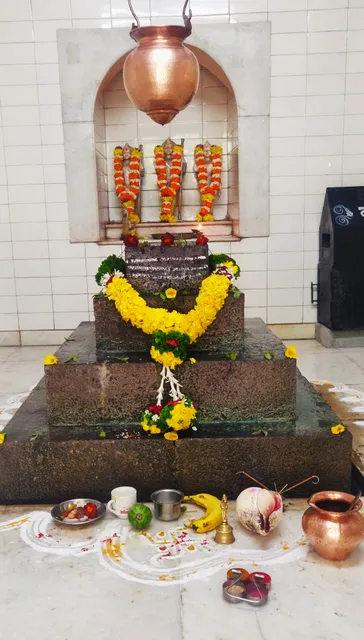
There’s also a cremation spot here that gives the site a more personal, emotional touch. This is where the last rites were performed, and it adds to the reverence the place holds. The whole experience is one of emotion—standing in a place so closely tied to a figure who endured so much for his beliefs and his people.
One of the nice surprises during my visit was seeing the Sangmeshwar Temple nearby, with a primary school attached to it. If you visit in the morning, say around 11:00 AM, you might even catch the school’s prayer session, which brings a sense of community and warmth to the area. There’s also a higher secondary school just 500 meters away, adding a sense of life to this otherwise serene and historic spot.
This entire area is known as Shri Dham Tulapur, and it’s deeply connected to the memory of Chhatrapati Sambhaji Maharaj. As someone with an interest in history, particularly the Maratha Empire, visiting this place felt like stepping into the past. It’s a humbling experience to witness such a significant site, and for anyone who has read about the Maratha rulers or admires their courage, it’s definitely a must-visit.
While the roads might be a bit tricky and the construction work can be a minor distraction, the emotional and historical weight of this place makes it worth the visit. It’s not just a memorial—it’s a place that motivates you to reflect on sacrifice, duty, and the strength of one’s beliefs. If you’re ever in Pune, make sure to visit Tulapur and pay your respects to the legacy of Dharmaveer Chhatrapati Shri...
Read moreGreatest king who has sacrificed his life for Bharat 🙏🙏🙏🙏
Today is the Punya Tithi of the great Hindu king Sambhaji Maharaj. This is the story of his resistance to tyrannical Islamic rule.
After the death of Shivaji in 1680, his 23 year old eldest son Sambhaji ascended the Maratha throne. Aurangzeb was relieved at the news of Shivaji’s death.
By 1681, Aurangzeb reached Burhanpur.
He intended to uproot Maratha race, destroy temples, crush Hindu resistance for good & go back to Delhi as victor within 1 year. The most powerful and richest person in the world came with 5 Lakh Mughal troops, largest army in the world
But Aurangzeb had little idea he'd spend next 27 years of life in Decca, ultimately failing his objective and meeting a sad death.
Aurangzeb also enlisted the services of Sidis and Portuguese who attacked Marathas from the West while Mughals attacked them from the North and East.
Sambhaji was encircled & death of newly formed kingdom of Shivaji, hope of millions of Hindus, seemed imminent.
But Sambhaji decided to fight fire with fire. His small bands dispersed & battled Mughals in all directions. In first year, he invited Subedar Bahadur Khan for war
In 1682, Mughal army at Ramsej (Nasik) was defeated, repulsed by Marathas. This defeat dealt a blow to the Aurangzeb's prestige.
In 1683, Sambhaji attacked Portuguese Goa & successfully captured Ponda fort. He was on his way to annihilate Portuguese traces in India for good.
Just then, the Mughals came in support of Portuguese & attacked Sambhaji from the East.
Heavily outnumbered and encircled, Sambhaji still managed to hold onto his territories & invaded/successfully raided Mughal-held Gujarat in 1685. Even the Mughal base at Aurangabad was not safe
Sambhaji invited other Hindu kings to join his Dharmayuddha.
He wrote “We can't bear the persecution Aurangzeb is inflicting upon Hindus. We'll sacrifice our lives to capture Aurangzeb so we practice our religion without molestation. Muster courage and nothing can stop us”
In his short reign of 9 years, Sambhaji and his troops ruling over a tiny territory of Konkan waged at least 15 battles with the Portuguese and 69 battles with the Mughals.
That they still held on is one of the greatest stories of Hindu resistance
Ultimately, he was betrayed by a traitor & his whereabouts revealed to the Mughals.
In 1689, Mughal troops suddenly fell upon a resting Sambhaji. This came as a shock to him and he was completely ambushed at Sangameshwar along with 25 of his advisors.
Sambhaji Maharaj was dressed as buffoon and paraded. His wife and daughters were captured and enslaved. Aurangzeb offered to spare Sambhaji’s life if 1)He converted to Islam 2)surrendered forts, men and treasures 3)Divulged information of those who secretly sided with him.
“I wont convert to Islam even if Aurangzeb offered his daughter to me,” thundered Sambhaji Maharaj. This was it!
His eyes were plucked out. His tongue was cut. After a fortnight of physical torture, his limbs were hacked into pieces and fed to dogs
Finally, Sambhaji Maharaj was beheaded at Tulapur. His severed head was paraded and put on public...
Read moreAurangzeb ordered the execution of Shree Sambhaji Maharaj and Shree Kavi Kalash. They were tortured and blinded and were executed by beheading on 11 March 1689 at Tulapur on the banks of the Bhima river near Pune.
Some historical accounts mentions that to crush maratha resistance, Aurangzeb ordered torture of highest degree to Shree Sambhaji Maharaj. He was blinded by piercing hot iron rods in his eyes, ears cut, skinned alive and salt was rubbed on open wounds. Wounds were made to bleed continuously. Shree Sambhaji Maharaj survived immense pain, torture and humiliation for 23 days before he was finally killed.
Some other historical accounts mentions Shree Sambhaji Maharaj challenged Aurangzeb in open court and refused to convert to Islam. Later, he was ordered by the Emperor to embrace Islam. He refused and was made to run the gauntlet of the whole Imperial army. Tattered and bleeding he was brought before the Emperor and repeated his refusal. His tongue was torn and again the question was put. He called for writing material and wrote 'Not even if the emperor bribed me with his daughter!" So then he was put to death by torture.
Some accounts state that Sambhaji's body was cut into three pieces. It was stiched by people of Mahar community and then fire cremation was done. That is one of the additional reason why Mahar community is revered by Hindus
Shree Sambhaji Maharaj was a brilliant, innovative, very well cultured and sophisticated person. He was well-versed in a couple of languages besides Marathi. Keshav Pandit was employed for young Sambhaji's education. Keshav Pandit, alias Keshav Bhatta of Shringarpur, was an erudite scholar in the Nitishastra and Sanskrit language and literature. He seemed to have deeper knowledge of the different forms of Sanskrit literature, Hindu jurisprudence and the Puranas. He also seems to have made young Sambhaji familiar with the famous works of different sciences and music written by ancient scholars in the Sanskrit language. Keshav Pandit composed Dandaniti on Maratha jurisprudence and also composed the Sanskrit biography of Sambhaji's brother titled 'Shri Rajaramacharitra' detailing his early campaigns and escape to Jinji.
Shree Sambhaji Maharaj himself composed several books during his lifetime. The most notable is Budhbhushanam written in Marathi and Sanskrit, and three other books, Nayikabhed, Saatsatak, Nakhshikha which are written in Hindi dialect of the time
Shree Sambhaji Maharaj was a righteous King who took keen interest in supporting the cultural and religious activities in the state. He honoured and encouraged learning by granting land, grains and money to scholars.
Cruel Aurangzeb could not have tolerated a thorough educated, sophisticated king who did not embrace his religion, finding him potential threat if left alive. Do remember prince Sambhaji as a kid did escape from Agra with his father Chatrapati Shivaji Maharaj to great embarassment of Aurangzeb.
A must visit place due to immense historical importance. The place is picturesque with two rivers confluence (Indrayani on left and Bhama on right) giving rise to...
Read more