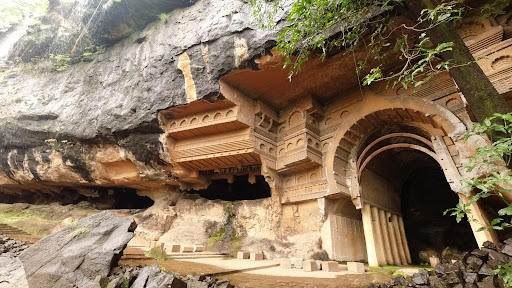
This ancient caves were build by Buddhists monks nearly 2000 years ago, the best part is its hidden in the mountain. U cant spot the caves from the foothills. It is about 20 kilometres from karjat station. The caves are beautifully carved with precision. You can see the chaitya hall is decorated with two wooden arches which are still significant and visible. An earthquake hit the caves is 1900 resulting all the pillars in the caves to fall apart. But they are replaced with new stone pillars recently. It takes about 40 min to reach to the caves for a normal trekker, for a beginner it takes about an hour.
#) the first cave is chaitya hall for prayer it, has a small cavity on the top right which has been sealed now which was a small cave starting from the right side of the chaitya hall.
#) just after the chaitya hall there is a display wall which has a carving of King ASHOKA on a horse which is the most beautiful carved figure in the entire complex, but it has been disfigured. It also has a name inscription of the sponsor.
#) the second cave has cottages for the senior monks beautifully carved. It has approx 16 chambers for the monks to sleep due to the earthquake in 1900 there is a crack developed in the middle of the cave from where the water leakes during monsoon.
#) third cave is for junior monks it has 9 chambers. #) fourth cave is a serious of small chambers used for sleeping and cooking. #) fifth cave has a water cistern not advisable to drink. #) sixth cave is forbidden as it is fenced by wooden logs.
WAYS TO REACH
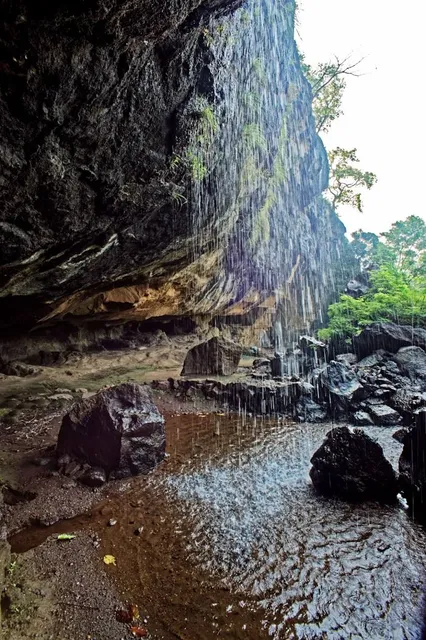
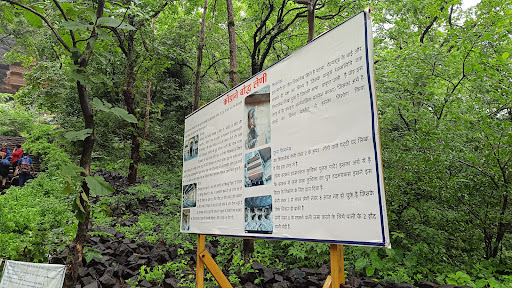
Once u reach the village follow the offroad till the board of Archeological survey of India. Then u can follow the same trail till u teach an open ground where there are fences all over the place, there is the gate in the middle just to get u to the right direction. If u get lost just follow the fences untill u find the gate. There are directions printed in the trees which will guide u. After about 30mins ( depends on your level) u will reach near a waterfall on the left ( visible in the monsoon's). That means u r on the right track. Post 10 min from the waterfall one will reach the ravishing Kondhane caves.
BEST TIME TO VISIT
U can visit whenever u want but the best time of the year is July- September. If you dont like crowd avoid visit in july go for september for isolation.
WHERE TO STAY
u will find ample amount of hotels near karjat for a stay, but i will recommend you to stay in cave as it is safe n adventurous, there are no hotels available near foothill.
WHAT TO CARRY
If you're visiting in the monsoon's water is optional bcoz there are 2 waterfalls in front of the cave which is drinkable from july to october. During other time of the year carry food and water...
Ā Ā Ā Read moreAmazing. I had visited this place in 2008 and revisited after 15 years but not much has changed.
The trek is safe and easy for all age groups, there are a few places where you need to be more cautious, but it's easier compared to a lot of other treks. We had people from all age groups around us from age 6 to age 60 , and they were able to climb up easily.
The climb down is the riskier part. You need to be more cautious and take your time to climb down since some steps are too steep for kids or aged people
People in India still need to learn cleanliness and there is a lot of work to do here
The good part is, you have some good view points or streams or flats every 15 minutes of the climb, so you can take a break and catch up as you want
It's well covered with greens and doesn't have any direct sunlight. But it's still recommended to start early around 9/9:30 am, after 11am a lot of people start coming in
We had nearly 200+ people around us but I think you won't feel it too crowded at any point in time
The waterfall and streams are perfect and easy to climb. The caves are in ruins and restoration process is going on. Hopefully in the next 4-5 years this place can become a nice heritage site
There are many options for stay in the close by from a 500ā¹ per night to 10,000ā¹ . I would strongly recommend staying in Radisson Blu which is only a 10 minute drive
Roads are good except the last 300 meter approach road , but I assume even that will be fixed in a year or two. Most of the road from karjat station to the caves is alongside the ullas river and the whole drive is easy and scenic. You may have a couple of access points to ullas river but better avoid since the water is red or dirty and has a strong current
There are enough food options, tea, coffee, corn, maggi, water, coconut and a few packed dry snacks. So don't carry anything with you except first aid kit, umbrella and a water bottle
Not many insects or mosquitoes. Did not see any snakes or wild life on the climb
There were two guards posted by the government and they were doing a good job
The water is not too cold and you can have an easy access right below the waterfall when you are at the top of the hill and in the caves. Its safe and even a kid can...
Ā Ā Ā Read moreThe Kondana Caves are located in the small village of Kondana, 33 km north of Lonavala and 16 km northwest of Karla Caves. This cave group has 16 Buddhist caves. The caves were excavated in first century B.C. The construction on wooden pattern is notable. One can reach the cave by descending from Rajmachi village.
Cave No1: Chaitya They face north-west, and the first to the south-west is a Chaitya-cave of very considerable dimensions, being 66.5 feet from the line of the front pillars to the extremity of the apse, 26 feet 8 inches wide, and 28 feet 5 inches high to the crown of the arch. The nave in front of the dagoba is 49 feet in length by 14 feet 8 inches, and the dagoba 9.5 feet in diameter, with a capital of more than usual height, the neck representing the relic casket being, as at Bhaja, of double the ordinary height, and representing two coffers, one above the other, carved on the sides with the Buddhist rail pattern. The fillets that covered this are decayed, as is also the whole of the lower part of the dagoba.
Cave No.2: Vihara A little to north-east is No. II., a Vihara, of which the front of the veranda is totally destroyed except the left end. This verandah was 5 feet 8 inches wide and 18 feet long, with the unique number of five octagon pillars and two antae. In the end of this veranda is a raised recess, and under a Chaitya arch is a small dagoba in half relief, apparently the only object of worship when these caves were excavated. Inside, the hall is 23 feet wide by 29 deep, and 8 feet 3 inches high, with 15 pillars arranged about 3 feet apart and from the side and back walls, but none across the front. The upper portions of these pillars are square, but about 1.5 feet from the top they are octagonal: the bases of all are gone, but they also were probably square.
Cave No.3 It is a plain Vihara with nine cells, much ruined, especially in front, but it had probably...
Ā Ā Ā Read more