HTML SitemapExplore
logo
Find Things to DoFind The Best Restaurants

Double Decker Living Root Bridge — Attraction in Meghalaya

Name
Double Decker Living Root Bridge
Description
Nearby attractions
Nearby restaurants
Nearby hotels
Serene Homestay
Nongriat, Meghalaya 793108, India
Related posts
Keywords
Double Decker Living Root Bridge tourism.Double Decker Living Root Bridge hotels.Double Decker Living Root Bridge bed and breakfast. flights to Double Decker Living Root Bridge.Double Decker Living Root Bridge attractions.Double Decker Living Root Bridge restaurants.Double Decker Living Root Bridge travel.Double Decker Living Root Bridge travel guide.Double Decker Living Root Bridge travel blog.Double Decker Living Root Bridge pictures.Double Decker Living Root Bridge photos.Double Decker Living Root Bridge travel tips.Double Decker Living Root Bridge maps.Double Decker Living Root Bridge things to do.
Double Decker Living Root Bridge things to do, attractions, restaurants, events info and trip planning
Double Decker Living Root Bridge
IndiaMeghalayaDouble Decker Living Root Bridge

Basic Info

Double Decker Living Root Bridge

7M2C+GQ5, Nongriat, Meghalaya 793108, India
4.7(2.4K)
Closed
Save
spot

Ratings & Description

Info

Outdoor
Adventure
Family friendly
attractions: , restaurants:
logoLearn more insights from Wanderboat AI.
Phone
+91 76400 03050
Open hoursSee all hours
Wed6 AM - 5 PMClosed

Plan your stay

hotel
Pet-friendly Hotels in Meghalaya
Find a cozy hotel nearby and make it a full experience.
hotel
Affordable Hotels in Meghalaya
Find a cozy hotel nearby and make it a full experience.
hotel
The Coolest Hotels You Haven't Heard Of (Yet)
Find a cozy hotel nearby and make it a full experience.
hotel
Trending Stays Worth the Hype in Meghalaya
Find a cozy hotel nearby and make it a full experience.

Reviews

Get the Appoverlay
Get the AppOne tap to find yournext favorite spots!
Wanderboat LogoWanderboat

Your everyday Al companion for getaway ideas

CompanyAbout Us
InformationAI Trip PlannerSitemap
SocialXInstagramTiktokLinkedin
LegalTerms of ServicePrivacy Policy

Get the app

© 2025 Wanderboat. All rights reserved.
logo

Reviews of Double Decker Living Root Bridge

4.7
(2,440)
avatar
5.0
1y

The Double Decker Living Root Bridge in Nongriat, Meghalaya, is one of the most iconic and unique natural wonders in India. These bridges are made from the roots of rubber trees, trained over generations by the Khasi people to form functional, living bridges that are both sturdy and beautiful. Here’s a detailed review based on common visitor experiences:

Key Highlights:

Natural Engineering Marvel: The Double Decker Living Root Bridge is an exceptional example of bioengineering. Visitors are often amazed by the way the Khasi tribes have used the aerial roots of rubber trees (Ficus elastica) to create these bridges. The fact that the bridge is alive and continues to grow and strengthen over time makes it a unique and eco-friendly alternative to man-made structures.

Adventure Trek to Reach the Bridge: Reaching the Double Decker Bridge involves a challenging trek of around 3,000 steep steps from the village of Tyrna to Nongriat. While the hike can be tough, it is considered rewarding. Visitors often mention that the journey through dense forests, crossing rivers, and encountering smaller living root bridges along the way, makes the adventure thrilling. The trek is part of the overall experience, with scenic views and lush greenery all around.

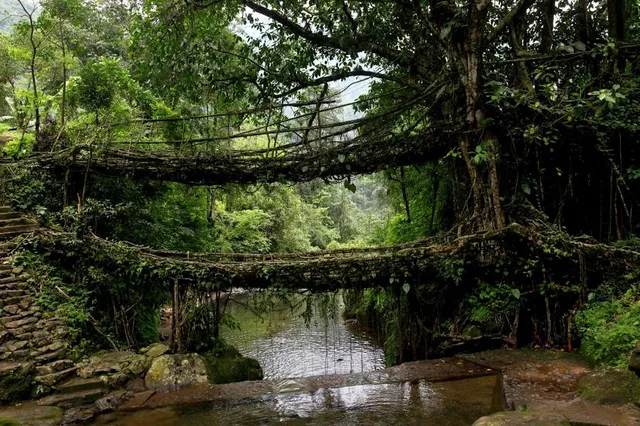
Two Levels of Bridges: The Double Decker Bridge has two layers of living roots, one above the other, making it a unique sight. Visitors can walk on both levels, which are surprisingly sturdy despite their natural origins. The experience of standing on a living structure, suspended above a flowing stream, is often described as surreal and unforgettable.

Scenic and Serene Location: Nongriat village, where the bridge is located, is nestled in the heart of Meghalaya’s rainforest. The area around the bridge is incredibly peaceful, surrounded by waterfalls, rivers, and dense greenery. Many visitors find the setting tranquil and a perfect place to connect with nature. The Rainbow Falls, located an hour’s trek from the bridge, is another highlight for those looking to explore more.

Cultural and Ecological Significance: The bridge not only serves as a tourist attraction but also plays a vital role in the daily lives of the local Khasi people. Visitors appreciate learning about the traditional knowledge and sustainable practices of the local tribes, which have preserved these natural structures for centuries.

Areas for Improvement:

Challenging Trek: The trek to the bridge is physically demanding, especially the steep ascent on the way back. While many visitors enjoy the challenge, it can be tough for those who are not used to trekking or have mobility issues. Some recommend being prepared with proper footwear, plenty of water, and taking breaks along the way.

Limited Facilities: As Nongriat is a remote village, there are limited facilities around the bridge. While there are basic homestays and small shops, some visitors mention the lack of infrastructure such as proper washrooms or food options. It’s advisable to carry snacks and essentials, especially if planning to stay overnight in the village.

Crowds During Peak Season: While the bridge is located in a remote area, it can get crowded during the peak tourist season. Some visitors prefer the quieter months to avoid the crowds and have a more serene experience at the bridge.

Overall Impression:

The Double Decker Living Root Bridge is a must-see for anyone visiting Meghalaya, offering a perfect blend of natural beauty, adventure, and cultural significance. The challenging trek, combined with the unique experience of walking on a living structure, makes it a once-in-a-lifetime experience. While the journey to reach it is tough, the reward of seeing this natural wonder in person is worth the effort. Visitors who stay overnight in Nongriat or explore nearby attractions like the Rainbow Falls often find their time in this remote village to be one of the highlights of their trip...

   Read more

avatar
5.0
9w

We visited the Double Decker Root Bridge in Sept 2025 and the experience was absolutely amazing. The trek is closed on Sunday. Please find the detailed review below:

Location: Use Tyrna Parking location in maps to reach the correct starting point. There is another entry point near Mawlakhiat (near Wansai Homestay) which is tougher and should be avoided. Do not directly put Double Decker Living Root Bridge for navigation as it would show the Mawlakhiat route. Many people make this mistake and struggle to reach the bridge. The Tyrna route is straightforward with well-laid steps.

Guide: A guide is not at all necessary for the Double Decker Bridge. The route is clear and very easy to follow. Local guides may insist it’s mandatory and show you a board, but you can politely refuse. They often rush trekkers and overcharge. While going down, just follow the stairs and the side with the shops. Simple Landmarks: Tyrna Parking: Starting Point Single Decker Junction Take the left for Double Decker Church on your left 1st metal bridge 2nd metal bridge Climb the stairs near Serene Homestay and pass in front of it Double Decker Bridge.

If you still want a guide, the fair price is ₹800 (as of Sep 2025) and don't pay a rupee more than that.

The Trek: The trek is long but not at all difficult, even for a relatively unfit person. Start early, around 6 a.m. It gets dark by 5.30 p.m., so you should be back at the parking area by 5 p.m. It’s best to keep this trek for the last day of your trip, as your legs will need rest afterward.

Things to Carry: Carry at least 2.5 litres of water per person, an umbrella, raincoat, 2 packets of Electral (ORS and not ORSL), comfortable shoes, snacks, a change of clothes and towels for swimming below the bridge. Wear full pants to avoid insect bites.

Stalls on the Way: There are many stalls selling water, snacks and pasta, but everything is quite expensive. A 500 ml bottle costs ₹20. Carry enough water and snacks so you don’t depend on these stalls. Serene Homestay near the bridge is good for lunch or even a night stay.

Trek Duration: We were slow trekkers. It took us 2 hours to go down and 4 hours 45 minutes to climb back. Allocate around 9 hours in total: 2 hours to go down, 5 to come up and 2 hours to relax at the bridge. Take frequent breaks; that’s the secret to finishing comfortably.

Palkhi: While coming back, locals may insist you take a palkhi saying the parking is far. Don’t fall for it. Go at your own pace, rest whenever needed (even after every 20 steps while coming back up) and you’ll finish easily.

Single Decker: If you reach the starting point late, say after 10 a.m., visit only the Single Decker Bridge and return.

Rainbow Falls and Blue Lagoon: If you plan to visit both, stay overnight near the Double Decker Bridge. Even with a 6 a.m. start, returning by 5 p.m. is difficult. For Rainbow Falls, take a guide as the route is confusing. In my opinion, the stream near the Double Decker Bridge itself is serene and perfect for a swim, so Rainbow Falls isn’t essential.

Charges: Parking at Tyrna costs ₹50 for two-wheelers and ₹100 for cars. Entry to the Double Decker Bridge costs ₹50 per person.

Overall: An amazing experience and a must-visit attraction on your Meghalaya trip. Start early from the correct starting point, carry ample snacks and water, be prepared, take enough breaks, go easy and enjoy every bit of...

   Read more
avatar
5.0
47w

You'll absolutely enjoy this trek and takes a whole day to complete it.

You can see this review if you are planning to cover double decker + blue lagoon

There are two ways to complete this trek. 1) Start from the double decker parking around 7-7:30 Am to reach single decker living root bridge(Mostly downhill steps till this point) and takes 45 mins - 1 hour to reach. If you want to cross it you'll need to usually wait for another 30 mins as only one person can cross it at a time and there'll be queue.but it's the longest living root bridge when compared to double decker bridge.

From there it's uphill via nongriat village and takes another 1.5 hours to reach double decker root bridge. Don't spend too much time here. Don't take pictures or sit in the fish pond. My recommendation is to continue with the flow and reach the blue lagoon from here. Blue lagoon is absolutely stunning and 1 more hour uphill trek from there. Spend 1 hour in blue lagoon and while coming back click some pictures on the double decker and finish the trek.

Now finishing is the toughest part😄 and takes around 4-4.5 hours from blue lagoon. Last 1700 steps are really tough and takes a toll on you😪.

So if you start around 7 AM ..you'll finish the blue lagoon by 12 Noon. And can start to come back by 4:30 PM. If you are planning to visit rain bow falls as wells it's going to add 1 more hour to your total trek.

  1. The other way takes 1 day and 1 night of your trip. Dividing the total trek in two halves and taking rest at nongriat village. If you are unable to start early in the morning and planning to start around 11 AM/ 12 Noon..From the parking point ..Visiting single decker and to reach double decker since it's going to take 3 hours. Take rest and enjoy your time in fish pond.It'll be late afternoon and you'll not be able to visit the blue lagoon and finish the trek by the time sun goes out (it'll be totally dark by 5 Pm). So you can stay at nongriat village, there are many home stays available. Double decker bridge is located in this village.Spend your night there and then have some breakfast and go to blue lagoon which takes 1 hour from double decker ..spend some time there and start your return journey. (That takes 4.5 hours from the blue lagoon.)

Things to remember:

1)Entry to double decker is closed on Sunday. Don't plan on Sunday 2) Take a bamboo stick for rent at the base parking. This will support you. 3)If you are planning to finish the trek on the same day, Do start at 7 AM. 4) A guide will not be necessary, ask locals who stay in the villages that come along your route if you are confused at some point. They are very friendly and will guide you (till the blue lagoon , we haven't covered rainbow falls. So No Comments on that) 5) Carry very less luggage/bare minimum not more than a pair of clothes and towel.

Lastly, if for some reason you are not able to finish the uphill trek on your return journey, there are palkis available to carry you. They charge around 8k - 10k to carry you back. BUT Even if you feel so and think that you can't finish it, go for it Take breaks on your return journey. Refresh and energize yourself with Red Tea☕ (chai is 🫶) + some...

   Read more
Page 1 of 7
Previous
Next

Posts

Rustic RoutesRustic Routes
The Double Decker Living Root Bridge in Nongriat, Meghalaya, is one of the most iconic and unique natural wonders in India. These bridges are made from the roots of rubber trees, trained over generations by the Khasi people to form functional, living bridges that are both sturdy and beautiful. Here’s a detailed review based on common visitor experiences: Key Highlights: 1. Natural Engineering Marvel: The Double Decker Living Root Bridge is an exceptional example of bioengineering. Visitors are often amazed by the way the Khasi tribes have used the aerial roots of rubber trees (Ficus elastica) to create these bridges. The fact that the bridge is alive and continues to grow and strengthen over time makes it a unique and eco-friendly alternative to man-made structures. 2. Adventure Trek to Reach the Bridge: Reaching the Double Decker Bridge involves a challenging trek of around 3,000 steep steps from the village of Tyrna to Nongriat. While the hike can be tough, it is considered rewarding. Visitors often mention that the journey through dense forests, crossing rivers, and encountering smaller living root bridges along the way, makes the adventure thrilling. The trek is part of the overall experience, with scenic views and lush greenery all around. 3. Two Levels of Bridges: The Double Decker Bridge has two layers of living roots, one above the other, making it a unique sight. Visitors can walk on both levels, which are surprisingly sturdy despite their natural origins. The experience of standing on a living structure, suspended above a flowing stream, is often described as surreal and unforgettable. 4. Scenic and Serene Location: Nongriat village, where the bridge is located, is nestled in the heart of Meghalaya’s rainforest. The area around the bridge is incredibly peaceful, surrounded by waterfalls, rivers, and dense greenery. Many visitors find the setting tranquil and a perfect place to connect with nature. The Rainbow Falls, located an hour’s trek from the bridge, is another highlight for those looking to explore more. 5. Cultural and Ecological Significance: The bridge not only serves as a tourist attraction but also plays a vital role in the daily lives of the local Khasi people. Visitors appreciate learning about the traditional knowledge and sustainable practices of the local tribes, which have preserved these natural structures for centuries. Areas for Improvement: Challenging Trek: The trek to the bridge is physically demanding, especially the steep ascent on the way back. While many visitors enjoy the challenge, it can be tough for those who are not used to trekking or have mobility issues. Some recommend being prepared with proper footwear, plenty of water, and taking breaks along the way. Limited Facilities: As Nongriat is a remote village, there are limited facilities around the bridge. While there are basic homestays and small shops, some visitors mention the lack of infrastructure such as proper washrooms or food options. It’s advisable to carry snacks and essentials, especially if planning to stay overnight in the village. Crowds During Peak Season: While the bridge is located in a remote area, it can get crowded during the peak tourist season. Some visitors prefer the quieter months to avoid the crowds and have a more serene experience at the bridge. Overall Impression: The Double Decker Living Root Bridge is a must-see for anyone visiting Meghalaya, offering a perfect blend of natural beauty, adventure, and cultural significance. The challenging trek, combined with the unique experience of walking on a living structure, makes it a once-in-a-lifetime experience. While the journey to reach it is tough, the reward of seeing this natural wonder in person is worth the effort. Visitors who stay overnight in Nongriat or explore nearby attractions like the Rainbow Falls often find their time in this remote village to be one of the highlights of their trip to Meghalaya.
akhil nalumachuakhil nalumachu
You'll absolutely enjoy this trek and takes a whole day to complete it. You can see this review if you are planning to cover double decker + blue lagoon There are two ways to complete this trek. 1) Start from the double decker parking around 7-7:30 Am to reach single decker living root bridge(Mostly downhill steps till this point) and takes 45 mins - 1 hour to reach. If you want to cross it you'll need to usually wait for another 30 mins as only one person can cross it at a time and there'll be queue.but it's the longest living root bridge when compared to double decker bridge. From there it's uphill via nongriat village and takes another 1.5 hours to reach double decker root bridge. Don't spend too much time here. Don't take pictures or sit in the fish pond. My recommendation is to continue with the flow and reach the blue lagoon from here. Blue lagoon is absolutely stunning and 1 more hour uphill trek from there. Spend 1 hour in blue lagoon and while coming back click some pictures on the double decker and finish the trek. Now finishing is the toughest part😄 and takes around 4-4.5 hours from blue lagoon. Last 1700 steps are really tough and takes a toll on you😪. So if you start around 7 AM ..you'll finish the blue lagoon by 12 Noon. And can start to come back by 4:30 PM. If you are planning to visit rain bow falls as wells it's going to add 1 more hour to your total trek. 2) The other way takes 1 day and 1 night of your trip. Dividing the total trek in two halves and taking rest at nongriat village. If you are unable to start early in the morning and planning to start around 11 AM/ 12 Noon..From the parking point ..Visiting single decker and to reach double decker since it's going to take 3 hours. Take rest and enjoy your time in fish pond.It'll be late afternoon and you'll not be able to visit the blue lagoon and finish the trek by the time sun goes out (it'll be totally dark by 5 Pm). So you can stay at nongriat village, there are many home stays available. Double decker bridge is located in this village.Spend your night there and then have some breakfast and go to blue lagoon which takes 1 hour from double decker ..spend some time there and start your return journey. (That takes 4.5 hours from the blue lagoon.) Things to remember: 1)Entry to double decker is closed on Sunday. Don't plan on Sunday 2) Take a bamboo stick for rent at the base parking. This will support you. 3)If you are planning to finish the trek on the same day, Do start at 7 AM. 4) A guide will not be necessary, ask locals who stay in the villages that come along your route if you are confused at some point. They are very friendly and will guide you (till the blue lagoon , we haven't covered rainbow falls. So No Comments on that) 5) Carry very less luggage/bare minimum not more than a pair of clothes and towel. Lastly, if for some reason you are not able to finish the uphill trek on your return journey, there are palkis available to carry you. They charge around 8k - 10k to carry you back. BUT Even if you feel so and think that you can't finish it, go for it Take breaks on your return journey. Refresh and energize yourself with Red Tea☕ (chai is 🫶) + some music. Cheers✌️
Remya Usha RajanRemya Usha Rajan
Trekking to double root bridge was truly an achievement for me. I must say that i am not a sports person or a physically fit person. And i had the thought that i could never do it. But i really wanted to see by myself this wonder of nature. I visited Cherrapunjee in the month of june(june 1) with my cousins and the weather was good. It rained in between. The beauty of the nature always create an awe feeling in me. I just hope that this place remains the same without people polluting it. We used google map as our guide. We were visiting for the first time and we had absolutely no idea about this place. We tried to talk to locals but that was of no use because they only knew their language. I don't know exactly the name of that place but it looks quite deserted and we parked our car there. We started moving and down the road there were houses and children were playing. On the way we met some workers. One of them could speak english and hindi. He told us to take a guide. And we got a local boy as our guide who couldn't talk to us. Lol. We reached the brink where the steps commence and all i could see was the extremely steep steps on the mountain and the forest ahead. My legs were shaking as i was scared of heights. When we climbed down the first set of steps i was thinking to go back. But my cousins were energetic and  enthusiastic which made me to give it a try. Trekking down these steps which were very small was a real challenge to me. (I wondered how they could construct these steep steps) But i wanted to do it anyways. Even though i was worried, i could enjoy  the beauty of nature. We started around 12:30pm. Half way through we reached a clean and quaint village. There were houses which sold carbonated drinks, water and maggi and also they offered home stay. As we went deep there were no more constructed steps, only rocks. We climbed them carefully as they were slippery. Inside the forest i saw jackfruit trees, orange tree and many others. Finally we reached the double root bridge almost by 3 by taking breaks in between. There was a waterfall and the water was fresh and cold. The place was very calm and alive with chirping of birds and the burbling of the river. The place is not a common tourist spot. I found only few people there. We started to climb back. There was mosquitoes and flies everywhere at this time.I took break many times. I saw a mountain squirrel too. We didn't carry anything to eat. Lack of energy made it more difficult. Filling myself with a bottle of sprite gave me ample energy to climb back and i was hoping to reach the brink soon. By the time we reached it was 6:30pm. Trekking almost 3500 steps up and down was not an easy task for me. But i did it and I was proud of myself. Our guide was a pleasant boy who responded to everything with a smile. He was shy to talk. We thanked him and bid good bye. The place was getting dark and still and silent. We were in a hurry to move out. Things i learned from this trip: *Petrol pumps are hard to find in cherrapunjee. So keep fuel in reserve. *Download the map. *While trekking its better to carry a backpack( with water and some energy bars.).
See more posts
See more posts
hotel
Find your stay

Pet-friendly Hotels in Meghalaya

Find a cozy hotel nearby and make it a full experience.

The Double Decker Living Root Bridge in Nongriat, Meghalaya, is one of the most iconic and unique natural wonders in India. These bridges are made from the roots of rubber trees, trained over generations by the Khasi people to form functional, living bridges that are both sturdy and beautiful. Here’s a detailed review based on common visitor experiences: Key Highlights: 1. Natural Engineering Marvel: The Double Decker Living Root Bridge is an exceptional example of bioengineering. Visitors are often amazed by the way the Khasi tribes have used the aerial roots of rubber trees (Ficus elastica) to create these bridges. The fact that the bridge is alive and continues to grow and strengthen over time makes it a unique and eco-friendly alternative to man-made structures. 2. Adventure Trek to Reach the Bridge: Reaching the Double Decker Bridge involves a challenging trek of around 3,000 steep steps from the village of Tyrna to Nongriat. While the hike can be tough, it is considered rewarding. Visitors often mention that the journey through dense forests, crossing rivers, and encountering smaller living root bridges along the way, makes the adventure thrilling. The trek is part of the overall experience, with scenic views and lush greenery all around. 3. Two Levels of Bridges: The Double Decker Bridge has two layers of living roots, one above the other, making it a unique sight. Visitors can walk on both levels, which are surprisingly sturdy despite their natural origins. The experience of standing on a living structure, suspended above a flowing stream, is often described as surreal and unforgettable. 4. Scenic and Serene Location: Nongriat village, where the bridge is located, is nestled in the heart of Meghalaya’s rainforest. The area around the bridge is incredibly peaceful, surrounded by waterfalls, rivers, and dense greenery. Many visitors find the setting tranquil and a perfect place to connect with nature. The Rainbow Falls, located an hour’s trek from the bridge, is another highlight for those looking to explore more. 5. Cultural and Ecological Significance: The bridge not only serves as a tourist attraction but also plays a vital role in the daily lives of the local Khasi people. Visitors appreciate learning about the traditional knowledge and sustainable practices of the local tribes, which have preserved these natural structures for centuries. Areas for Improvement: Challenging Trek: The trek to the bridge is physically demanding, especially the steep ascent on the way back. While many visitors enjoy the challenge, it can be tough for those who are not used to trekking or have mobility issues. Some recommend being prepared with proper footwear, plenty of water, and taking breaks along the way. Limited Facilities: As Nongriat is a remote village, there are limited facilities around the bridge. While there are basic homestays and small shops, some visitors mention the lack of infrastructure such as proper washrooms or food options. It’s advisable to carry snacks and essentials, especially if planning to stay overnight in the village. Crowds During Peak Season: While the bridge is located in a remote area, it can get crowded during the peak tourist season. Some visitors prefer the quieter months to avoid the crowds and have a more serene experience at the bridge. Overall Impression: The Double Decker Living Root Bridge is a must-see for anyone visiting Meghalaya, offering a perfect blend of natural beauty, adventure, and cultural significance. The challenging trek, combined with the unique experience of walking on a living structure, makes it a once-in-a-lifetime experience. While the journey to reach it is tough, the reward of seeing this natural wonder in person is worth the effort. Visitors who stay overnight in Nongriat or explore nearby attractions like the Rainbow Falls often find their time in this remote village to be one of the highlights of their trip to Meghalaya.
Rustic Routes

Rustic Routes

hotel
Find your stay

Affordable Hotels in Meghalaya

Find a cozy hotel nearby and make it a full experience.

Get the Appoverlay
Get the AppOne tap to find yournext favorite spots!
You'll absolutely enjoy this trek and takes a whole day to complete it. You can see this review if you are planning to cover double decker + blue lagoon There are two ways to complete this trek. 1) Start from the double decker parking around 7-7:30 Am to reach single decker living root bridge(Mostly downhill steps till this point) and takes 45 mins - 1 hour to reach. If you want to cross it you'll need to usually wait for another 30 mins as only one person can cross it at a time and there'll be queue.but it's the longest living root bridge when compared to double decker bridge. From there it's uphill via nongriat village and takes another 1.5 hours to reach double decker root bridge. Don't spend too much time here. Don't take pictures or sit in the fish pond. My recommendation is to continue with the flow and reach the blue lagoon from here. Blue lagoon is absolutely stunning and 1 more hour uphill trek from there. Spend 1 hour in blue lagoon and while coming back click some pictures on the double decker and finish the trek. Now finishing is the toughest part😄 and takes around 4-4.5 hours from blue lagoon. Last 1700 steps are really tough and takes a toll on you😪. So if you start around 7 AM ..you'll finish the blue lagoon by 12 Noon. And can start to come back by 4:30 PM. If you are planning to visit rain bow falls as wells it's going to add 1 more hour to your total trek. 2) The other way takes 1 day and 1 night of your trip. Dividing the total trek in two halves and taking rest at nongriat village. If you are unable to start early in the morning and planning to start around 11 AM/ 12 Noon..From the parking point ..Visiting single decker and to reach double decker since it's going to take 3 hours. Take rest and enjoy your time in fish pond.It'll be late afternoon and you'll not be able to visit the blue lagoon and finish the trek by the time sun goes out (it'll be totally dark by 5 Pm). So you can stay at nongriat village, there are many home stays available. Double decker bridge is located in this village.Spend your night there and then have some breakfast and go to blue lagoon which takes 1 hour from double decker ..spend some time there and start your return journey. (That takes 4.5 hours from the blue lagoon.) Things to remember: 1)Entry to double decker is closed on Sunday. Don't plan on Sunday 2) Take a bamboo stick for rent at the base parking. This will support you. 3)If you are planning to finish the trek on the same day, Do start at 7 AM. 4) A guide will not be necessary, ask locals who stay in the villages that come along your route if you are confused at some point. They are very friendly and will guide you (till the blue lagoon , we haven't covered rainbow falls. So No Comments on that) 5) Carry very less luggage/bare minimum not more than a pair of clothes and towel. Lastly, if for some reason you are not able to finish the uphill trek on your return journey, there are palkis available to carry you. They charge around 8k - 10k to carry you back. BUT Even if you feel so and think that you can't finish it, go for it Take breaks on your return journey. Refresh and energize yourself with Red Tea☕ (chai is 🫶) + some music. Cheers✌️
akhil nalumachu

akhil nalumachu

hotel
Find your stay

The Coolest Hotels You Haven't Heard Of (Yet)

Find a cozy hotel nearby and make it a full experience.

hotel
Find your stay

Trending Stays Worth the Hype in Meghalaya

Find a cozy hotel nearby and make it a full experience.

Trekking to double root bridge was truly an achievement for me. I must say that i am not a sports person or a physically fit person. And i had the thought that i could never do it. But i really wanted to see by myself this wonder of nature. I visited Cherrapunjee in the month of june(june 1) with my cousins and the weather was good. It rained in between. The beauty of the nature always create an awe feeling in me. I just hope that this place remains the same without people polluting it. We used google map as our guide. We were visiting for the first time and we had absolutely no idea about this place. We tried to talk to locals but that was of no use because they only knew their language. I don't know exactly the name of that place but it looks quite deserted and we parked our car there. We started moving and down the road there were houses and children were playing. On the way we met some workers. One of them could speak english and hindi. He told us to take a guide. And we got a local boy as our guide who couldn't talk to us. Lol. We reached the brink where the steps commence and all i could see was the extremely steep steps on the mountain and the forest ahead. My legs were shaking as i was scared of heights. When we climbed down the first set of steps i was thinking to go back. But my cousins were energetic and  enthusiastic which made me to give it a try. Trekking down these steps which were very small was a real challenge to me. (I wondered how they could construct these steep steps) But i wanted to do it anyways. Even though i was worried, i could enjoy  the beauty of nature. We started around 12:30pm. Half way through we reached a clean and quaint village. There were houses which sold carbonated drinks, water and maggi and also they offered home stay. As we went deep there were no more constructed steps, only rocks. We climbed them carefully as they were slippery. Inside the forest i saw jackfruit trees, orange tree and many others. Finally we reached the double root bridge almost by 3 by taking breaks in between. There was a waterfall and the water was fresh and cold. The place was very calm and alive with chirping of birds and the burbling of the river. The place is not a common tourist spot. I found only few people there. We started to climb back. There was mosquitoes and flies everywhere at this time.I took break many times. I saw a mountain squirrel too. We didn't carry anything to eat. Lack of energy made it more difficult. Filling myself with a bottle of sprite gave me ample energy to climb back and i was hoping to reach the brink soon. By the time we reached it was 6:30pm. Trekking almost 3500 steps up and down was not an easy task for me. But i did it and I was proud of myself. Our guide was a pleasant boy who responded to everything with a smile. He was shy to talk. We thanked him and bid good bye. The place was getting dark and still and silent. We were in a hurry to move out. Things i learned from this trip: *Petrol pumps are hard to find in cherrapunjee. So keep fuel in reserve. *Download the map. *While trekking its better to carry a backpack( with water and some energy bars.).
Remya Usha Rajan

Remya Usha Rajan

See more posts
See more posts