World Heritage Week
The Monument Trail - Sultangarhi Tomb - Delhi
#3
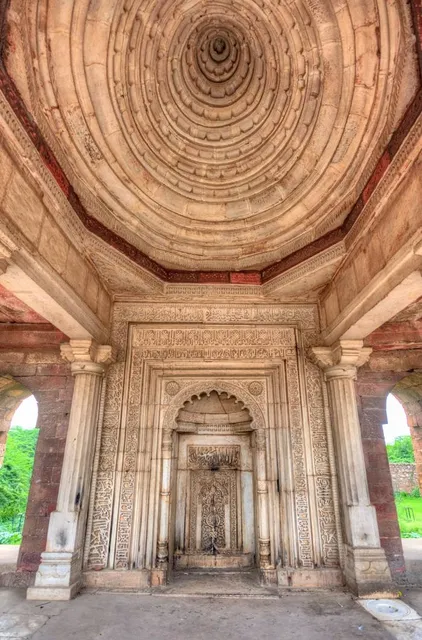
As I admired the white marble mihrab of the mosque, Mukesh just walked past me. I stopped him and before I could strike a conversation the loud noise of descending aeroplane interrupted. It is amusing to know that the hallmark of modernity, Delhi's airport which is just a few miles away, is built in one of the oldest inhabited parts of the city.
At the crack of dawn, when most of the city dwellers are still in their cosy beds, Mukesh arrives at the monument. He reaches here even before the 1st-morning walker wakes up. He lives in Mahilpalpur which though not very far away, is not that close to for anyone to reach a dead prince's grave, before dawn, every day for 8 years. It all started when someone in his family was seriously ill and doctors too had lost hope. He was then asked by someone to visit Peer Baba and light a lamp. In an event when there is endless darkness of lost hope, the flicker of the little oil lamp seems like a sun. He came. He prayed. The one who was ill recovered and is living a healthy life. And Mukesh whose real name is Meharsingh has been arriving every morning ever since, without any miss.
Over time, he has assumed the role of a guardian to the tomb, and makes sure no one vandalizes it, no one creates trouble here and no one litters. He also helps the guard and ticket man to identify the locals so they can enter the premises without the tickets. The guard who sometimes double up as Ticket clerk says hardly anyone come here from outside. This place does not see tourists. And most of the time only one or two tickets are sold. he also confirms since locals revered the saint, they are not asked to pay to enter the shrine.
Despite its old age, the mausoleum does not look fragile. it is well kept with minimum structural changes - so far so that it does not even have an electricity connection, which is quite unusual for places that are live and visited by masses.
To my understanding, the shrine is in good shape due to it's being connected with the people. Had it only been the responsibility of ASI, it would have been in ruinous condition like many that are lying waste across the city.
Mukesh says many people have approached the village elders asking them to have a light bulb installed in the crypt and to get a ventilation shaft bored in the wall, to the request the elders have simple response that it's baba's house who has been living in dark and you are his guest, and guest does not have a right to make alteration in his host's house.
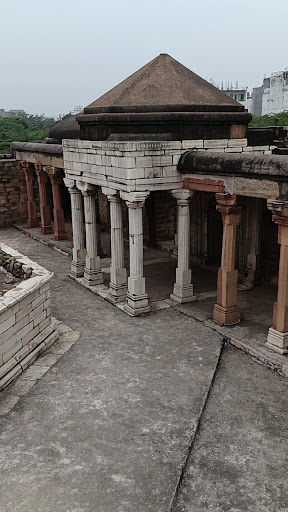
As the morning sun spread its golden hue, the white columns of the central arch glittered like gold. The number of people walking past the shrine have increased. As the distance sound of collective honking gave an idea that the traffic is increasing on the road and it was high time for me to leave before it becomes difficult to drive the still long distance to home. I thanked Mukesh promising him to meet him again, and for the last time I glanced at the tomb, some pigeons fluttered their wings and took a flight and came back to peck on the grain that was spread for their feast.
~Tokeer Ahmed Khan
#Solowalk #solotravel #delhi #history #heritage...
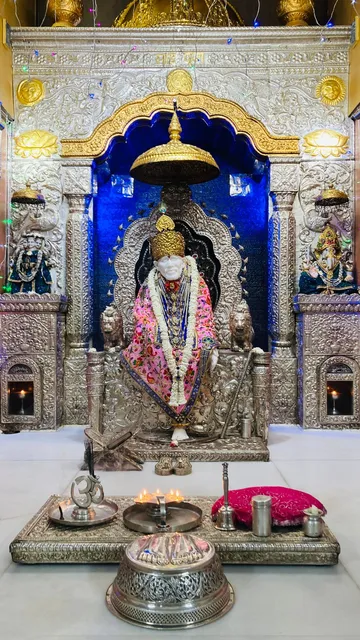
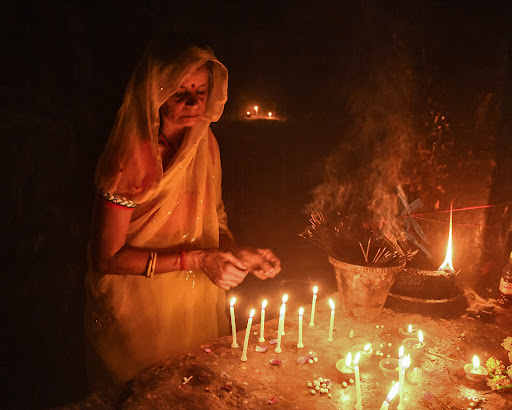
Read moreOnce someone asked a Seeker ,”Is it possible that the sun would darken for you if you were to see it without the teacher?..The able seeker responded ,”The Sun would remain the same ,but the presence of the Teacher ,twelve sun would shine for me.”...such is the power of a good teacher and good company .I recalled this legend today when I reached at the Dargah of Prince Nasiruddin Mahmood Rahmatullah Alaih ,whose Dargah is situated in Sultangarhi in Delhi.This pious prince who was very able leader and in line for throne lost his life in some battle in Lakhnauti in 1229 .He used to spend a lot of time in the company of learned men,Sufis and pious people .Due to the effect this pious company he was also on the path of higher consciousness even though being the eldest son of Sultan Iltutmish he was in line for throne after his father .His Tomb is a beautiful monument and is said to be one of the earliest Tomb Mosque example where white stone was used.Today even after around eight centuries of his departure from this perishable world,people throng to his shrine to seek Divine blessings.Incense sticks are burnt,lamps are lit and sweets are distributed to all and sundry .Some people even offer milk ,jaggery and other interesting Tabarruk .Every Thursday this place comes to life with people from all religion and states visit this blessed place ..I dont know of any other prince whose shrine is so venerated .The effect of good company is so visible at Dargah of Hazrat Nasiruddin Mehmood Sahab . Inside the underground cave ,this women was busy light candles as a mark of respect ..Faith brings light .May everyone’s life be filled with light of faith...
Read moreSultan Gari was the first Islamic mausoleum (mausoleum) built in 1231 AD for Prince Naseeruddin Mahmud, the eldest son of Iltumish, in the "funeral landscape of Delhi" in the Nangal Dewat forest, near Nangal Dewat Vasant Kunj. Iltumish was the third Sultan of the Ghulam dynasty who ruled Delhi from 1210 to 1236 AD. The area where the Gari (meaning: cave) tomb is located was part of medieval Delhi known as the Ghulam dynasty, which ruled during the period from 1206 AD to 1290 AD, during the Gurjara-Pratihara era (700 to 700 BCE) already existed as a Hindu temple. 1100 AD) This area is now part of the Qutub Complex. The Ghulam dynasty was the precursor to the early Delhi Sultanate which ruled from 1216 AD to 1516 AD. This dynastic city was followed by the construction of five other cities of Delhi, which were ruled by different dynastic rulers of the Delhi Sultanate, namely, the Khilji dynasty (1290–1320), the Tughlaq dynasty (1320–1413 BC), the Sayyid dynasty (1414– It was the rule of. 51 CE), and the Lodi dynasty (1451–1526 CE). This was followed by the rule of the Mughal Empire which lasted from 1526 AD to 1857 AD.
The crypt or tomb is set in a ghari (cave) with a winding steep staircase made of stone, and supported by pillars and a floor. The cave is covered with stone slabs with an unusual octagonal roof. The exterior of the mausoleum structure, built of Delhi sandstone with marble decoration, features a walled area with turrets (minarets) at the corners, giving it the appearance of a fortress in the aesthetic Persian and Oriental architecture. No other tombs have been identified...
Read more