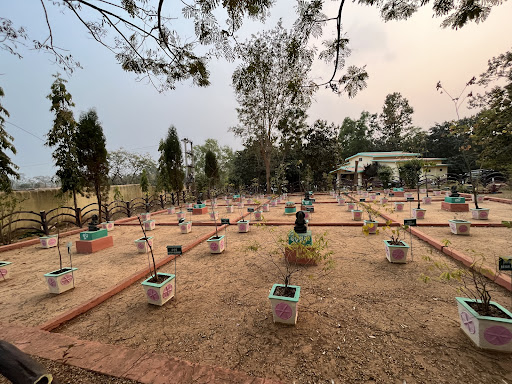
THE crocodile breeding centre at Ramatirtha in Mayurbhanj district is reeling under the State Government’s apathy.The centre, one of the oldest in the State, has been a victim of neglect since long. While the Forest department is claiming to have spent crores of rupees for protection of forests and wildlife, it has turned a blind eye to the plight of the breeding centre.
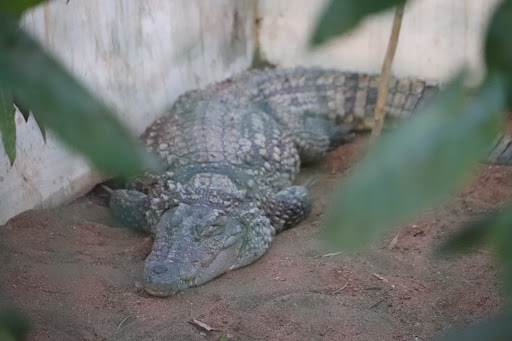
Due to the Government’s lack of interest and financial support, crocodile population at the centre is on the decline. Moreover, lack of funds has also affected infrastructure development in the centre which needs an immediate facelift to attract visitors. While there is not enough food for the reptiles, inadequate infrastructure has led to decline in tourist inflow to the centre which also boasts of a crocodile park. In 2012, the centre housed 11 crocodiles of which four were adults. However, three females succumbed due to old age while a male died due to injuries sustained in an attack by a female crocodile. Currently, it is home to eight crocodiles comprising four males and as many females. The centre is being managed by a caretaker and two Forest Rangers.
As per reports, after a survey in the 1970s revealed a sharp decline in the number of crocodiles in Similipal forest, the State Government decided to set up a centre at Ramatirtha for captive breeding of crocodiles. In 1979, the centre started functioning and 24 crocodiles consisting of both males and females were brought from Madras.
The objective of the breeding centre was to rebuild the viable population of crocodiles of different breeds and supply the reptiles to other States for further breeding. In 1984, the first crocodile breeding was accomplished at the centre and since then, 1,500 eggs have been hatched. So far, 700 young crocodiles have been released to rivers of West Deo, East Deo, Khairi, Budhabalanga and Polpala.
Generally, the crocodiles lay eggs in March. At one go, the reptiles can lay up to 40 eggs. The last census, which was carried out in 2003, revealed that more than 150 Muggers were shifted to different river systems under the Similipal biosphere.
Rama Kanta Majhi, one of the Forest Rangers who looks after the centre, said a facelift is the need of the hour. If the centre is revamped, it will help draw more tourists to the centre, he said. ‘’Our main problem is fund shortage. We have requested the Forest department to provide more aid to run the centre effectively,’’...
Read moreRamatirtha Crocodile Breeding Centre is located inside the Rama tirtha Nature Camp at Jashipur in Mayur bhan) district. Ramatirtha Crocodile project was the one & only project dedicated to the conservation of Mugger crocodiles ( Crocodiles palustris) in Odisha started in the year 1984 with an attempt to conserve the population of Muggar crocodiles (Crocodies palustris) through successful breeding and releasing it into the wild. Now the breeding programme has apparently stopped and resently 6 nos. of adult crocodiles are being kept in captivity. This centre is now managed by Ecotourism range of Similipal North Wildlife Division, Jashipur. HISTORY In accordance with the national project on crocodile conservation, a scheme based on the principle of 'Grow and Release' under captive breeding of crocodile was started at Ramatirtha in 1979. The objectives were to rebuild viable population of Mugger in Similipal River system and to conduct management-oriented research. In 1979, the centre started functioning and 24 crocodiles consisting of both Males and Females were brought From Madras. In 1984, first crocodile breeding was accomplished at the Centre and since then at least 1500 eggs have been hatched and 600 crocodiles have been successfuly released into Wild in different river system of Similipal so far. MUGGER CROCODILES The mugger crocodiles ( Crocodiles palustris) also called as Marsh crocodile, Broad-snouted crocodile and Mugger, is a crocodile native to frehwater habitats from southern Iran to the indian subcontinent. It is extinct in Bhutan and Myanmar and has been listed as Vulnerable on the IUCN Red List since 1982. It is a medium-sized crocodile that inhabits lakes, river, marshes and artificial ponds. Both young and adult mugger crocodiles dig burrows where they retreat when temperature drop below 5° C (41° F) or exceeds 38°C (100° F). Females dig holes in the sand as nesting sites and lay up to 46 eggs during the dry season. Sex of hatchlings depends on temperature during incubation. It preys on fish, reptiles, birds and mammals. Young feed on insects. It is one of three crocodilians in India, apart from Saltwater crocodile (C. porosus) and Charial (Gavialis gangeticus). Odisha is one of the blessed State having 3 types of crocodiles (Gharial. Salt water crocodiles- Baula, Mugger)...
Read moreRamatirtha is located nearby Jashipur town of Mayurbhanj district of Odisha. Ramatirtha is located beneath the feet of Similipal National Park. It is the only Crocodile Rearing Center of Mayurbhanj district which attracts lots of tourist to visit. Mayurbhanj district is fully sheltered with vast natural resources and exquisites, that attracts lacs of tourist every year. In 1979, govt of Odisha first planned to nurture crocodiles in the rivers of Similipal forest; for which 115 crocodile babies were brought from Tamilnadu Crocodile Bank. In between 1984 to 1987, 1517 nos. of crocodile eggs has been collected. On 1988, 12 baby crocodiles were brought from Nandankanan Zoological Park, Bhubaneswar. The crocodiles kept at Ramatirtha of Mayurbhanj are very exceptional kind; which called as 'Mugger Crocodiles' (Crocodylus palustris). 'Mugger' is the corrupted word, derived from sanskrit word 'Makara' which means...
Read more