
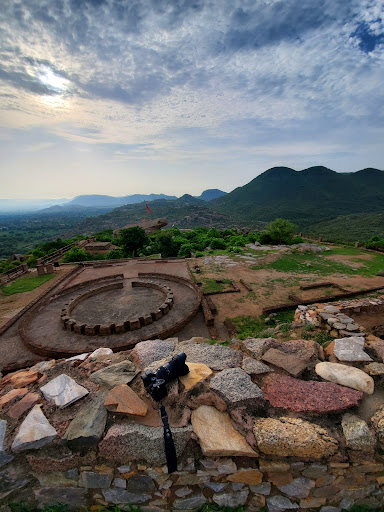
Bairat Temple is a freestanding Buddhist temple, a Chaityagriha, located about a mile southwest of the city Viratnagar, Rajasthan, India, on a hill locally called "Bijak-ki-Pahari". The temple is of a circular type, formed of a central stupa surrounded by a circular colonnade and an enclosing wall.
 Learn more insights from Wanderboat AI.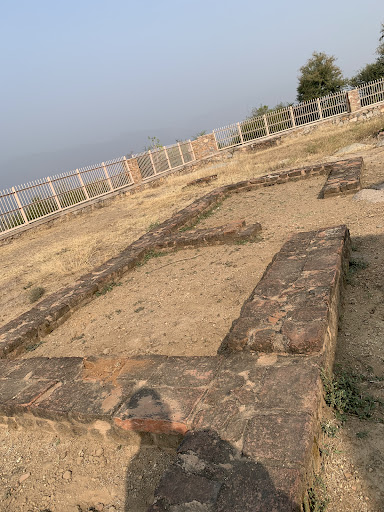

Bairat's history goes back to the time of the Mahabharata and Mahabhashya, when it was known as "Viratnagar". Viratnagar was the capital of the ancient Mahajanapada(kingdom) of Machcha or Matsya. The kingdom came under the control of the neighboring Chedi Kingdom in the 5th century.citation needed]
Bairat was a part of the Mauryan Empire. The ruins of the Bijak-ki-pahadi, a BuddhistChaitya (chapel) from the 3rd century BCE located in Bairat, are the oldest free-standing Buddhist structures in India.[1]The town is also home to ruins of a Buddhist monastery,[2] a wood and timber shrine, and rock-cut edict from Emperor Ashoka; these date from the Mauryan period. However, Akhnoor, a town in the state of Jammu and Kashmir is also considered by many as the ancient Virat Nagar.[3
The town has a number of Mughalstructures, including a Chhatri (cenotaph) with some of the earliest surviving murals in Rajasthan, and a lodge where the Mughal emperor Akbar hunted and stayed overnight on his yearly pilgrimage to Ajmer.[5] This town in famous Mahabharata Time temple god of krishna Keshav Rai Temple in city main point Viratnagar.Temple 16th shatabdi 3 krishan 3 vishnu not Devi shakti .This temple see aseem seen desh ~duniya people see famous temple keshav Rai Mandir Viratnagar jaipur .
The town's Viratnagar Museum houses artifacts from Bairat's long history, including sculptures, coins, pottery, seals and metal objects. The Virat Nagar also known for Great cow lover Mahatma Ramchandra Veer's birthplace. The only Hindu saint who did anshan to stop the killing of animal in the Temples of India. He had established the Panchkhand Peeth on the top of hill. He was a devotee of a well known shasthra pandit named Hanuman and their caste was named Vanar. He had also written the Hindu epic Ramayana in Hindi language the named "Ram katha Amrit", " Vijay Pataka" "Vinash ke Marg" &...
Read more
Temples —built on elliptical, circular, quadrilateral, or apsidal plans— were initially constructed using brick and timber,[some temples of timber with wattle-and-daub may have preceded them, but none remain to this day.
Circular temples Some of the earliest free-standing temples may have been of a circular type, as the Bairat Temple in Bairat, Rajasthan, formed of a central stupa surrounded by a circular colonnade and an enclosing wall. It was built during the time of Ashoka, and near it were found two of Ashoka's Minor Rock Edicts.] Ashoka also built the Mahabodhi Temple in Bodh Gaya circa 250 BCE, also a circular structure, in order to protect the Bodhi tree under which the Buddha had found enlightenment. Representations of this early temple structure are found on a 100 BCE relief sculpted on the railing of the stupa at Bhārhut, as well as in Sanchi, from that period the Diamond throne remains, an almost intact slab of sandstone decorated with reliefs, which Ashoka had established at the foot of the Bodhi tree. These circular-type temples were also found in later rock-hewn caves such as Tulja Caves or Guntupalli,
1.Ashoka's Mahabodhi Temple and Diamond throne in Bodh Gaya, built circa 250 BCE. The inscription between the Chaitya arches reads: "Bhagavato Sakamunino/ bodho" i.e. "The building round the Bodhi tree of the Holy Sakamuni (Shakyamuni)".Bharhut frieze (circa 100 BCE) 2..Remains of the circular Bairat Temple, circa 250 BCE. A stupa was located in the center. 3.Relief of a multi-storied temple, 2nd century CE, Ghantasala Stupa 4.The Vajrasana is the slab with flowers on it, raised on a later base. It is at the foot of the Bodhi tree. The Ashokan friezes are visible on the sides...
Read more
बीजक की पहाड़ी (Beejak Ki Pahadi) में बौद्ध धर्म से संबंधित अवशेष मुख्य रूप से मौर्य काल (तीसरी शताब्दी ईसा पूर्व) के हैं और यहाँ की सबसे महत्वपूर्ण संरचना एक प्राचीन बौद्ध चैत्य (स्तूप) है। यह स्थल सम्राट अशोक के बौद्ध धर्म प्रचार के प्रयासों से जुड़ा हुआ माना जाता है। यहाँ इन अवशेषों के बारे में विस्तृत जानकारी दी जा रही है:बौद्ध चैत्य (स्तूप)संरचना: बीजक की पहाड़ी पर स्थित यह चैत्य एक गोलाकार संरचना है, जो चट्टानों को काटकर बनाई गई है। यह एक छोटा सभागार (Assembly Hall) और एक गोलाकार छत के साथ डिज़ाइन किया गया है।वास्तुकला: इसमें 26 अष्टकोणीय (ऑक्टागोनल) खंभे हैं, जो छत को सहारा देते हैं। यह संरचना भारत में सबसे पुरानी मुक्त-खड़ी बौद्ध संरचनाओं में से एक मानी जाती है। यह उस समय की शिल्पकला का उत्कृष्ट उदाहरण है, जब चट्टानों को काटकर धार्मिक स्थल बनाए जाते थे।उद्देश्य: यह चैत्य संभवतः बौद्ध भिक्षुओं के लिए ध्यान, प्रार्थना और सभा के लिए बनाया गया था। यहाँ कोई बड़ा स्तूप या मूर्ति नहीं मिली, जो इसे सादगीपूर्ण बौद्ध स्थल के रूप में दर्शाता है।कालखंड: इसे तीसरी शताब्दी ईसा पूर्व का माना जाता है, जो अशोक के शासनकाल (268-232 ईसा पूर्व) से मेल खाता है। अशोक ने बौद्ध धर्म के प्रचार के लिए कई स्थानों पर ऐसी संरचनाएँ बनवाई थीं।अन्य बौद्ध अवशेषभाब्रू शिलालेख: बीजक की पहाड़ी के निकट भाब्रू नामक स्थान पर अशोक का एक शिलालेख मिला था, जिसे "भाब्रू शिलालेख" कहा जाता है। यह शिलालेख बौद्ध धर्म के प्रति अशोक की निष्ठा और उनके द्वारा बौद्ध ग्रंथों के प्रचार की घोषणा करता है। इसमें बौद्ध त्रिपिटक के कुछ हिस्सों का उल्लेख है, जो भिक्षुओं को पढ़ने के लिए सुझाए गए थे। यह शिलालेख अब कोलकाता के भारतीय संग्रहालय में संरक्षित है।प्रागैतिहासिक संदर्भ: हालाँकि बीजक की पहाड़ी पर बौद्ध चैत्य मौर्य काल का है, इस क्षेत्र में प्रागैतिहासिक अवशेष (जैसे मिट्टी के बर्तन) भी मिले हैं। लेकिन ये बौद्ध धर्म से सीधे जुड़े नहीं हैं और पहले के कालखंड से संबंधित हैं।ऐतिहासिक महत्वअशोक का प्रभाव: बीजक की पहाड़ी का यह चैत्य अशोक के बौद्ध धर्म को बढ़ावा देने के अभियान का हिस्सा माना जाता है। कलिंग युद्ध के बाद अशोक ने हिंसा त्यागकर बौद्ध धर्म अपनाया और पूरे भारत में ऐसे स्थलों का निर्माण करवाया।सादगी और प्राचीनता: यह चैत्य उन शुरुआती बौद्ध संरचनाओं का उदाहरण है, जो बाद में विकसित हुए बड़े स्तूपों (जैसे साँची) से पहले के हैं। यहाँ मूर्तियाँ या अलंकरण कम हैं, जो प्रारंभिक बौद्ध कला की विशेषता है।विराटनगर का महत्व: बैराठ (विराटनगर) उस समय एक महत्वपूर्ण व्यापारिक और सांस्कृतिक केंद्र था, जिसके कारण यहाँ बौद्ध धर्म का प्रसार हुआ। बीजक की पहाड़ी पर यह चैत्य उस समय के धार्मिक और सामाजिक जीवन को दर्शाता है।वर्तमान स्थितिबीजक की पहाड़ी का यह बौद्ध चैत्य भारतीय पुरातत्व सर्वेक्षण (ASI) के संरक्षण में है। यह संरचना समय के साथ कुछ हद तक क्षतिग्रस्त हुई है, लेकिन इसकी मूल रूपरेखा अभी भी देखी जा सकती है।यह स्थल पर्यटकों के लिए खुला है, हालाँकि यह बहुत प्रसिद्ध नहीं है, जिसके कारण यहाँ शांति बनी रहती है।निष्कर्षबीजक की पहाड़ी में बौद्ध धर्म का प्रमुख अवशेष यह चैत्य है, जो मौर्य काल की देन है और अशोक के शासन से जुड़ा है। यह गौतम बुद्ध के निर्वाण के लगभग 200 साल बाद का है। यह स्थल प्रारंभिक बौद्ध वास्तुकला और धर्म के प्रसार का एक...
Read more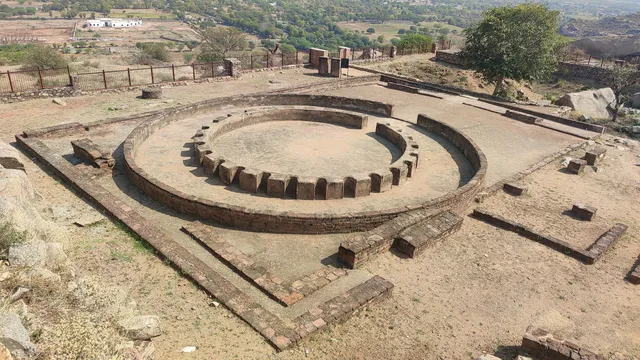


&promo_pic=/hotel-sample/coolest.webp)




