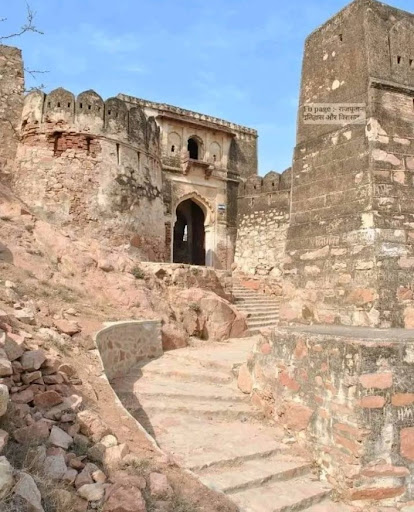
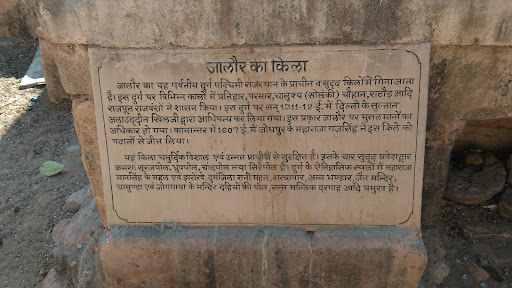
A healthy visit.... As there were more then 2000 steps to climb up... It will take 40 min for a healthy and fit person to climb and 20 mins to come down . Initially if you are not a regular adventurer you will find it somehow scary in the beginning.. no people around but as u will reach at the top you will find many people there.... And the most beautiful thing i saw was that there are many mosques and temples together... you will get a complete view of jalore from the topmost point... Unfortunately it is shattered now mostly but if it could have been maintained then it would be as beautiful as the chhitorgarh fort....
It is the centre attraction of jalore,the granite city of india. (Old name - jabalipura) . This for is also called suvarnagiri and was ruled by Gurjar pratiharas in 8,9th century. By paramaras in 10th and in 1181 chauhans . Later allauddin Khilji captured it in 1311. Later the Mughals and restored to marwar in 1704 to independence. Jalore is also called cradle of Marwari house.Jalore Fort Rajasthan (Suvarnagiri Fort Jalore)
The fort is very old, not much is left in the fort, it is in complete ruins.
There is a thousand years old temple of Maa Ashapura And India's second Somnath Mahadev Temple
This was an amazing place to do tracking in very early in the morning time..
Around 1500 steps takes 1 hour by walk. Not so much Rush...
Best and great view of city jalor to take a pictures...
Must visit the place during monsoon. When, weather is so cloudy.. It feels like heaven.
Historical Fort on top of Jalore City.
Well worth the visit and climb up. Simple, pure, Historical, beauty and peace.
Lots of temples and mosques to see and a LOT of history up there.
There aren't any commercial aspects here at all so all completely natural and untouched. Jalore Fort, located in the town of Jalore in Rajasthan, India, is a significant historical monument with a rich history spanning several centuries. Here is a brief overview:
Ancient Origins: The foundations of Jalore Fort date back to the 8th century. It is believed that the fort was originally built by the Paramara dynasty. The strategic location of Jalore, atop a steep granite hill, made it an ideal site for a fortification.
Prithviraj Chauhan's Rule: Jalore Fort gained prominence during the reign of Prithviraj Chauhan in the 12th century. Prithviraj Chauhan was a Rajput king known for his valiant efforts against the Ghurid ruler Muhammad Ghori.
Alliances and Conflicts: Over the centuries, Jalore Fort witnessed various alliances and conflicts as different Rajput clans and regional rulers sought control over the fort. It was strategically significant in the turbulent medieval history of Rajasthan.
Rathore Dynasty: The Rathore Rajputs, particularly Rao Maldeo, significantly contributed to the fort's architecture and expansion during the 14th century. The fort became a vital military outpost for the Rathores.
Mughal Period: Jalore Fort came under Mughal control during Akbar's reign in the 16th century. The fort played a role in the Mughal campaigns in the region.
Maratha and British Influence: In the subsequent centuries, Jalore Fort experienced the influence of Marathas and, later, the British. The fort underwent changes and adaptations based on the military strategies of the time.
Architecture: Jalore Fort is known for its impressive architecture, featuring massive walls, bastions, and gates. The construction primarily utilizes granite stones, showcasing the architectural prowess of the builders.
Present Day: Today, Jalore Fort stands as a historic landmark and a popular tourist attraction. Visitors can explore the fort's various structures, including the Maharang Mahal, the Shish Mahal, and the Rani Mahal, which reflect the rich cultural and architectural heritage of Rajasthan.
Jalore Fort stands as a testament to the historical and cultural legacy of the region, having witnessed the ebb and flow of different dynasties and rulers over...
Read moreJalore Fort is the main attraction of Jalore, a town in the Indian state of Rajasthan, one of the nine castles of the Maru, under the Paramaras in the 10th century. It is one of the most famous and impressive forts in the state and has been known through history as the Sonagir or the ‘golden mount’. Jalore fort is perched atop a steep and perpendicular hill. It commands the town from rocky outcrop 336m (1200 ft) high fortified with a wall and bastions with cannon mounted upon them.

The fort has four gigantic gates however it is approachable only from one side, after a two-mile (3 km) long serpentine ascent. The approach to the fort is from the north, up a steep, slippery road through three rows of fortification to a single rampart wall 6.1m (20ft) high. It takes an hour to climb up. The fort is built on the lines of traditional Hindu architecture.
The Main Poles or Gates
Built into the front wall are four mighty gates or pols that lead into the fort: The Suraj Pol, Dhruv Pol, Chand Pol and the Sire Pol. The Suraj Pol or the "Sun gate" is built so that the first rays of the morning sun enter through this gateway. It is an impressive gate with a small watch tower built over it. The Dhruv Pol is rather simple looking compared to Suraj Pol.
The Attractions inside the Fort Edit
The mahal or "the residential palace" inside the fort is now desolated, and what is left of it are the ruined symmetrical walls with huge rock formations around it. The cut-stone walls of the fort are still intact at many places. There are some drinking water tanks in the fort.
The Fort Mosques The Kila Masjid (Fort Mosque) within the fort is also noteworthy as they demonstrates the widespread influence of the architectural decorations associated with the Gujarati styles of the period (i.e. late 16th century).
Another shrine in the fort is that of Saint Rehmad Ali Baba. Near the main gate there is the tomb of Malik Shah[disambiguation needed], a noted Mohammedan saint.
The Jain Temples Jalore is also a place of pilgrimage for Jains and the famous Jain temples of Adinath, Mahavira, Parshvnath and Shantinath are located here.
The oldest temple is that of Adinath, which existed as far back as in the 8th century. The mandapa was subsequently built in 1182 A.D. by Yasovira, a Srimali vaishya. The temple stands out the most among the dark fort walls and rocky surrounding . Built in white marble this imposing structure is quite a sight.
The temple of Parsvanath was built by the ruler of Jalore and then rebuilt in 1785 A.D. This temple has a spectacular toran or an archway and a golden "cupola' in the hall meant for theatre performances. Built near the Bal Pol, which is situated north west of the fort.
The temple of Mahavira was also known as Chandanavihara Nahadarao, named after a Pratihara ruler and a hero of Jain tradition who built it in the 14th century.
The temples of Santinatha and the Ashtapads are believed to have existed in the 13th century.
Hindu Temples There is an old Shiva temple, a temple devoted to Lord Shiva. It was built by Kanhaddev Ruler of Jalore. Same was renovated by Mah Singh Ruler of Jodhpur and built a Samadhi Mandir of Shri Jalandharnath. Recently this temple renovated again by Holy Shri Santinathji Maharaj in 2005 with all facility for dovotees. A triple temple dedicated to Amba mata, Ashapuri and Hanuman (the monkey god) is also located within the...
Read moreJalore Fort Rajasthan. It is a different type of fort with many edges. With so much to lure your senses and offer you recreation at its best, get drenched in the spirit of adventure that you get to explore at jalore fort, Jalor. Jalore Fort is located in the Jalore district of the state of Rajasthan, Jalore district has been an important site of the Middle East in the south-west of Rajasthan india.. History. Enjoy the attractions of this popular tourist spot. Post navigation. It sits on the highest point of a steep and opposite slope. India is the World second largest people country. According to some historical sources, in 8th-9th centuries, one branch of the Gurjara Pratiharas was ruling at Jablipur (Jalore). Advertisements. Jalore Fort is the main attraction of Jalore, a town in the Indian state of Rajasthan. Ravla Bhenswara. Fort of Kot Kasta. It is one of the most famous and impressive forts in the state and has been known through history as the Sonagir or the ‘golden mount’. Find all the transport options for your trip from Jalore Fort to Jodhpur right here. According to historical believes it was called as ‘Drumkulya’ the northern part of southern Ocean. It is one of oldest forts of Rajasthan and is famous for long siege and battle between its Rajput king and Khilaji in early 14th century.The base point for climb -up is an unspectacular place and can only be approached through narrow lanes.The autorickshaw is best vehicle to reach to base.From there it is about 40 minutes … History of Jalore. Find address and best time to visit. Jalore Jalore Fort, one of the famous forts in India. It is one of the most famous and impressive forts in the state and has been known through history as the Sonagir or the "golden mount". JALORE FORT More TOPEKHANA More … More Photo. The whole post has been made on the lines of old-fashioned … It takes an hour to climb the stronghold entryway. Considered to be one of the most impregnable forts in India, the Jalore Fort in Rajasthan is one of the primary attractions in Jalore. Presently this district is surrounded by Barmer, Sirohi, Pali and Banaskantha district of Gujarat. The incumbent, Raja Gopal Singh ji owns the magnificent fort which has now been converted into one of the finest heritage hotels in India. Perched atop a rocky outcrop, the fort is protected by bastions and a thick wall. The Paramara clan of the Agnivansha branch of the Rajputs ruled Jalore at the end of 10 th century and the Jalore Fort … History. In ancient times Jalore was known as Jabalipura - named after saint. During the...
Read more