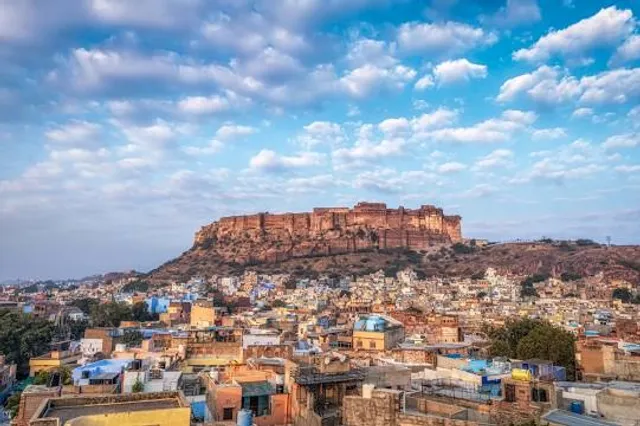
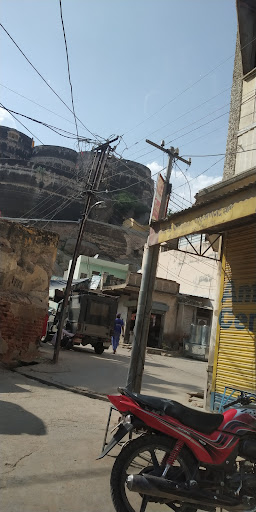
There is a very rich and inspiring history attached to the imposing fort built by Rao Raja Laxman Singhji of Sikar, in the year 1805. Before Lachhmangarh came into existence, this hilly region was known as ‘Ber’ a small non-descriptive village.
Folklore has it that once while returning from Fatehpur, Rao Raja Laxman Singhji was relaxing on the foothills of ‘Ber’ (where the fort stands today) when he saw an awe-inspiring scene. A wolf came from somewhere and attacked a newly born lamb. The wolf tried very hard to kill the lamb but the mother sheep put up a tough front and fought the wolf bravely compelling him to leave . On seeing this incident, Rao Rajaji and his companions decided to build a fort at this site and considered the foothill to be a ‘Veer Bhoomi’ (Land of the Brave).
The construction of the fort commenced in 1805 and within a short span of two years, it was fully constructed. Since the completion of construction in 1807 the Fort remained under the rule of one state till India got freedom. The fort has also seen attackers from rulers of Khetdi, Fatehpur and Mandawa in the year 1882. These attacks took place under the leadership of Raja Bakhtawar Singh. At the time of the attack, his forces were camped two kilometres away from the fort. It is a different matter that the erstwhile rulers had thwarted the attacks with the help of Doongji Jawaharji.
The signs of the fierce gun battle attack on the fort can still be seen. It is said that the fort was equipped with three powerful cannons called Kadak, Bijli and Bhawani. These cannons were used to defeat the enemy forces. Till recent times, these canons were placed at the fort. Post independence they were taken away. The fort attracts the attention due to its grandeur. It is said that after the attacks of Fatehpur, Mandawa and Khetdi, the fort was further built to secure it from any further attacks and to provide security to the Paswan queens.
This fort never became the permanent residence of the rulers. However, some caretakers of the state were always stationed here, to look after the security and safety of the area. After independence, like other Rajput states, Rao Raja Kalyan Singh, the then ruler of Sikar too decided to merge with Indian union. Due to this reason, income from revenue stopped and they (former rulers) were only receiving pension which was very inadequate considering their lavish life style. Hence, they started selling their properties.
As a result, the fort of Lachhmangarh was up set up for sale in the year 1960 and it was sold to Mr. Ram Niwasji Jhunjhunwala’s family by Kalyan Singhji. Now, the Jhunjhunwala family is maintaining the fort, one can still see the stamp of feudal age...
Read moreLaxmangarh Fort Laxmangarh Fort is a demolished old fort, situated at a distance of 30km from Sikar, on a hill in Laxmangarh. The fort is on the western side of the Laxmangarh town. It was built in 1862, by Rao Raja Laxman Singh of Sikar. He built this fort to protect Laxmangarh from assailment of Kan Singh Saledhi. The uniqueness of the architecture of the fort lies in the fact that it is built on scattered pieces of huge rocks, in Shekhawati Style. The main attraction of the fort are the frescoes. There is a ramp in the fort, Many havelis in Laxmangarh, close to the fort, like Bansidhar Rathi Haveli, Sawant Ram Chokhani Haveli, Mirijamal Kyala Haveli, Sanganeria Haveli, Kedia Haveli and Char Chowk Haveli attract a large number of tourists every year. History of Laxmangarh fort Before the origin of Laxmangarh, the hill on which the fort is built was known as ‘Ber’. It was a small village. According to the beliefs of people of Laxmangarh, once when Rao Raja Laxman Singh was returning from Fatehpur, he chose the foot of ‘Ber’ hills to relax. Just then, an awful event happened. A wolf tried to attack a newly born lamb. But the mother of the lamb fought courageously with the wolf. At the end of the fight, the wolf had no other way, but to leave without the pray. This incident inspired Rao Raja Laxman Singh to build a fort at this foothill. He and his people believed this place to be land of brave or ‘Veer Bhoomi’.
The building of fort was started in 1805. Two years from then, in 1807, the fort was fully built. From 1807 till India got freedom, the fort was under the rule of Roa Rajas. It was able to withstand various attacks from Fatehpur, Khetdi, and Mandawa in1882. All these attacks were lead by Raja Bakhtawar...
Read moreLaxmangarh Fort is a prominent historical fort located in the town of Laxmangarh, near Sikar, in the Shekhawati region of Rajasthan, India. Built on a hill in the 19th century, the fort offers a panoramic view of the town and showcases the architectural brilliance of the era.
Key Features of Laxmangarh Fort:
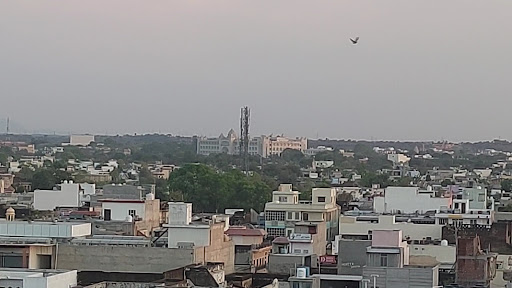
Historical Significance: The fort was built by Raja Laxman Singh of Sikar in 1862. It served as a strategic and defensive structure during his reign. Architecture: The fort is perched on a rocky hill, and its construction integrates natural rock formations with traditional fortification techniques. It stands as a fine example of Shekhawati architecture, with beautifully decorated gateways and walls. Panoramic Views: From the top of the fort, visitors can enjoy a breathtaking view of Laxmangarh town, including its unique grid-like layout and the traditional havelis adorned with frescoes. Current Status: Although parts of the fort are in ruins, it still retains its charm and historical value. A portion of the fort is privately owned and not open to the public, but the exterior and surrounding areas are accessible for exploration. Nearby Attractions: Laxmangarh is also known for its richly painted havelis, including the Poddar Haveli, and serves as a gateway to exploring the Shekhawati region’s artistic heritage.
Tips for Visitors:
• Wear comfortable shoes as climbing to the fort can be challenging. • Visit during the cooler months (October to March) for a pleasant experience. • Explore the nearby frescoed havelis to get a complete sense of Shekhawati’s cultural richness.
Let me know if you’d like more details or assistance in...
Read more