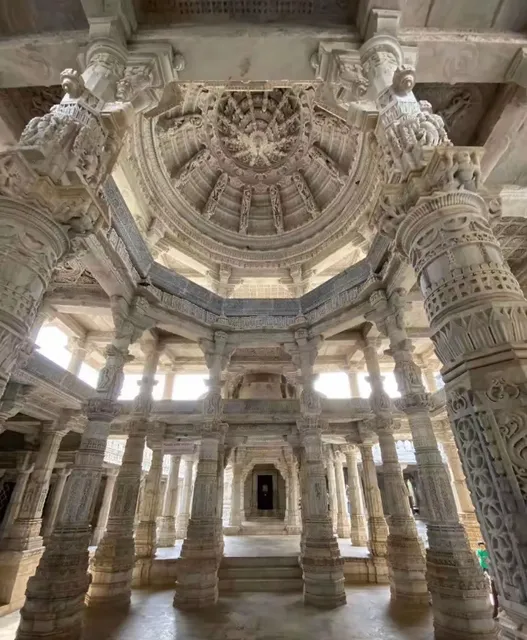
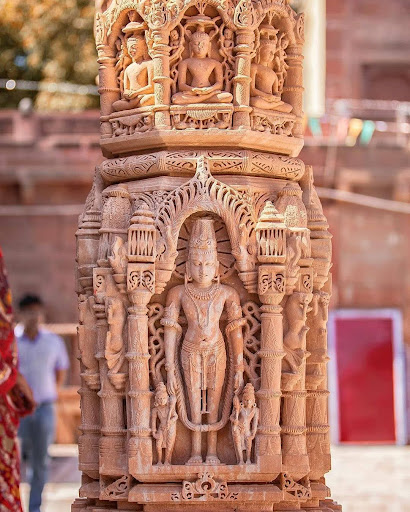
Chaumukha Jain Temple, 1444 A forest of marble pillars, each carved differently from the other.
History of Ranakpur Jain Temple Ranakpurpur Jain Temple was built to order by a local businessman named Darna Shah. He wanted a beautiful temple built after he had a dream of a celestial vehicle. Many sculptors and artists submitted their designs to Shah but none of them matched the image he had dreamt of. One plan that matched his dream was by an architect named Deepak from Mundara. Deepak was able to make a design because he was impressed by the dedication of Shah to build this temple. Afterwards, Shah sought the land to build the temple from King Rana Kumbha. Not only did he give a big piece of land to build the temple on, but he also asked Deepak to build a town around it. The town built was named Ranakpur, after the king, and the same town is now known as Ranakpur. The construction of the temple began in the 14th century and went on till the 15th century.
There are a total of 5 temples in India that are considered the most sacred for Jain. One of them is Ranakpur Jain Temple. The others in the list are Dilwara Temple in Mount Abu, Rajasthan; Khajuraho Temples in Khajuraho, Madhya Pradesh; Palitana Temples in Shatrunjya Hills, Gujarat; and Gomateshwara Temple in Shravanabelagola, Karnataka.
When you’re visiting Rajasthan, Ranakpur temple is one of the places recommended to visit. It also goes by the name of Charturmukha Dharana Vihara and is dedicated to Tirthankara Rishabhanatha who was the first Tirthankara of Jainism, and he also founded the Ikshvaku dynasty.
The complex of Ranakpur ka Jain mandir includes 5 temples.
Chaturmukha/Chaumukha Temple Built in the 15th century using white marble, it is the most popular temple in the complex and it honours Adinath, also known as Rishabanatha. It gets its name from its 4-faced design. This temple is spread across 48,000 square feet and is known for its intricacy and beautifully carved 1444 pillars, 426 columns, 89 domes, and 29 halls. Interestingly, one of the pillars is incomplete. There’s a legend about the temple that one pillar is bound to be incomplete. Whenever it has been completed, it has broken the next day itself. 1444 pillars that support the temple have been carved with exquisite detail that is nearly impossible to do even today.
One of the most attractive features of the temple, besides the pillars, is the beautifully carved idol of Parshvanatha. It has been made out of a single slab of marble. Its beauty in the detail is due to the 1008 snake carefully crafted around the idol. The same idol also has two chauri bears and yaksha and yakshi, who are half-human and half-snake. There are also two elephants carved, one on either side, that seem to be purifying Parshavanath. And you can’t find the end of the tails of these elephants.
The Ranakpur Jain Mandir also has 84 bhonyras. Bhonyras are underground chambers that were built in the earlier times during disturbance to prevent the attacks on Jain idols. It is said that the design of Ranakpur Jain Temple was used as an inspiration to design Dilwara Temple. While Dilwara Jain Temple is not for its sculptures, Ranakpur Jain Temple is known for its intricacies in the design.
Suparshvanatha Temple Supershvanatha is the seventh Tirthankara and this temple is dedicated. The intricate designs are present even in this temple. It is also popular for the erotic arts on the wall.
Surya Temple The construction of this sun temple dates back to the 13th century, full 2 centuries before the construction of Ranakpur Jain Temple. But it got desecrated during the time of disturbance due to repeated attacks and was later reconstructed with the remaining temple complex.
So when you are looking for places to visit in Rajasthan, Ranakpur Jain Temple must be...
Read moreThis is one of the most beautiful Jain Temple I have ever seen. Architecture and the Carvings here will make you feel as if you are in heaven and feeling it yourself. Nestled in the dense forest and Aravali mountains, this place will make you alive to the fullest. Serene place and sensational beauty. Peaceful and Calm place.
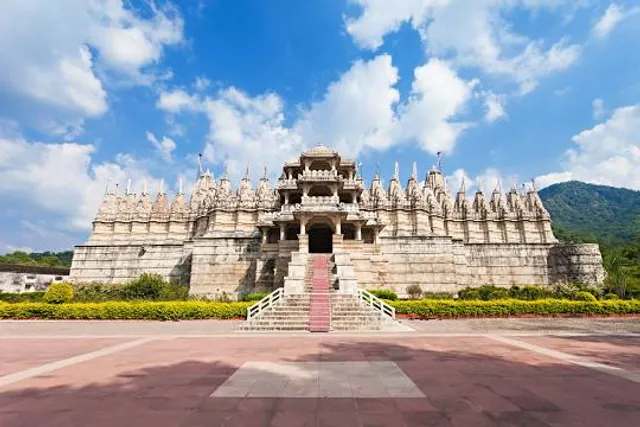
History : Ranakpur Jain temple or Chaturmukha Dharana Vihara is a Śvētāmbara Jain temple at Ranakpur dedicated to Tirthankara Rishabhanatha. The temple is located in the village of Ranakpur near Sadri in the Pali district of Rajasthan. It is a major pilgrimage place for the Śvetāmbara community.
The temple honours Adinath, the first Tirthankar of the present half-cycle (avasarpiṇī) according to Jain cosmology. The Ranakpur temple is one of the largest and most important temples of Jain culture. The campus includes various temples such as Chaumukha temple, Surya temple, Suparshvanatha temple and Amba temple. Ranakpur along with Muchhal Mahavir, Narlai, Nadol and Varkana forms "Gorwad Panch Tirth".
This temple is built in Māru-Gurjara architecture. The temple has a garbhagriha in which the main Chaumukha Adinatha idol is placed. The four openings of the sanctum lead to rangamandapa— the Dancing hall, which is connected to a two-storeyed mandapa, which is again connected to another two-storeyed mandapa called Balana and nalimandapa. This courtyard is surrounded by a wall enclosing sub-shrines. The wall is also exclusive on projections like devakulikas and minor deity. The temple has five shikharas amongst which the central one is the largest. The temple is rich with sculptural pieces - carvings created with great skill and artistry. The Shikhara in the temple is symbolic of Mount Meru, the mountain which forms the axis of Jambudvipa with a preaching hall as the Samavasarana.
The temple is a grand white marble structure spread over 48,000 square feet (4,500 m2) with 1444 marble pillars, twenty-nine halls, eighty domes and 426 columns. One pillar is incomplete and legend says every time it is built the next morning the pillar breaks down again. The temple, with its distinctive domes, shikhara, turrets and cupolas rises majestically from the slope of a hill. The 1444 marble pillars, carved in exquisite detail, support the temple. The pillars are individually carved and no two pillars are the same. Legend says that it is impossible to count the pillars. One of the pillars bears the carving mother of a tirthankar lying on a cot. In the axis of the main entrance, on the western side, is the largest image. Inside the garbhagriha, the moolnayak of this temple, there is a 6-ft. tall, white-coloured chaumukha idol of Adinath with four heads facing in four directions. Temple has a total of 84 bhonyra (underground chambers) built to protect the Jain idols from the Mughals.
The temple is famous for its beautiful carved idol of Parshvanatha made out of a single marble slab. The idol has 1008 snake heads and numerous tails. Two chauri bearers and Yaksha and yakshi, half-human and half-snake, stand on either side. There are two elephants purifying Parshvanatha. One cannot find the end of the tails. The temple also has a representation of Ashtapad, showing eight tirthanakars in a row, Girnar and...
Read moreTranquility and Architectural Splendor: Ranakpur Jain Temple
Nestled amidst the Aravalli hills of Rajasthan, the Ranakpur Jain Temple stands as a sublime testament to the grandeur of ancient Indian architecture and the spiritual devotion of its builders. My recent visit to this awe-inspiring temple left me spellbound, as the intricate craftsmanship and serene surroundings provided a truly transcendent experience. The temple, dedicated to Adinatha, the first Tirthankara of Jainism, is renowned for its architectural excellence and is considered one of the most important pilgrimage sites for Jains. As I approached the temple complex, the soaring spires of the marble structure emerged, creating an ethereal sight against the backdrop of the verdant hills. The highlight of Ranakpur Jain Temple is undoubtedly its remarkable architecture. The intricate marble carvings that adorn every inch of the temple are a testament to the dedication and skill of the craftsmen. The marble pillars, each uniquely crafted with exquisite detailing, create a mesmerizing play of light and shadow as the sun moves across the sky. The Chaumukha Mandir, with its four-faced idol of Adinatha, radiates a sense of serenity and spirituality. Exploring the temple complex, I was struck by the precision and symmetry evident in every aspect of the architecture. The delicately carved domes, shikhara (spires), and mandapas (halls) create a harmonious blend of artistry and spirituality. The cool, quiet interiors of the temple provided a welcome respite, inviting contemplation and introspection. The temple's location in the lush valley of Ranakpur adds to its allure. Surrounded by hills and dense forests, the tranquility of the surroundings enhances the spiritual experience for visitors. The sprawling complex also includes various smaller temples and shrines dedicated to different Tirthankaras, offering a comprehensive exploration of Jain religious beliefs. Visitors to the Ranakpur Jain Temple will appreciate the meticulous maintenance and cleanliness of the premises. The dedicated staff ensures that the temple remains a pristine and sacred space for worshippers and tourists alike. Informational plaques and guides are available to elucidate the history, significance, and cultural nuances of the temple, enriching the overall experience. A visit to the Ranakpur Jain Temple is not merely a cultural excursion; it's a journey into the heart of Jain spirituality and a celebration of architectural brilliance. Whether you're a devotee seeking spiritual solace or a traveler with an appreciation for art and history, this temple offers a serene haven that transcends time. Ranakpur Jain Temple is a must-visit destination, where the divine and the artistic converge to create an unforgettable experience.
Photography: Limited to specific time slots, charges applicable.You can keep your phones in your car or outside the main temple (submit the phones before entering) Admission: Free, Dress code applicable to enter the main temple, Dont carry anything made of leather inside the temple. Parking: Free parking inside the...
Read more