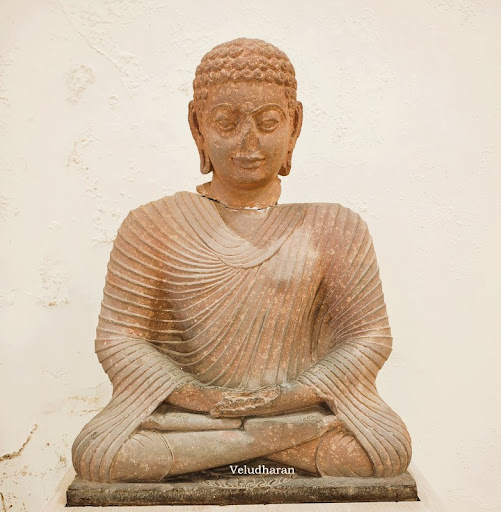
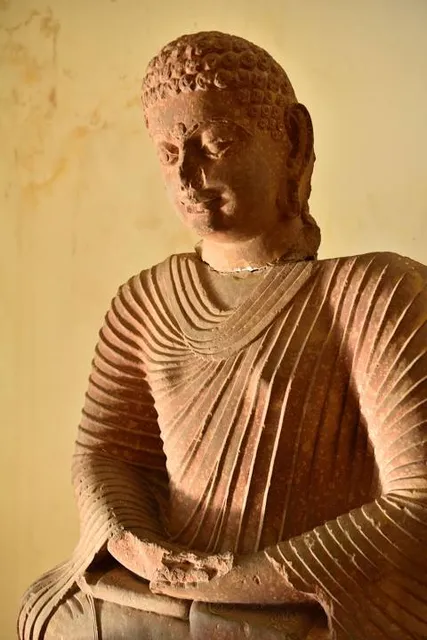
STUPA COMPONENT, PANGURARIA, DIST. SEHORE The most interesting one from Panguraria, dist, Sehore, is a pillar and chhatra of a Buddhist Stupa, which has been displayed in the open courtyard of the museum. This was brought here from the site of Panguraria a Buddhist place in Sehore district of Madhya Pradesh which was lying for a long time in the Museum building premises. The original stupa belonged to the 3rd century BCE, i.e. Mauryan period. It turned into ruins at site. Therefore the components of original stupa scattered at site. As stated above only two components i.e. pillar and chhatra were brought here. The different dimensions of these chhatra and pillar show that the stupa of which these parts are, might be much bigger than the Stupa of Sanchi, Buddha in Meditation, Period 400 - 500 CE, Gupta period, and Sand Stone Description: Buddha seated in meditation. Head refixed. Neck, left ear lobe, nose, hands, eyes and lips are slightly broken. The drapery (Cheever) is covering both the shoulders. Chakra and auspicious symbols are depicted on feet. Standing Nagaraja, 700-800 CE, and Sand Stone Depicted on a pedestal in human form Nagaraja is in sthanaka posture. Back slab shows snake coils in a zigzag form, hooded canopy out of which only 5 hoods are seen. Head dress is arranged like a twisted garland. Wearing ear ornament, necklace, armlet (Katakvalaya) and wristlets (Keyura) wearing dhoti hanging up to knee. Right hand holds a lotus while his left hand is held on the left waist. Both the arms are partly broken. Headless Sthanaka Buddha, 500 CE, and Sand Stone Headless standing Buddha carved in Mathura sand stone. Drapery (Cheever) covers both the shoulders while left hand holds upper garment near waist. Bodhisattva Padmapani, 400- 500 CE, Gupta Period, and Sand Stone Bodhisattva Padmapani standing in samabhang posture. Wears elaborate ornaments, ear ring, necklace, armlet, bracelets. Drapery (uttariya) and short dhoti, tied with a plain girdle. The end part of dhoti is hanging down at the left side. The right uplifted hand holds a lotus while left one holds the end part of uttariay. Lion Pillar Capital, 300 BCE, Mauryan Period, and Sand Stone. Lion Pillar Capital made out of Chunar sand stone, consisting of a bell shaped lotus with cable necking surmounted by a circular abacus which is carved with Madhu Malti flower and Geese supporting four lions seated back to back. Bell, below the abacus is decorated with sixteen conventional petals. It is having fine polish, a typical example of Mauryan period. Bodhisattva, 400 to 500 CE, Gupta Period, and Sand Stone. Description: Standing Bodhisattva Vajrapani is depicted in dhoti, ear ring, necklace, armlet, bracelets and head dress. Hair curls fall on the shoulder. Right hand holds vajra, which is traceable on the right hip, the left hand holds the end pard of uttariya. A small halo provided at the back of head which has twelve holes. Standing Buddha, 700 CE, and Sand Stone. Standing Bodhisattva Vajrapani is depicted in dhoti, ear ring, necklace, armlet, bracelets and head dress. Hair curls fall on the shoulder. Right hand holds vajra, which is traceable on the right hip, the left hand holds the end pard of uttariya. A small halo provided at the back of head which has...
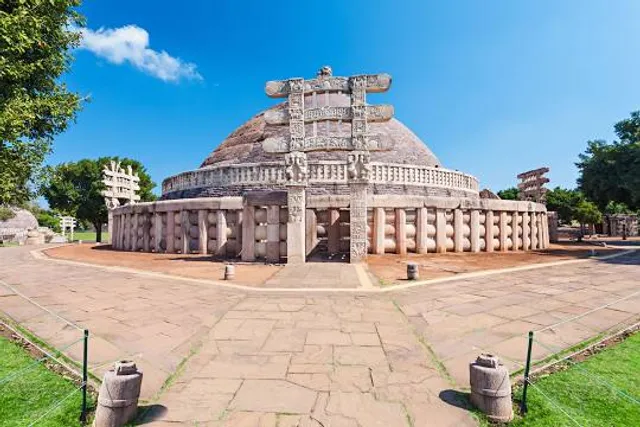
Read moreThe Sanchi Stupas, located in the heart of India, stand as an exquisite testament to the rich history and architectural brilliance of ancient times. These magnificent structures, dating back over two millennia, continue to captivate visitors with their grandeur and spiritual significance. As a witness to their awe-inspiring beauty, I cannot help but express my utmost admiration for the Sanchi Stupas.
Stepping onto the grounds of Sanchi, I was immediately enveloped in a serene atmosphere that seemed to transcend time. The sight of the iconic hemispherical domes, embellished with intricate carvings and adorned with the finest artistry, left me speechless. The sheer scale of the stupas is truly breathtaking, and the meticulous attention to detail is a testament to the craftsmanship of the ancient architects.
The Great Stupa, the centerpiece of Sanchi, commands attention with its imposing presence. Its massive stone structure, standing over 36 meters tall, exudes a sense of power and spiritual significance. As I circumambulated the stupa, I marveled at the delicate stone reliefs that adorned its outer walls. Each carving told a story, narrating the life and teachings of the Buddha, while intricate motifs and patterns added a sense of grace and elegance.
The surrounding pillars and gateways, known as toranas, add a touch of grandeur to the complex. These intricately carved structures showcase the mastery of the artisans of yore, depicting scenes from Buddhist mythology and offering glimpses into ancient Indian society. The craftsmanship displayed on these pillars is a testament to the skill and dedication of the craftsmen who worked tirelessly to create such masterpieces.
Beyond their architectural magnificence, the Sanchi Stupas hold deep spiritual significance. As a sacred Buddhist site, they serve as a pilgrimage destination for followers of the faith. The peaceful ambiance and the sense of tranquility that envelop the complex make it a perfect place for meditation and reflection. Standing atop the hill, one can witness breathtaking panoramic views of the surrounding countryside, further enhancing the spiritual experience.
The preservation and restoration efforts at Sanchi deserve praise. The meticulous work undertaken to maintain the stupas and their surrounding structures have ensured that future generations can continue to appreciate their beauty and historical significance. The site's informative exhibits and well-maintained gardens provide a holistic experience for visitors, allowing them to delve into the rich cultural and architectural heritage of ancient India.
Visiting the Sanchi Stupas was an experience that left an indelible mark on my soul. It transported me to a bygone era, where craftsmanship and spirituality were seamlessly intertwined. Whether you are an architecture enthusiast, a history buff, or a spiritual seeker, Sanchi will undoubtedly leave you in awe. I highly recommend visiting these ancient marvels to witness firsthand the grandeur and serenity they exude—a true testament to the timeless allure of human creativity...
Read moreSanchi one of the World Heritage Site and India's oldest structure situated on a secluded hill and was commissioned by the Emperor Ashoka the great in 3rd century BC. It's one of my most favourite location and a Buddhist pilgrimage too.
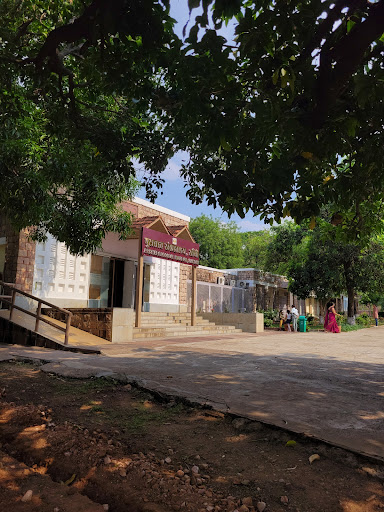
Sanchi Archaeological Museum is situated before the World Heritage Site. Since 13th century AD it was disappeared and was rediscovered by Taylor in 1818 AD. Later Sir John Marshall who had given a rebirth to this Buddhist Monument by his untired efforts from 1912 AD to 1919 AD. He displayed all his findings in a small museum close to the site thereafter it was shifted in to the School building which was converted into the museum and all Antiquities were shifted to this museum. It has verandahs, main hall and four galleries all are used to display the antique items some were discovered from nearby to areas. Among the displayed antiques, few are rare, belongs to the period from 3rd century BC to Medieval period. Among these sculptures and artefacts Ashoka's pillar capital, a four lions seated back to back, other pillars remains including the damaged remains of Great Stupa's Southern gateway.
In the main hall antiques of six different periods as Maurya, Shunga, Satvahan, Kushan, Gupta and Northern Gupta period, all belongs to 3rd century BC to 7th century AD.
All the four galleries are displaying the various antiques and sculptures like Stone sculptures of Buddha, miniature sculptures, iron tools, medium sized sculptures and damaged parts, photo gallery displays the rare photos and sketches etc.
A bungalow built in Gothic style was the residence of Sir John Marshall. Now it's dedicated to Marshall and known as Sir John Marshall Memorial. All the things that were used by Marshall and the information which he found in his excavation were recorded by him are also displayed.
In the open Garden some stone pillars, Umbrellas, sculptures etc remains of Stupa which were discovered from Paguraria located near Sehore are displayed, which was an ancient Buddhist place even may be greater than Sanchi.
It's a major attraction among the history buffs wanderers soulseekers heritage art and architecture lovers. Entry fee is nominal and various restaurants and hotels are located in the...
Read more