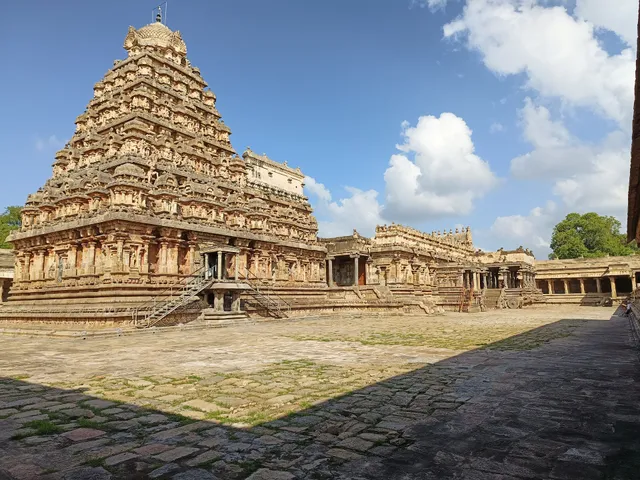
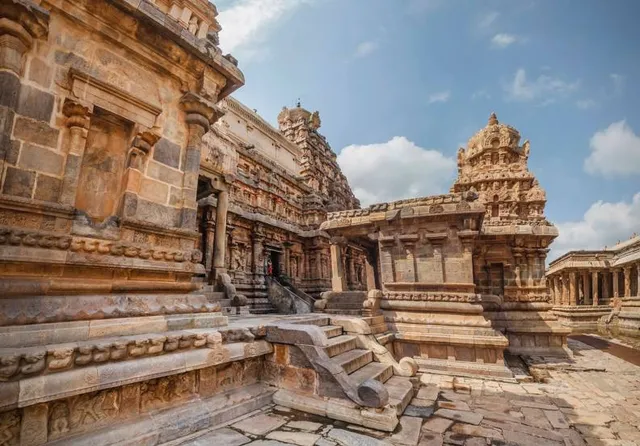
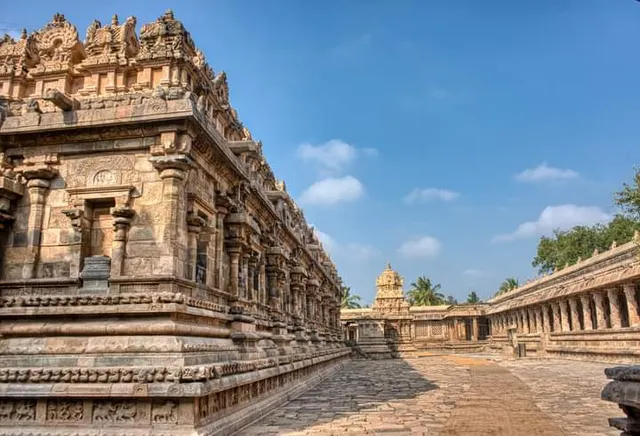
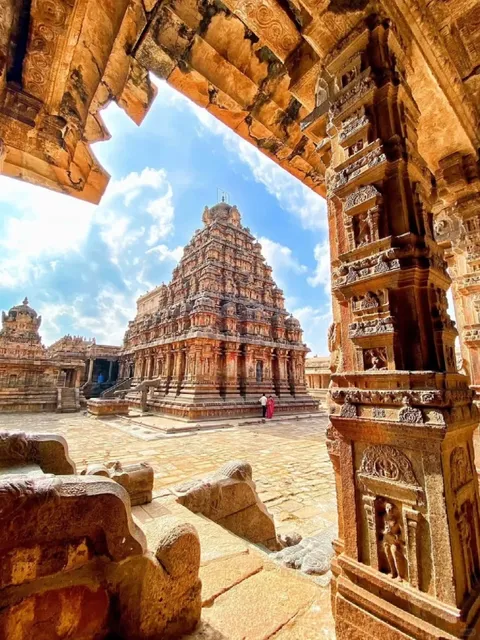
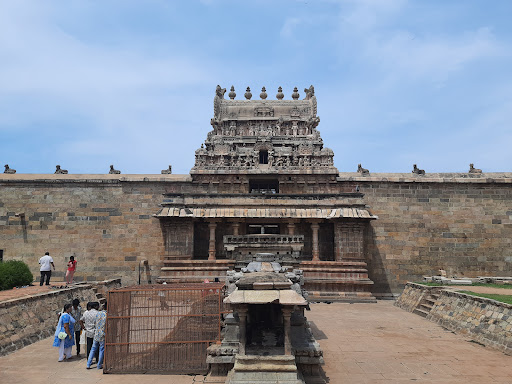
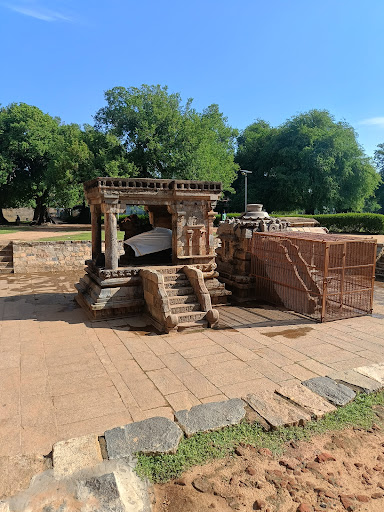
The magnificent Airavatesvara, situated in Darasuram near Kumbakonam, is a UNESCO World Heritage site. Built in the 12th century CE by Rajaraja Chola II, it is a testament to the rich history of Thanjavur district.Since 1954, the temple has been under the care of the Archaeological Survey of India. It is renowned for its breathtaking sculptures and stunning architectural design, offering a glimpse into the impressive artistic and architectural accomplishments of the Chola dynastyThe temple features an 80-ft vimana resembling a chariot, with horses. The Rajagopuram showcases the balipida and nandi mandapa. The gopuram reveals a stone-wheeled vimana, with mukha & artha mandapas, anthrala, and garbhagraha. A circumambulatory path surrounds the structure.Another wonder of the temple are the musical steps that are protected by railings to prevent from vandalism. The flight of seven steps when struck produces the sound of seven musical notes "sa, re, ga, ma, pa, dha, ni and sa."It is named after Lord Indra's white elephant - Airavat. Legend says Airavata lost his color due to a curse but regained it by bathing in the temple tank and praying to Lord Siva. Inscriptions of this legend adorn the temple walls, along with other captivating tales.The temple's inscriptions detail donations, storms, and even the salary of goldsmiths. They describe the reign of Rajaraja II and Kullothunga III, who oversaw renovations. The walls bear witness to a rich tapestry of history and royal patronage.The temple features a striking sculpture of Veerabadra, showcasing his fierce form with multiple faces and four hands wielding a danda, sulam, and other weapons. This unique piece stands out in the temple's diverse sculpture collection.The temple showcases pillars with intricate miniature sculptures, including a detailed Dravidian vimana carved within an inch. It also features various carvings of gods, goddesses, humans, and animals, all skillfully crafted in less than an inch of space.The mukha mandapa is home to a stunning sculpture of Goddess Ganga, depicted gracefully holding a lotus in one hand and a kalasa in the other. A particular highlight of this sculpture is its captivating facial features.This Dravidian temple showcases spectacular architectural features. Its wonders include a stone chariot Vimana, intricate sculptures representing epics, puranas, and everyday life, like childbirth scenes. A true marvel of craftsmanship and detail.The temple exhibits captivating sculptures, notably an astonishing portrayal of an elephant and bull sharing a head but separate bodies.Each body reflects distinct animal features, while the shared head reveals both, depending on the viewing angle-a mesmerizing artistic marvel.Remnants of Nayaka period paintings are visible on the pada, mandapas, and ceilings. These artworks feature bright colors like yellow, blue, and red, which are eye-catching...
Read moreAiravatesvara Temple is a Hindu temple of Dravidian architecture located in Kumbakonam, Thanjavur District in the South Indian state of Tamil Nadu. This temple, built by Chola emperor Rajaraja II in the 12th century CE is a UNESCO World Heritage Site, along with the Brihadeeswara Temple at Thanjavur, the Gangaikondacholisvaram Temple at Gangaikonda Cholapuram that are referred to as the "Great Living Chola Temples".
The Airavatesvarar temple is one among a cluster of eighteen medieval era large Hindu temples in the Kumbakonam area, Thanjavur District. The temple is dedicated to Shiva. It also reverentially displays Vaishnavism and Shaktism traditions of Hinduism, along with the legends associated with Nayanmars – the Bhakti movement saints of Shaivism.
The stone temple incorporates a chariot structure, and includes major Vedic and Puranic deities such as Indra, Agni, Varuna, Vayu, Brahma, Surya, Vishnu, Saptamtrikas, Durga, Saraswati, Sri devi (Lakshmi), Ganga, Yamuna, Subrahmanya, Ganesha, Kama, Rati and others.
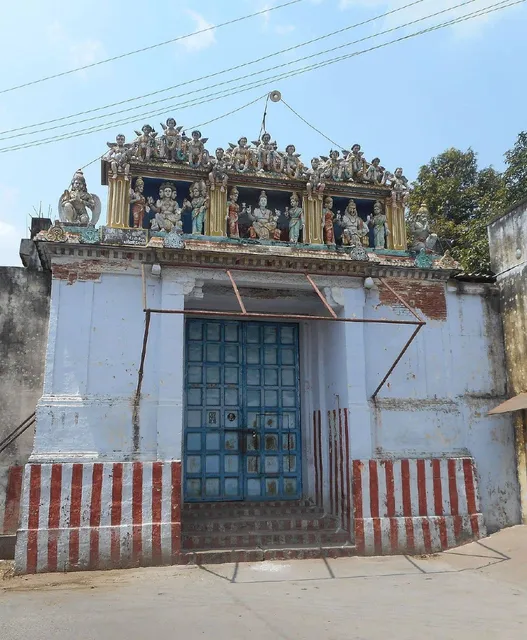
At present, parts of the temple such as the gopuram is in ruins, and the main temple and associated shrines stand alone. The temple continues to attract large gatherings of Hindu pilgrims every year during Magha, while some of the images such as those of Durga and Shiva are part of special pujas
The temple is surrounded by stone-walls.
The Gopuram is shorter than the other two teples and partly ruined, but the Vimana has exquisite architechterial marvels. The Vimana of this temple is, in my opinion, the best among the three. Also, since this is the youngest among three and not very poular like the other two (and hence less visitors), the colours of the wall-paintings on the Vimana (and on some other places, too) is still visible.
There are two horse-pulled chariots (built of stone) on each side of the staircase tot he sanctum. The wheels of the chariots are actually sun-dials-- one each for the Uttarayan and Dakshinayan of the Sun (Summer Solstice and Winter Solstice). This is probably the only Chola temple with such feature.
The main sanctum is closed for offerings from 12 noon to 4 PM, but the temple remains open; though it is advisable not to visit at that time as the stones get heated very much, and it is difficult to walk on those hot stones.
There is no entry ticket. One hour time is sufficient for a visit. Parking space is limited, and only for cars (buses cannot be parked there). There is a shop near the parking which sells biscuits, chips, mineral water, cold drinks etc.
Surprisingly, there is no toilet facility at this UNESCO World Heritage Site. I mean, there is actually toilets there, but locked and in very bad condition (covered in bushes). The administration should look into this aspect to enhance the experience of...
Read more🛕 Airavatesvara Temple, Darasuram
Airavatesvara Temple, located in Darasuram near Kumbakonam, Tamil Nadu, is one of the finest examples of Chola architecture. It is dedicated to Lord Shiva, known here as Airavateswarar. The temple is recognized as a UNESCO World Heritage Site and is part of the group called “Great Living Chola Temples”, along with Brihadeeswarar Temple (Thanjavur) and Gangaikonda Cholapuram Temple.
🔱 Main Deity
Presiding Deity: Lord Shiva as Airavateswarar
Consort: Goddess Periya Nayaki Amman
📖 Legend
According to legend:
Airavata, the white elephant of Lord Indra, once cursed by Sage Durvasa, worshipped Lord Shiva here to be freed from the curse. Hence, the Lord is known as Airavateswarar (“The Lord worshipped by Airavata”).
Another story says that Yama, the god of death, was relieved from a burning sensation caused by a curse after taking a dip in the temple tank and worshipping Lord Shiva here. Hence, the temple’s water is considered holy.
🏛️ Architecture
The temple was built by Rajaraja Chola II in the 12th century CE.
It is a masterpiece of Chola art, known for its intricate stone carvings, musical steps, and miniature sculptures.
The Vimana (tower) is about 24 meters high, smaller than that of Thanjavur’s temple but highly detailed.
One of the unique features is the “musical stairs” at the entrance — each step produces a different musical note when tapped.
The mandapam (hall) is designed as a chariot drawn by horses, symbolizing Lord Shiva’s divine journey.
🌸 Special Features
The walls depict scenes from Shaivite, Vaishnavite, and Shakta traditions, showing the religious harmony of the Chola period.
Sculptures of 108 dance poses of Bharatanatyam are carved beautifully on the temple walls.
The Periya Nayaki Amman Temple, dedicated to Goddess Parvati, is located nearby and is part of the same complex. 📅 Timings
Session Time
Morning 6:00 AM – 12:30 PM Evening 4:00 PM – 8:30 PM
📍 Location
Address: Airavatesvara Temple, Darasuram, near Kumbakonam, Thanjavur District, Tamil Nadu – 612702
Distance: About 3 km from Kumbakonam town
Nearest Railway Station: Darasuram (1 km) / Kumbakonam (3 km)
🌍 UNESCO Heritage
In 2004, the Airavatesvara Temple was declared a UNESCO World Heritage Site for its architectural brilliance, perfect proportions, and fine stone sculptures. It stands as a living testimony to the glory of the Chola dynasty and their devotion to art, music,...
Read more