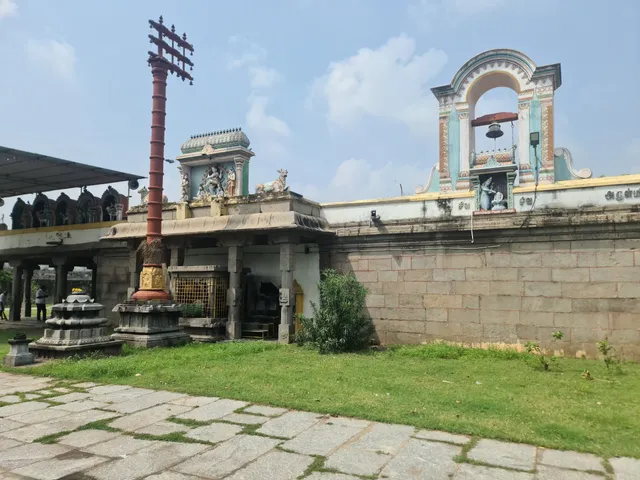
Thirukkachur is a very small village situated about 3 kms from Singaperumal Koil. This village lies on the west side of Singaperumal Koil off the GST Road.
There is a small hillock in this village called Oushadhagiri. At the foot hill, there is this stunning, ancient temple for Lord Shiva called Sri Oushadheeswarar.
This is a beautiful temple which is said to be built by Kulothunga Chozha, where the main deity is Sri Oushadheeswarar (in Sanskrit ‘oushadha’ means medicine) also called Marundheeswarar and Goddess Andhaka Nivarani Ambaal (also called Sri Irul Neekki Ambaal). This temple is also called as Malai Koil by the villagers.
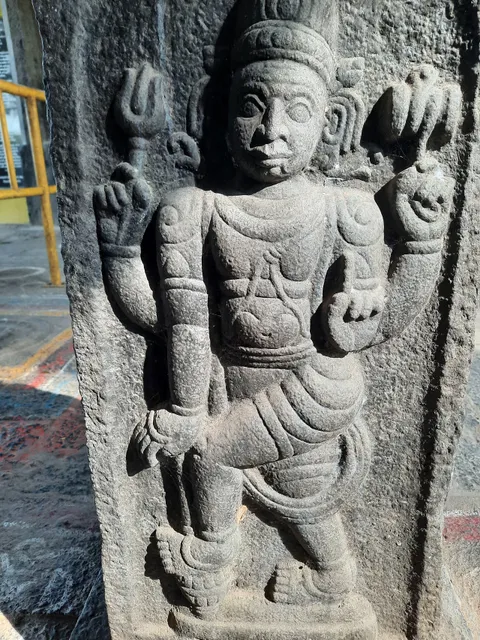
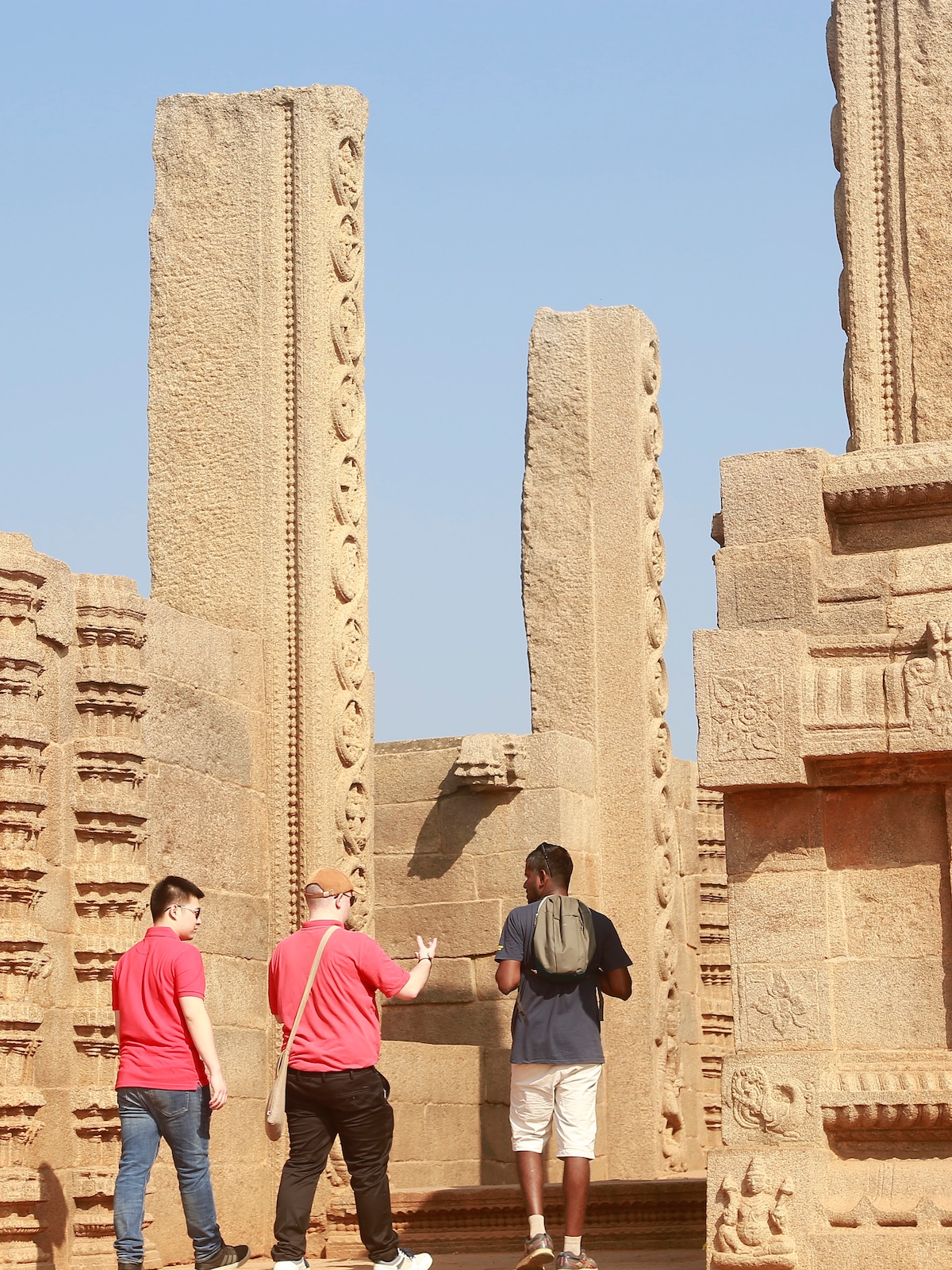
The entrance of this temple is facing south. There is no Rajagopuram for this temple. Soon after the entrance, there is a stone pillared Mandapam on which wonderful ancient carvings of Lingothbavar, Kamakshi, Pattinathaar, Dhandaayudhapaani etc, are seen.
It is said that this hill is rich in herbs containing very rare and precious herbs all over.
Legend has it that, as per the direction of Lord Indra, Aswini Devas came to this place to find some rare herbs and worshipped Lord Shiva here.
It is also said that Sage Agasthiyar worshipped Lord Marundheeswarar both at Thiruvaanmiyur and Thirukkachur and enriched his knowledge on Herbal Medicines.
Another unique feature of this temple is the deity Sri Marundheeswarar here is facing west. The outer praakaram is huge and has Dwajasthambha and Nandhi facing east towards the sanctum.
The people believe that the soil of this place itself is medicinal (மண்ணே மருந்து) and would cure one from ailments. There is a small pit near Dwajasthambha filled with mud. This mud is considered sacred and medicinal, which devotees apply on their forehead like Vibhuthi.
There is a separate shrine for Sri Andhaka Nivarani Ambaal, where She is in standing posture.
Sri Brahma, Sri Durgai, Sri Sandigeswarar and Sri Bhairavar are seen on the praakaram around the sanctum. Sri Sandigeswarar here is seen with 4 heads which is not seen in many temples. He is called Chathurmuga Sandigeswarar.
Sri Dhakshinamurthy is present facing south.
There is an ancient well at the north eastern side of this temple. This serves as the Theertham for this temple and is called 'Oushadha Theertham'. This water too is believed to have medicinal properties.
This well is made in such a way that, one can enter the well and reach up to the surface of water through the steps. This steps start at a distance from the well and goes inside the well even below the water level. It is said that there are 60 steps to this stair case. A very unique and a 'well designed well’.
The Sthala Viruksham for this temple is Palaa Maram (Jack tree).
Girivalam is very popular here. Devotees undertake Girivalam on Pournami (full moon) days and Tuesdays praying the Lord, to get cured of their illness.
Sundaramurthy Naayanaar, who had visited this village and composed hymns on Sri Kachabeswarar, has sung 2 hymns in praise of Sri...
Read moreThe temple is situated in the foothills of Tirukachur, a village in the Kanchipuram district. It features a flat gateway tower, and all the shrines are enclosed within concentric rectangular granite walls, covering an area of approximately 1 acre (0.40 ha).
The central shrine houses the image of Marundeeswarar in the form of a Lingam. Irulneeki Thayar (also known as Anthaga Nivarini), facing east, is located behind the sanctum. Access to the central shrine is through a Mahamandapam and Arthamandapam. Surrounding the main shrine are shrines dedicated to Vinayaka, Murugan, Navagraha, Chandekeswara, and Durga, following the tradition of Shiva temples in Tamil Nadu.
On the western side, there is a shrine depicting Shiva offering food to Sundarar. Images of Vinayaga, Thandapani, Appar, Sambandar, Pattinathar, and Vallalar are present in the temple. Sundarar specifically mentions the deity as Marundeeswarar, Virundeeswarar, and Iranthittai Eswarar in connection to an event, and a sculpted image in the temple portrays Siva feeding Sundarar. Additionally, the image of Chandesa is depicted with four heads.
Facing west, the entrance features a Mottai Gopuram from the south. Balipeedam, New Dwajasthambam, and Rishaba/Idaba mandapam are located to the west, with the Shiva Lingam visible through Jala/Salaram. Ganapathy and Subramaniyar are positioned in front of the Moolavar Sanctum.
In the koshtam, Durgai, Brahma, Sri Mahavishnu (in place of Lingothbavar), Dakshinamoorthy, and Ganapathy are present. Bas Reliefs of Dwarapalakas, Ambal, Sundarar, Appar, Pattinathar, Vallalar, Vinayagar, and Dhandapani adorn the mandapa pillars.
Within the outer prakaram, there are sannadhis for Gnana Ganapathy, Naagars, Chathuranga Chandikeswarar (Brahma Mugam – unique to this temple), Bhairavar, Suryan, and Navagrahas.
Ambal Sri Irulneeki Amman is in a separate sannadhi, standing in the west-facing posture. The temple's Theertha well is a beautifully constructed Oushadham well with steps.
Two Kala Poojas are performed with the efforts of Sri Kuzhandhai Swamikal and Sri Veerasamy Swamikal.
HISTORY: The temple was built during the First Kulothunga and Chozhas period. Although no inscriptions have been found, the construction of Rajagopuram occurred after the arrival of a new disciple to Sri Kuzhandhaivel Swamikal.
LEGENDS: Aswini Devars worshiped Lord Shiva and Ambal for the medicinal herb “Palai Athipalai” to cure their diseases. Lord Shiva declared this hill as "The hill itself is a medicine." When Sundarar visited this temple after girivalam, Iraivan served food obtained from villagers as picksha (Yasakam).
Brahma worshiped Lord Shiva in this temple; hence, Chandikeswarar is in the form of Brahma Chandikeswarar with...
Read moreThirukachur Marundeeswarar Temple or Oushadheeshwar Temple is Dedicated to Shiva. the deity Shiva is worshipped as Marundeeswarar and his consort Irulneeki Thayar being the most prominent.
The presiding deity is associated with the 7th century Tamil Saiva Nayanar Sundarar. The temple is counted as a twin temple along with Kachabeswarar temple and the place where Lord Vishnu did penances to Lord Shiva to incarnate into his Kachaba (Tortoise) Avatar.
Very ancient historical temple. Pournami girivalam is very famous.
As per Hindu legend, Anjanakshi as the skin of Matha Sati fell on Mount Rudragiri on which the temple is situated. Anjanakshi means "Destroyer of Darkness," owing to two legends, one the burst of fire that happened when the mother's skin fell on the mountain; the other belief is that Matha Sati provided bright light from the sky to Brahma and Vishnu when they searched for a lost weapon in the area in the dark. Also, the Devas, the celestial deities, including Indra got cured of their illness by worshiping Shiva at this place and by the holy herbs obtained from the Mount Rudragiri on which Matha Satí's skin fell off and merged with Bhumadevi creating precious medicinal herbs. The present temple is situated on Rudragiri. The Devas were treated by Aswani Devata, the divine doctor at the behest of Shiva. Also, Lord Shiva appeared during a plague, during which the sage there was unable to make medicines for a lot of people. The Lord told people to eat a little of the mud of the holy Mount Rudragiri on which His consort Satí's skin merged, to get cured and this saved the people from the plague. Shiva henceforth obtained the name Marundeeswarar (Oushadheeshwar), Marundu literally means a Medicine. The temple has a recorded history from the 10th century, but scholar attribute the presence of the temple at least from the 7th century, pertaining to the period of Sundarar, the famous Saiva Nayanar. Sundarar has glorified the temple in his verses in 11th Thirumurai...
Read more