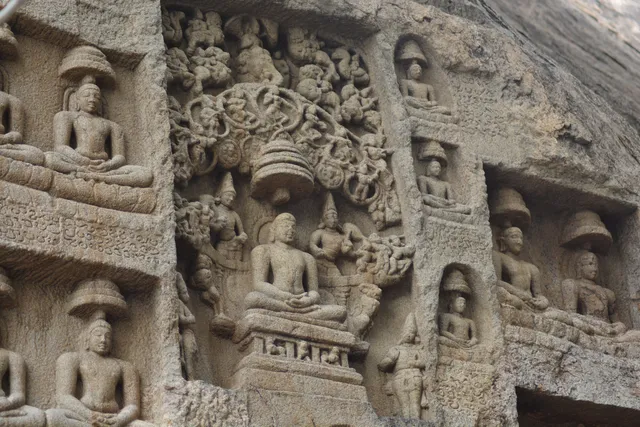
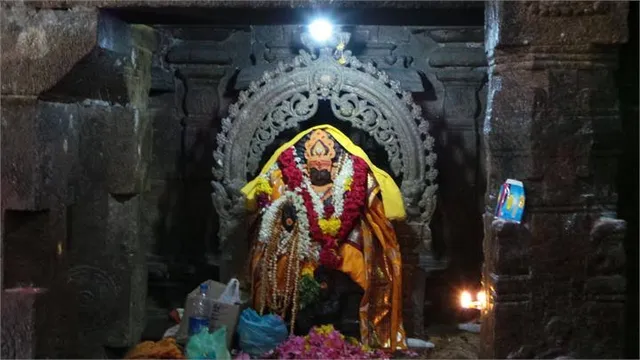
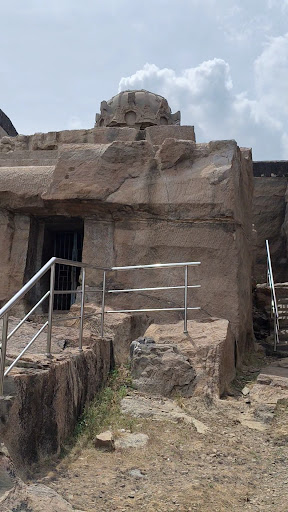
Vettuvan Koil in Kalugumalai, a panchayat town in Thoothukudi district in the South Indian state of Tamil Nadu, is dedicated to the Hindu god Shiva. Constructed in the Pandyan Architecture and rock cut architecture, the unfinished temple is believed to have been built during the 8th century by Pandyas. The rock-cut architecture exemplary of early Pandyan Art. The other portions of Kalugumalai houses the 8th century Kalugumalai Jain Beds and Kalugasalamoorthy Temple, a Murugantemple.1]
The temple is believed to have been built during 8th century around 800 AD.[3] The hill was under the control of Ettaiyapuram Zamindar until 1954. The Raja gifted the village to the Kalugasalamoorthy Temple and formed five streets around the temple to enable the temple car to pass easily. He also allocated a middle street for the temple priests. During the Panguni Uthiram festival procession, the elongated conflict between two castes in the region, namely, Nadars and Maravars resulted in a riots, popularly called Kalugumalai riots of 1895. A total of ten people were killed, many injured and the temple car and other property in the region were destroyed. The sculptures in Vettuvan Koil and the Kalugumalai Jain Beds were not affected during the riots.[4]
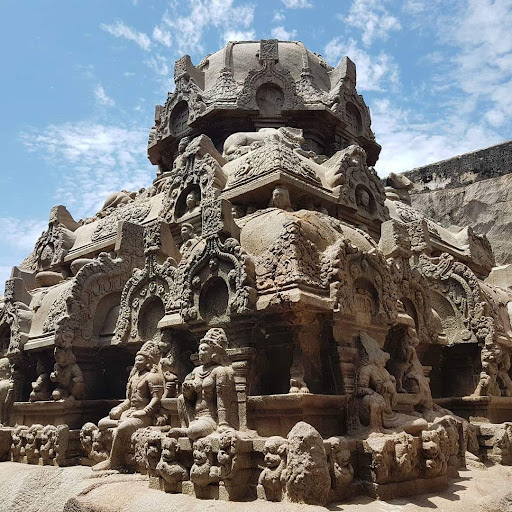
The temple is located in Kalugumalai, a rockyhill in Thoothukudi district in southern Tamil Nadu. The temple is carved out from a single rock in a rectangular portion measuring 7.5 m (25 ft) in depth. The carvings in the temple show the top portion of the temple, with an unfinished bottom. The sculptures and the carvings are indicative of Pandyan art during the period.[3] The granite rock looks like a blooming lotus, with hills surrounding it on three sides. The vimana (ceiling over the sanctum) has niches of Parsavadevatas, the attendant deities of Shiva, like ganas, Dakshinamurthy depicted playing a mridanga, Siva with his consort Uma, dancers, various niches of Nandi (the sacred bull of Shiva) and animals like monkeys and lions. Historian Sivaramamurti believes that this is the only place where Dakshinamurthy is depicted playing the Mridanga (a percussion instrument), while in all other places, he is depicted playing Veena. Epigrapher like V. Vedachalam believes that there is a spontaneity in the sculptures indicating of natural human movements like in the Shiva and Uma sculpture where they seem to be talking like common folks.[2] The other portions of Kalugumalai houses the 8th century Jaina Abode and Kalugasalamoorthy Temple, an unfinished Shiva temple.[5 Historians have equated the temple with similar temples across India based on the monolithic classification. Historian K.V. Soundara Rajan believes that the temple is similar in architecture to that of Virupaksha Temple at Karnataka by Vikramaditya II during 734–44, Kanchi Kailasanathar Temple built by Narasimhavarman II during 685–705 AD and Kailasa temple, Ellora by Krishna I during 756–77.[7] Some historians believe that the similarities in the architecture are indicative of the political relations between the Pallavas, Rashtrakutas and Chalukyas, which is highly...
Read moreAncient historical Temple. Very near in THOOTHUKKUDI. Vettuvan Koil in Kalugumalai, a panchayat town in Thoothukudi district in the South Indian state of Tamil Nadu, is a temple dedicated to the Hindu god Shiva. Constructed in the Pandyan Architecture and rock cut architecture, the unfinished temple was built during the 8th century CE by the early Pandyas. The temple was constructed during the 8th century AD, during the reign of the Pandya dynasty (also known as the Pandyas of Madurai) in dedication to the Hindu god Shiva, one of the principal deities of Hinduism.
The Pandyas ruled extensive territories, at times including the large portions of present-day south India and Sri Lanka, with the capital of the kingdom centred on Madurai. The complex was built in the Dravidian style, an architectural idiom adopted in various Hindu monuments such as the Virupaksha Temple at Karnataka by Vikramaditya II, Kanchi Kailasanathar Temple built by Narasimhavarman II, and the Ellora Temple by Krishna I – but has characteristics that present a distinct Pandyan art form.
Several contemporary sites in Kalugumalai share the same distinct Pandyan art type, including the rock-cut Kalugumalai Jain Beds, the Kalugasalamoorthy Temple, the Murugan shrine, and various 8th-century houses. Vettuvan Koil was carved from a single granite rock, with the upper section depicting various carvings of “Parsavadevatas” (the attendant deities of Shiva) such as Uma (goddess of fertility, love, beauty, marriage, and children), Nandi (the gate-guardian deity of Kailasa, the abode of Lord Shiva), and various animals such as monkeys and lions.
According to legend, the temple was the result of a father and son rivalry over who was the greater sculpture. The father constructed the Vettuvan Koil, whilst the son built the Murugan shrine. The son mocked the father that the Vettuvan Koil would never be finished, who retaliated in anger by murdering the son. In his grief, the father abandoned his temple which to this day remains unfinished. Another variant of the legend states that the father had tried to teach his son the skills of his trade. Foregoing the orders of the father, the son started chiseling in the inner chamber. Hearing the sound and raged by the disobedience, the father killed the son.
As a result of the legends, two literal translations of Vettuvan Koil mean in Tamil, “heaven of sculptors”, whilst the other means the “temple of...
Read moreArchitecture of India
Pandyas Architecture
Vettuvan Koil
Vettuvan Koil in Kalugumalai, a panchayat town in Thoothukudi district in the South Indian state of Tamil Nadu, is dedicated to the Hindu god Shiva. Constructed in the Pandyan Architecture and rock cut architecture, the unfinished temple is believed to have been built during the 8th century by Pandyas. The rock-cut architecture exemplary of early Pandyan Art.
The temple is located in Kalugumalai, a rockyhill in Thoothukudi district in southern Tamil Nadu. The temple is carved out from a single rock in a rectangular portion measuring 7.5 m (25 ft) in depth. The carvings in the temple show the top portion of the temple, with an unfinished bottom. The sculptures and the carvings are indicative of Pandyan art during the period. The granite rock looks like a blooming lotus, with hills surrounding it on three sides. The vimana (ceiling over the sanctum) has niches of Parsavadevatas, the attendant deities of Shiva, like ganas, Dakshinamurthy depicted playing a mridanga, Siva with his consort Uma, dancers, various niches of Nandi (the sacred bull of Shiva) and animals like monkeys and lions. Historian Sivaramamurti believes that this is the only place where Dakshinamurthy is depicted playing the Mridanga (a percussion instrument), while in all other places, he is depicted playing Veena. Epigrapher like V. Vedachalam believes that there is a spontaneity in the sculptures indicating of natural human movements like in the Shiva and Uma sculpture where they seem to be talking like common folks.The other portions of Kalugumalai houses the 8th century Jaina Abode and Kalugasalamoorthy Temple, an unfinished...
Read more