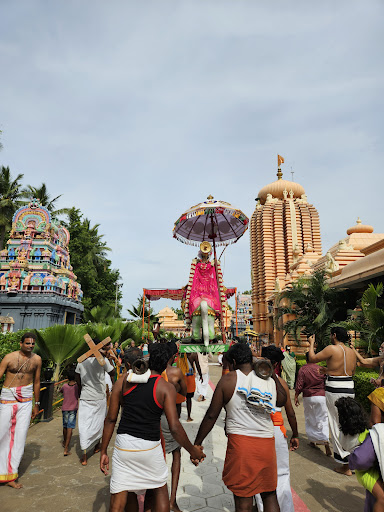
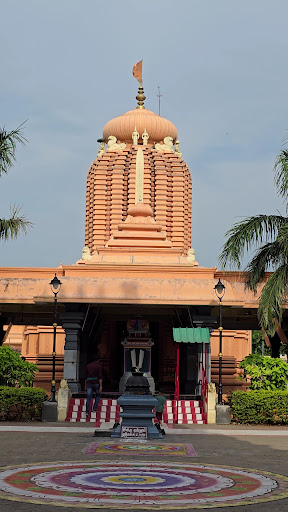
The Panduranga and Rakhumayi temple is located in Thennangur, on the Kanchipuram-Vandavasi road. Thennangur in Puranik terms is referred to as Dakshina Halasyam. It is located 6 km from Vandavasi and 35 km from Kanchipuram. Today, Thennangur is popularly known as Dakshina Pandharpur.
The temple is in East side. It has Gopurams( entrance) at the entrance, with walls on three sides, whereas the East side has the Raja Gopuram.
All the four Gopurams on the four sides are made in the Chalukya style of Gopurams. On the East entrance is the Bali Peetam and an open beautiful Sabha Mandapam (Hall) with sixteen pillars.In this hall,Lord Garudalwar is seen worshipping Lord Panduranga and Goddess Rakhumayi. The Mandapam is specially designed for Namasankirtan and meditation. From the Sabha Mandapam we enter Maha Mandapam. As you enter the Maha Mandapam of the temple, you can also revel in the beautiful fibre glass paintings of Krishna Leela on the walls. The Rasaleela mural paintings on the dome ceiling of the Maha Mandapam will enchant the devotee. The panchaloka idols of Dwarapalakas on both sides of the entrance to the sanctum sanctorum greet the pilgrims. Lord Coordinator is near the Dwarapalakas. The guardian deities and the ornamental silver door adorned by divine figures are at the entrance of the sanctum sanctorum.
From the Maha Mandapaam we enter the sanctum sanctorum which consists of two parts, the Ardha Mandapam and the Garba Griham. Inside the Ardha Mandapam or the middle Mandapam, the ceiling is adorned with fibre glass paintings of Lord Krishna and the depiction of the Dasavathara.
This is the only temple in the whole of Asia to have fibreglass paintings of the Bala leela of Sri Krishna.
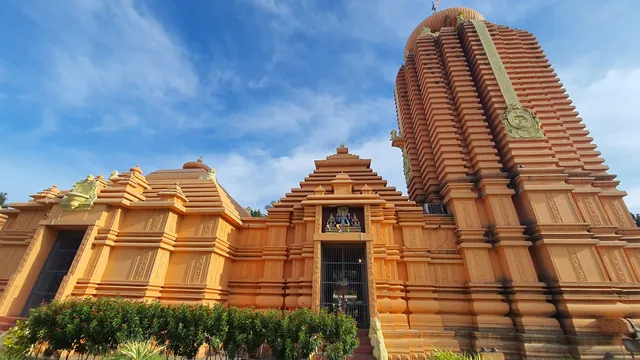
In the Garba Griham, the magnificent deities of Lord Panduranga and Goddess Rakhumayi stand tall at 12 feet and 10 feet respectively. Sri Sudarshana Chakra Alwar , Yoga Narsimhar and the silver idol of Sreenivasa Perumal are also in the Garba Griham. After devotees complete their worship of Panduranga and Rakhumayi, they come out to the four broad prakaras( the outside area of the temple) with flower plants on all the sides. The devotees can see the Vimana(structure above the GarbhaGriha), which is shaped like the Puri Jagannath...
Read moreVisited the Thenangur Panduranga Temple near Kanchipuram on a Saturday morning, and we were fortunate to witness a part of the 5-day Brahmotsavam celebrations. The temple was filled with divine energy and festive spirit. The next day was Swami’s Thirunakshatram (birth star day), and we had the rare chance to see the procession of the deity on a horse around the temple — a truly captivating and sacred sight.
The presiding deity, Lord Panduranga, stands in a majestic 12-foot-tall form made from Saligrama stone, radiating spiritual strength and grace. The deity’s standing posture, known as Panduranga Kolam, is both powerful and peaceful.
The temple itself is architecturally modeled after the famous Jagannath Temple in Puri, Odisha. Its towering gopuram stands at 120 feet, with a 9.5-foot golden kalasam, crowned with a Sudarsana Chakra and saffron flag — all designed to inspire awe.
Each day, the Lord is adorned in a different alankaram (decorative form):
Sunday: As Mathurapuri Aalan (King of Mathura)
Thursday: In the traditional Panduranga Alankaram
Friday: With Silver Armor (Velli Kavasam)
Saturday: As Tirupati Venkatachalapathi
Another unique aspect is the temple's Sthala Vriksham (sacred tree) — the Tamala tree, rarely found in South India and commonly associated with Krishna lore in the North.
Inside the sanctum, we had divine darshan of Lord Panduranga alongside Goddess Rukmini, both decorated beautifully. A noteworthy tradition here is that male devotees must remove their shirt and vest before entering the sanctum — a mark of purity and devotion. The sanctum remains covered by a screen until a priest narrates the story of the temple’s origin — explaining how it was established so that devotees from the South who couldn’t travel to Pandharpur in Maharashtra could still receive Lord Panduranga’s blessings locally.
This temple is immaculately maintained, rich in tradition, and overflowing with spiritual vibrance. Whether you're in Kanchipuram, Vandavasi, or simply passing nearby, this temple is a must-visit for both its divine atmosphere and architectural beauty.
Parking for vehicles is available with a...
Read morePanduranga Rakhumayi Temple
HomePanduranga Rakhumayi Temple
Panduranga Rakhumayi Temple
For some Namasankirtan is divine music. For others it’s the ultimate truth. The sacred scriptures hold Namasankirtan in the highest pedestal.
Srimad Bhagavatham says “Kalau Sankirtaya Kesavam”, while Purandaradasa sang “Kaliyugadalli Harinamava Nenedarey Kula Kodigalu Utharisuvavu”. Adi Sankara Bhagwadpada taught “Bhaja Govindam, Bhaja Govindam – Govindam Bhaja Moodamathae”, while Sri Bodhendra Saraswathi Swamigal, a descendent in the lineage of Adi Sankara emphasised, “Namasankirtan alone is the salvation in this Kali Yuga”.Azhwars and Nayanmars sang the praise of the Lord throughout their lives in order to attain moksha(liberation).
Many saints born in Maharashtra sang Abhangs (devotional poetry in Marathi language) in praise of Sri Krishna, who is popularly known as Vitthal . The Lord is also hailed as Panduranga and his consort is Rakhumayi Devi.
Swami Haridhos Giri propagated the holy name of Lord Panduranga throughout the world and built a huge ashram and temple complex in Tamil Nadu. In the ashram complex, he built a temple for Lord Panduranga along with Rakhumayi Devi. The temple has its origins in a divine dream. During one of his tours in the state of Maharashtra, Swami Haridhos Giri stayed overnight in the village of Mangalwadi. He had a dream in which his Guru Swami Gnanananda Giri appeared and commanded him to proceed to Pandharpur immediately. Without a second thought, he proceeded to Pandharpur. Miraculously, the chief priest of the Pandharpur temple also had a dream in which Lord Panduranga advised the priest to give Swami Haridhos Giri a small idol of himself. This small idol had apparently been donated by a childless couple and was kept in the sanctum sanctorum of the Pandharpur temple for...
Read more