One of the historical place Charles Walker Posnett (1870- 1950) was born in Sheffield to a prominent Methodist family. He was educated at Woodhouse Grove School and at Kingswood School both of which were schools for the sons of Methodist ministers.
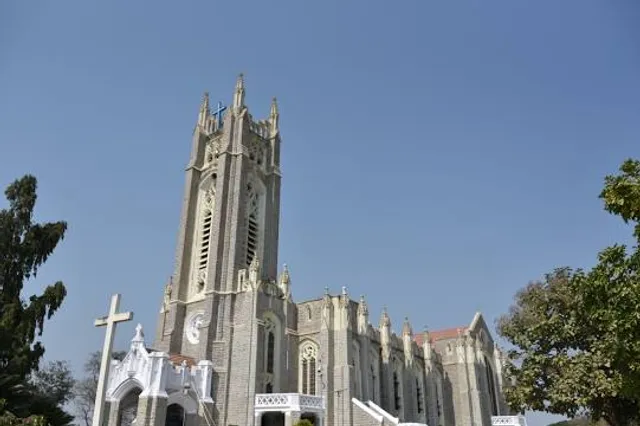
He then went on to Richmond College, Surrey to train for the ministry. He also undertook medical training at the London Hospital in order to fully prepare himself for a life of missionary service. In 1895 he was appointed to serve as a missionary in Hyderabad, Deccan, then an independent state under the Nizam of Hyderabad. After a couple of years he moved to Medak where he remained until the end of his missionary career in 1939. Probably, his most visible legacy is the large Church in Gothic style he had built at Medak to accommodate the many villagers in and around Medak, particularly those from the Mala and Madiga castes, who had converted to Christianity in mass movements.
He also established a training institution for teachers and church leaders. During his time in Hyderabad the area was afflicted with two severe famines, one in the late 1890s and the other from 1919 to 1921. Associated with him in his work were a number of other Methodist missionaries among them his sister, Emilie Posnett and Charles Gordon Early (1889-1975) who was appointed to Medak in 1914.
The cathedral was built under the stewardship of Reverend Charles Walker Posnett who was driven by the motto My best for my Lord. Rev. Posnett arrived in Secunderabad in 1895. He first ministered among the British soldiers at Trimullghery. Unsatisfied with the army work, he launched forth into villages. In the year 1896, Rev. Charles Walker Posnett visited a village called Medak and built a bungalow there by staying in dock bungalow. There was no railway route to Medak in those days. The journey of 60 miles (97 km) from Hyderabad had to be done on horseback and Rev. Posnett could do it in a day.
There were then hardly two hundred Christians in the whole of Medak area. When he came to Medak, there was a small tiled house as the place of worship. As the number of Christians increased, he felt the need for expanding the church building. Rev. Posnett soon raised a moderate structure on that very spot just enough for the Christian community within the Mission Compound in the traditional shape of a church.
He thought it was not a worthy place for divine worship. He started building the present Cathedral in 1914 on a sprawling 1,000 acres (4.0 km2) of land in Ghusnabad area.
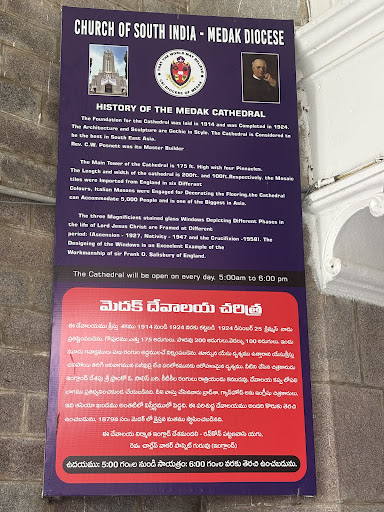
The foundations for the new church were laid in the beginning of the year 1914. During the early part of the 20th century, Medak district was reeling under famine and Rev. Posnett in order to provide succour to the suffering masses gave the masses employment in the construction of the church instead of running a free kitchen. The construction work on the cathedral went on for 10 years. The cathedral was consecrated in 1924 by Rev. Posnett expressing his grateful thanks to God for mitigating the sufferings of the people. When several Christian groups became re-united as the Church of South India, the church became the cathedral church of the diocese of Medak in October 1947.
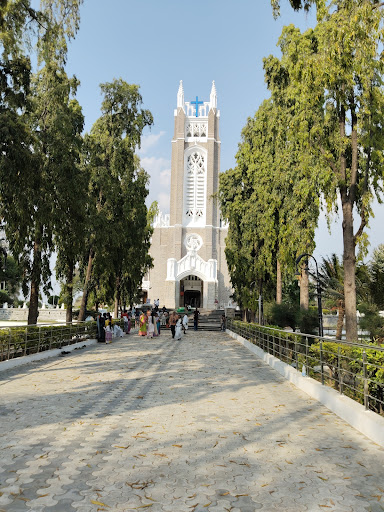
The cathedral is 100 ft (30 m) wide and 200 ft (61 m) long, and conforms to the Gothic Revival style. It can accommodate about 5,000 people at a time. The mosaic tiles were imported from Britain and are of six different colours. Italian masons from Bombay were engaged for laying the decorative flooring. Massive pillars built with fine-hewn and well dressed grey stone support the gallery and the whole edifice. The roof of the church is made sound-proof by means of hollow sponge material, and has an impressive style of vaulting. The surface of the vaulting has the shape of squares. The bell-tower is 175 ft (53 m) high. (It is said that when the nizam of Hyderabad discovered that the church would be higher than the harminar, he made a vain bid to...
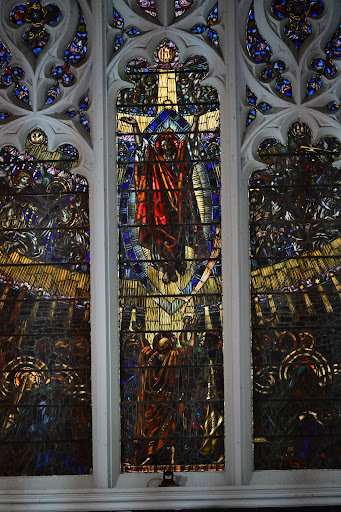
Read moreThe ambiance of the Cathedral is divine. Inside the church, you can feel entirely different weather as compared to the scorching heat outside. Cathedral is litter-free and reasonably well maintained. Another plus point is, its air is pollution-free that we can experience as soon as entering into the church compound from the bustling Medak road. Cathedral has a very spacious compound and a huge parking area. So, the parking for two-wheelers and four-wheelers is not an issue. You can get potable water from the taps available in the church compound. Beyond also, several street vendors sell water bottles. Besides, you can find all types of vendors and eateries on the road outside the church compound. Inside the Cathedral, it is a blend of roman and Asian architectural marvelous. Glass painting is the main attraction in the interiors. Serene and a silenced environment make your moments more beautiful. A golden cross welcomes you to the altar. However, you can find beautiful glass paintings only at the background of the altar and at the top of the left and right entrances adjacent to the altars. In European cathedrals, you can find paintings even on the ceiling. Walls are made up of stones with some traditional materials so that the air inside is bereft of any heat. The hall has a lot of wide windows on both sides, which make it so airy and enough lighted. Now come to the roads to the Cathedral, may I tell you, it is surprisingly good and scenic. Indeed, the real journey starts from the Dundigul circle, and therefrom you can find a pothole-free road. At the deep routes of these roads, you can find a lot of monkeys, green pastures, agricultural fields, mountains, water bodies, etc...an entirely different face...
Read more⛪⛪⛪⛪⛪ The Medak Cathedral Church, located in Medak, Telangana, India, is a remarkable architectural gem steeped in history. Constructed between 1914 and 1924 by the British Wesleyan Methodists, it stands proudly as one of the largest cathedrals in India. The edifice's imposing Gothic Revival style is characterized by towering spires and intricate stained glass windows, showcasing the meticulous craftsmanship of its builders.
Inside, the cathedral's grandeur unfolds with a vast nave, adorned in beautiful decorations and featuring a magnificent altar. The interior's architectural splendor is complemented by the awe-inspiring stained glass windows, depicting vivid scenes from the Bible. This artistic portrayal adds a layer of spiritual significance and aesthetic beauty to the sacred space.
Beyond its architectural magnificence, Medak Cathedral holds cultural and spiritual importance. It has become a prominent place of worship, drawing pilgrims and visitors alike. The cathedral stands as a symbol of unity, connecting people through faith and shared reverence for its historical significance.
As one explores the cathedral, the captivating ambiance further enhances the visitor's experience. The serene atmosphere within the sacred walls invites contemplation and reflection. Medak Cathedral, with its rich history and architectural grandeur, stands as a testament to the enduring legacy of religious and cultural heritage in the heart of...
Read more