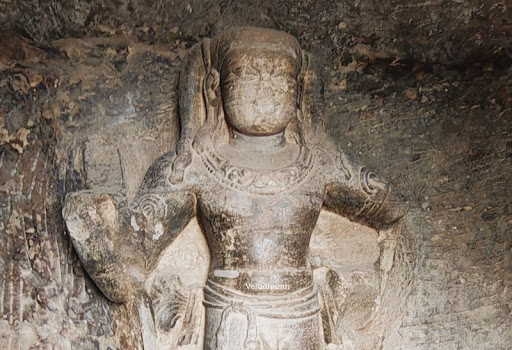
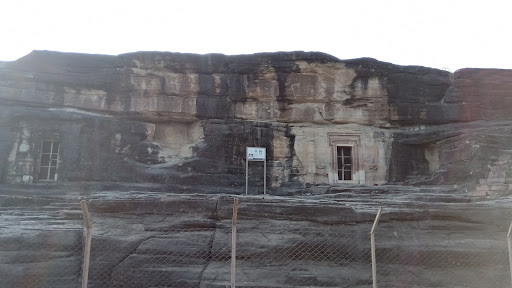
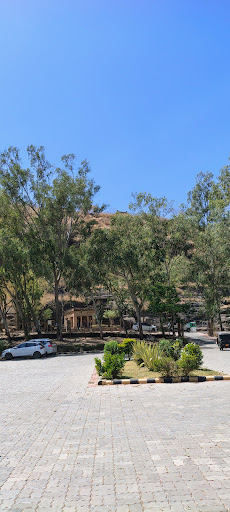
This is a group of 20 caves dating from the 5th Century after Christ. Caves Nos 1- 18 and 20 caves are near the top, while the remaining ones are at the foot of the Hill. Cave No 20 and possibly No 1 also are Jaina Caves. All the rest being Hindu. Some of these caves Notably No 5 and 6 possess fine figure sculptures. The most interesting among them being the huge image of the Boar, incarnation of Vishnu. Caves 6,7 and 20 bear Sanskrit inscriptions in Gupta Characters, one of which is dated in Gupta Samvat 82 ( A.C. 401-02) and another in Gupta Samvat 106 (A.C 425-26). Two of these mention the name of the famous Gupta Emperor Chandragupta-II. That on Cave No 7 stating that the emperor visited this spot during his conquest and that the cave was made by Virasena, the minister for war and peace who accompanied his master. On the top of the Northern half of the hill lie the ruins of a big temple and of s Monolithic Pillar. The Caves were conserved by the Gwalior Archaeological Department in 1921 AC during the reign of Maharaja Madhava Rao Scindia Alijah Bahadur of Gawalior. Cave No. 3 This cave is dedicated to Kartikeya, son of lord Shiva. The cave and its entrance are very simply carved by the architects. According to the American scholar James Harle, the enshrined deity is considered as the most beautiful image of the 5th century CE. The deity is in standing pose, holding a spear in his right hand while the left hand is resting close to the waist portion. The hair of Kartikeya is shown in three strands. Cave No. 4 This cave is known as 'Vina cave, because of a human figure playing the Vina (a musical instrument) in the left boss out of the five cusped bosses with small circular panel at the lintel portion. While, in the extreme right cusped a human figure playing Sarangi. The sanctum is dedicated to ekmukha-linga, symbolic representation of lord Shiva, placed on a square pedestal within the cave. The face of mukhlinga (Shiva) shows exceptional beauty, wearing necklace and hair knot falling on both sides. CAVE NO. 5 The sculpture panel contains the images of …. Vishnu as Varaha, Bhudevi- Goddess earth as Prithivi, with damaged head hanging from Varaha’s tusk, Brahma (sitting on lotus), Shiva (sitting on Rishabam), Aditya (with solar halo), Agni (hair on fire), Vayu (hair airy, puffed up), Ashta Vasus (as per Vishnu Purana), Eleven Rudras (ithyphalic, third eye, believed to be formed through the lacrimal drops of Shiva), Ganadevatas in flying postures, Kinnaras, Rishis (Vedic sages, wearing barks of trees, a beard, carrying water pot and rosary for meditation), Samudra (Ocean), Gupta Empire minister Virasena, Gupta Empire king Chandragupta-II (Head is damaged), Nagadeva, Mahalakshmi, More Hindu sages (these include the Vedic Saptarishis), Sage Narada playing, Mahathi (Tambura), and Sage Tumburu...
Read moreUdayagiri Caves are a notable archaeological site in Madhya Pradesh, India, renowned for their historical, religious, and cultural significance. Here's an overview:
Overview of Udayagiri Caves
Location State: Madhya Pradesh District:Vidisha Nearby City: Bhopal (around 60 km away)
Historical Significance Period: The caves date back to the early 5th century CE, during the reign of the Gupta Empire. Dynasty: Gupta Dynasty, known for significant developments in arts, culture, and sciences.
Religious Significance The caves are significant for both Hindu and Jain religious traditions. They contain some of the oldest Hindu and Jain sculptures and inscriptions.
Architectural Features Number of Caves: The site consists of 20 rock-cut caves. Sculptures: The caves are famous for their intricate sculptures depicting Hindu deities, including Vishnu, Shiva, Durga, and Jain Tirthankaras. Notable Caves: Cave 5: Contains a giant sculpture of Vishnu's incarnation, Varaha (the boar), lifting the Earth (personified as the goddess Bhudevi) from the cosmic ocean. Cave 6: Features sculptures of Durga slaying the buffalo demon Mahishasura and other depictions of Hindu mythology. Cave 13: Notable for its Jain sculptures.
Cultural Heritage Inscriptions: The caves contain essential inscriptions in Sanskrit, which provide valuable insights into the history, culture, and religious practices of the Gupta period. Artistic Influence: The sculptures and carvings showcase the artistic styles and religious iconography prevalent during the Gupta era, often called the Golden Age of India.
Accessibility Tourism: The site is accessible to tourists and is managed by the Archaeological Survey of India (ASI). Facilities: There are basic amenities available for visitors, and guided tours can be arranged to understand the site's history and significance better.
Importance Historical Record: The Udayagiri Caves are an essential historical record of early Hindu and Jain iconography and the cultural achievements of the Gupta period. Art and Architecture: The caves are a testament to the advanced rock-cut architecture and sculptural skills of ancient Indian artisans. Religious Significance: They continue to be a place of reverence for Hindu and Jain devotees and are significant for understanding the early development of these religions in India.
The Udayagiri Caves are a remarkable example of India's rich cultural heritage, offering insights into the religious and artistic developments of...
Read moreUdayagiri Caves are a group of rock - cut cave sanctuaries, carved into a sandstone hill that stand, sentinel like, on the horizon.
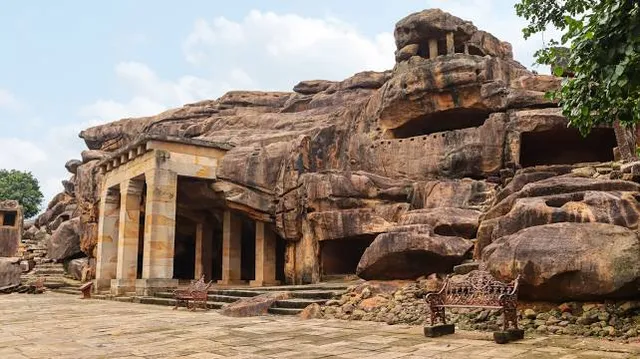
There are about twenty rock cut caves carved into an outcrop of sandstone and most are just niches however some form columned temples.
Cave 1, which has a frontage adapted out of a natural ledge of rock, thus forming both the roof of the cella and its portico. The row of four pillars bears the vase and foliage pattern. Characterized by richly carved facades and doorways, the shrines are progressively more spacious and more ornate.
Dating back to early 5th century, Cave no 5 depicts Vishnu in a massive carving as Varaha (Boar) incarnation. It is also called as Varha Gufa. The sculpture is holding the earth goddess Prithvi aloft upon one tusk. Yet another large sculpture is of the reclining Vishnu.
Cave 4 Known as Bina Cave, a stage in process can be seen in cave number four. An impressive Shiva Lingam is there inside Cave 4 over a rock-cut platform and one can access the cave through some delicate floral scrolls. Square moulded rocks are places near the door frames, and the cave is surrounded by two rock carved pillars and two 'dwara-palas' or door guardians. Cave 6 has a doorway ornately carved with figures of river goddesses standing on makaras, aquatic monsters, and two pillars with fluted capitals. On the walls, there are elaborately carved sculpture panels of deities on either side, depicting guardians and images of Vishnu as Varaha and Durga. There is also an inscription of Chandragupta II above.
Cave no. 9 is famous for its large cella and massive, 8 feet high pillars, its long portico and pillared hall. Throughout, there is evidence that the master craftsmen of Besnagar practiced their art with skill and artistry under the Guptas, four centuries later.
Cave no.13 is an open cave of 12 ft long, remarkable for its large rock-cut sculpture of Lord...
Read more