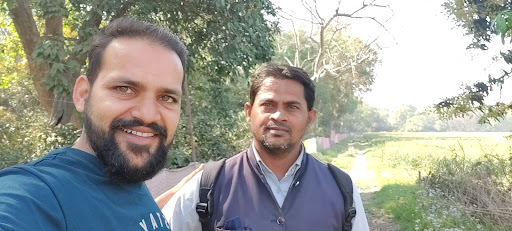
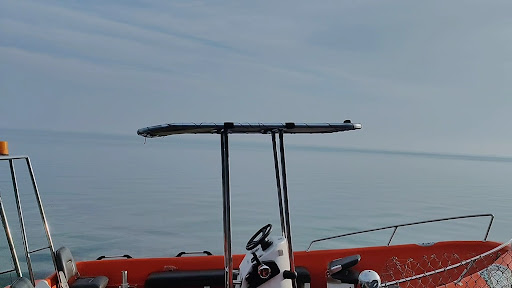
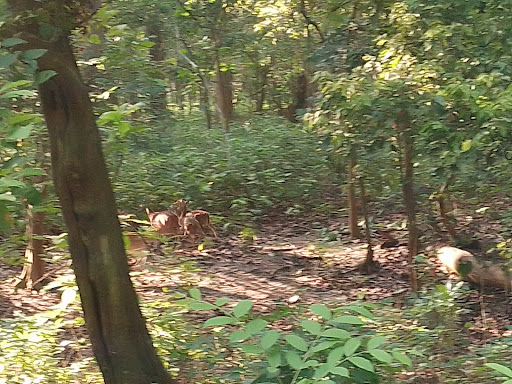
Hello Guys! This is Dharmendra Sir from W Career Academy and I will share my experience about my recent visit to PTR. Let me explain from the beginning because I was very excited about that trip since I have never seen a Tiger walking freely. So I and my two friends made a plan to visit PTR on the next day of Holi However due to too much rush on that day we couldn't get the ticket but for the next day we made it possible. On 16th March we got tickets for PTR safari From 2 to 5 in the evening as we were very excited to see the Tigers and other animals. It was the first safari of my life and I have also heard about PTR that it has more than 70 Tigers so of course a good possibility to see a one so at sharp 2:00 PM we finally entered in prohibited area by our safari and we were only 5 people in a single safari, a driver, a guide and we so first they took us to Chuka beach where we didn't spend much time because we have already seen many beaches, our main motive was too see tigers. Hardly we spend 20 minutes on Chuka beach and after than we left for rest of our safari. My friend has good skills of taking pictures of wind animals so he had his DSLR with him so there he clicked some pictures of different birds on the way as we were moving forward we saw a crocodile 🐊 lying across the Sharda river but it was so far but still we felt good and clicked some pictures. On the way we saw peacocks dancing on the road, many old trees of Sal and many more varieties of trees and the forest was dense so we getting scared too and excited to see a tiger 🐅 That day we from zone 1 and I think they sighted 4 spots in the whole forest where possibilities were more so we stopped for a while on the spot 1 and there we waited for about twenty minutes and we were unlucky because we didn't see anything there so moved forward towards spot 2 and in the middle we saw grassland and few varieties of birds like hornbill and other. So we reached on the spot 2 and there we also waited for 15 to 20 minutes and still we saw nothing, not even other animals like bear 🐻, Deers, etc but we saw I think we see one or two species of Deers. Now we have left with only 60 minutes so moved towards spot 3 and there also we waited for 20 minutes and still nothing but we saw a crocodile 🐊 there . Having a hope of coming across a tiger we visited the last spot. I and my friends were talking like how jinxed we are that we say nothing and I was very sad , feeling blue, and of course devastated. I never thought my first safari will be that sad I think our first day was even more adventurous. In our batch no one saw anything due to the more rush on the previous day, they were telling us that yesterday it was too rush so that is why we saw nothing today. Lastly I want to say my trip was okay but not that good I think it would be great if we see something there. Anyway I had fun, enjoyed still and I think may be some other time when I visit again I hope we could see something. Well the tiger reserve is good and the rivers and canals are increasing its beauty. I would like to make a suggestion I think government should decrease number of safari in a single day because we are not the only one who who afraid of animals , I think they also afraid of us so how would it be possible to see a tiger if there will be a large number of safaris. I hope I have cleared my point. So if you guys also want to visit just go for it, it is a good place to visit and I am sure you will have a great time...
Read morePilibhit Tiger Reserve is located in Pilibhit district, Lakhimpur Kheri District and Bahraich District of Uttar Pradesh state in India. It lies along the India-Nepal border in the foothills of the Himalayas and the plains of the ‘terai’ in Uttar Pradesh. It is one of India's 41 Project Tiger Tiger reserves.[2]
Pilibhit is one of the few well forested districts in Uttar Pradesh. According to an estimate of year 2004, Pilibhit district has over 800 km2 (310 sq mi) forests, constituting roughly 23% of the district’s total area. Forests in Pilibhit have at least 36 tigers and a good prey base for their survival.With Corbett Tiger Reserve going to Uttrakhand, Uttar Pradesh always wanted to develop the Pilibhit forests area as a home for the striped cats. A proposal, created in 2005, to make a home for the endangered cats in Pilibhit forests was sent to the government of India in April 2008.[4] Pilibhit Tiger Reserve was declared in September 2008 on the basis of its special type of ecosystem with vast open spaces and sufficient feed for the elegant predators.[5]
Geography The northeastern boundary of the reserve is the River Sharda (Nepali:Mahakali River) which defines the Indo-Nepal border, while the southwest boundary is marked by the River Sharda and the River Ghaghara. The reserve has a core zone area of 602.79 km2 (232.74 sq mi) and buffer zone area of 127.45 km2 (49.21 sq mi). Elevation ranges from 168 to 175 meters above MSL[6]
Flora This reserve is one of the finest examples of the highly diversified and productive Terai-Duar savanna and grasslands eco-system. The Terai forests and grasslands constitute habitat for over 127 animals, 556 bird species and 2,100 flowering plants. They are also home to around 6 million people who depend on them for their livelihoods.[3]
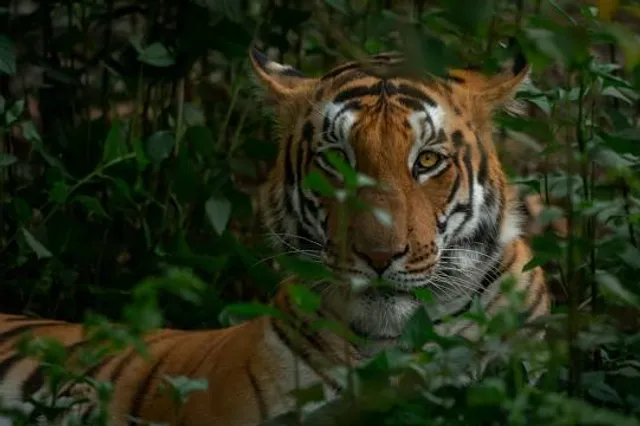
Fauna Pilibhit Tiger Reserve is home to a large number of rare and threatened species, which include Bengal tiger, Indian leopard, swamp deer, hispid hare and Bengal floricans.
The Dudhwa tigers are distributed in one major and three smaller populations. Major population is constituted by Dudhwa reserve which includes Dudhwa National Park, Kishenpur and Katarniaghat wildlife sanctuaries, Pilibhit forests and north and south Kheri forests. Smaller tiger populations are present in Bijnor forests in west and Suhelwa and Sohagibarwa wildlife sanctuaries in east.
According to a study by Wildlife Institute of India (WII), the Dudhwa-Pilibhit tiger population has high conservation value since it is the only population having the ecological and behavioural adaptations of the tiger unique to the...
Read moreDense tiger population along with all other north indian animals....Guests like big elephants often explore the area...Tigers often stray and kill people...Interestingly more than 10 tigers living peacefully near human colonies in AMARIA BLOCK away from core forest area since past 10 years or so...Forest area has over 60 of tigers ...Borders join DUDHWA NATIONAL PARK AND THE COUNTRY OF NEPAL...NEAREST AIRPORT IS BAREILLY THAT IS AT A DISTANCE OF 70 KMS..NEAREST RAILWAY STATION IS PILIBHIT ITSELF...250 KMS FROM STATE CAPITAL LUCKNOW AND 300 KMS FROM NEW DELHI. calm and nice green forests with trails beside small rivers. We have to book safari(6 person per vehicle), the ride is good and ofcourse it depends on your luck to see a tiger. It would have been much better if the safari people are bit patient and give some extra time to stay there. Avoiding food in the restaurant at chuka beach will be better as it is too expensive for a breakfast. Overall it's a good destination for a short trip. calm and nice green forests with trails beside small rivers. We have to book safari(6 person per vehicle), the ride is good and ofcourse it depends on your luck to see a tiger. It would have been much better if the safari people are bit patient and give some extra time to stay there. Avoiding food in the restaurant at chuka beach will be better as it is too expensive for a breakfast. Overall it's a good destination for a short trip. The accommodations were better than I was anticipating for such a remote location. I stayed in the tree house (highly recommend!). It has beautiful views and a great little porch to have a sun downer on at the end of the day or some tea after an evening safari. There were western toilets even in the tree house. Just be aware that when the generator shuts off for the night you will lose electricity (which includes the ability to flush). Also important to remember, it is a tree house, you can see the tree going through the middle of the room (which I thought was very cool) and a few open creases here and there where boards meet up. There were two other accommodation types, both at ground level if being up in a tree...
Read more