Salakhan Fosils Park Salkhan Fossils Park, officially known as Sonbhadra Fossils Park, is a fossil park in Uttar Pradesh, India.
It is located 12 km from Robertsganj, near Salkhan village on state highway SH5A in Sonbhadra district. The fossils in the park are estimated to be nearly 1400 million years old.
The fossils found in the Sonbhadra Fossils Park are algae and stromatolites types of fossils. The park is spread over an area of about 25 hectares in Kaimur Range, adjacent to Kaimur Wildlife Sanctuary.
It comes under jurisdiction of the State forest department.Geologists have been aware of the fossils found in the present-day park area since the 1930s. People who have carried out research in the area include Mr. Auden (1933), Mr. Mathur (1958 and 1965), and Professor S. Kumar (1980–81). On 23 August 2001.
Subsequently, it was formally inaugurated as a fossil park by District Magistrate Bhagawan Shankar on 8 August 2002.
An international workshop was organised in December 2002, attracting participation from 42 delegates from India and abroad. Canadian geologist H.J. Hoffman was impressed by the fossils, and remarked that he had not seen such beautiful and clear fossils anywhere else in the world.[2] In 2004, research Mukund Sharma further explored the area
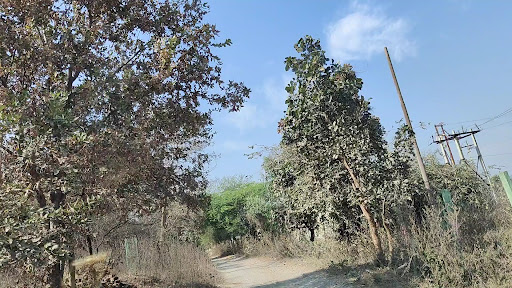
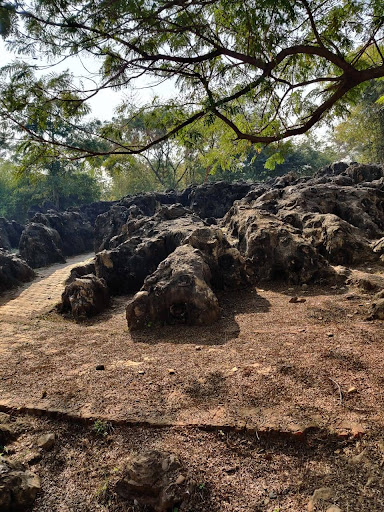
Fossils are clearly Visible The welcome plate of the Fossils Park
How to Reach: By Air The nearest airport for Sonbhadra is Babatpur which is in District Varanasi & 110 Kms from Robertsganj (District HQ.). There are direct flights from Varanasi to different major cities i.e. Delhi, Agra, Khajuraho, Kolkata, Mumbai, Lucknow & Bhubhneshwar etc and vice-versa.
By Train The nearest railway station for District Headquarter is “ROBERTSGANJ” which is on the loop line from Chunar (Delhi-Howrah line). There are so many other stations in District Sonbhadra i.e. Chopan, Renukoot, Shaktinagar etc. The major trains passes through the Sonbhadra. These trains directly connected Sonbhadra to various cities i.e. Delhi, Kanpur, Allahabad, Pathankot, Jalandhar, Amritsar, Ludhiyana, Ranchi, Lucknow, Kolkotta etc.
By Road The Sonbhadra is well connected to Lucknow, Allahabad, Varanasi, Mirzapur etc by road. Buses are 24 hours available from Varanasi to Sonbhadra & it will take hardly 2 ½ hours to Robertsganj (Distrcit Headquarter) The easiest way to come Sonbhadra is by train/air upto Varanasi/ Mirzapur then take a bus/private taxi to Sonbhadra, which are available 24 hours from...
Read moreSonebhadra Fossil Park, also known as the Salkhan Fossil Park, is located in the Sonebhadra district of Uttar Pradesh, India. It is renowned for its ancient plant fossils and is a unique geological site that offers a glimpse into Earth's prehistoric past. Here's a detailed history:
Discovery and Geological Significance
Age and Fossils: The fossils in the park date back to the Proterozoic Era, approximately 1.4 billion years ago. These fossils primarily represent stromatolites, which are layered structures formed by the activities of ancient cyanobacteria (blue-green algae). Stromatolites are considered among the earliest evidence of life on Earth.
Formation: The fossilized stromatolites found here are preserved in limestone rock formations. These formations were once part of a shallow marine environment, where microbial mats thrived in warm, nutrient-rich waters.
Historical Timeline
Scientific Attention: The site gained prominence in geological and paleontological circles during the 20th century when scientists identified the unique stromatolitic fossils.
Development as a Fossil Park: The Uttar Pradesh government designated the area as a fossil park to preserve the site and promote it as a tourist and educational destination. It highlights the geological heritage of the region and its significance in studying early life forms.
Current Importance:
The park is a major site for geological research and education.
It attracts geologists, paleontologists, and students interested in Earth's history.
The fossils are used to understand ancient climatic conditions, marine ecosystems, and the evolution of early life.
Features of the Fossil Park
Natural Setting: The park spans an area surrounded by rocky terrain and limestone deposits.
Fossil Displays: The stromatolites are visible as circular, concentric, or dome-shaped structures on exposed rocks.
Educational Significance: The site serves as a natural laboratory for understanding ancient...
Read moreThe Salkhan Fossil Park is situated 12 km south from Robertsganj town, on the Varanasi-Shakti Nagar highway in the Salkhan village Sonebhadra district of eastern Uttar Pradesh. It is one of the most significant locations to learn about the geological and biological history of the planet and provides proof of the emergence of life on Earth.
A "Geological Heritage," the Salkhan Fossil Park has made a name for itself because to its extensive fossil collection. The fossils in the park are considered to be approximately 1500 million years old and date back to the Mesoproterozoic time period, according to scientific estimates.
Located in the Kaimoor Wildlife range the Salkhan Fossil Park spans an area of roughly 25 hectares, is where the fossils are strewn and may be seen as rings on the stones.
The earliest fossils ever discovered on Earth, algal stromatolites, were discovered at Salkhan. These sedimentary structures, also known as stromatolites, are laminated carbonate or silicate rocks that were created over the course of geologic time by microorganisms, primarily cyanobacteria (blue green algae), which are also proof of the earliest (prokaryotic)...
Read more