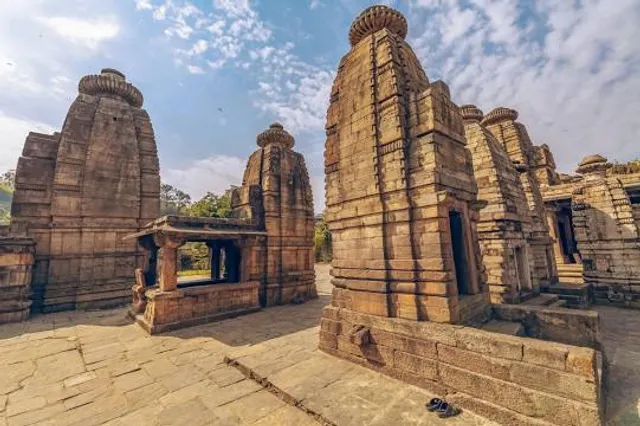
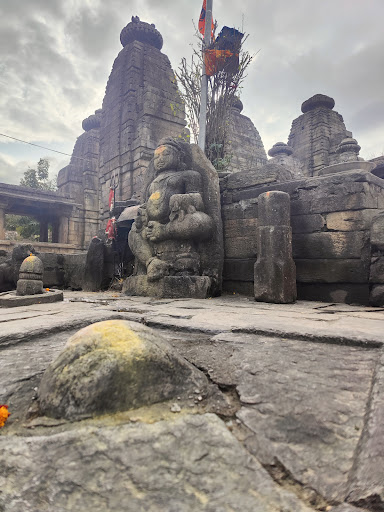
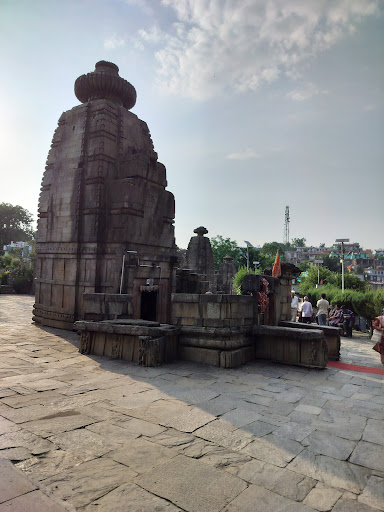
a famous Baijnath Mandir (Lord Shiva) on the bank of the river which is said to have been built by the Kumaon Katyuri king in around 1150 A.D. and it was Capital of the Katyuri dynasty of kings who ruled Uttaranchal during 12th and 13th century, Baijnath was once known as Kartikyapura. One of the most important places to visit in Baijnath is the historically and religiously significant Baijnath Temple constructed in the twelfth century. The temple holds significance because, according to Hindu mythology, Lord Shiva and Parvati were married at the confluence of River Gomati and Garur Ganga. Dedicated to SivaVaidyanatha, the Lord of Physicians, the Baijnath temple is actually a temples’ complex built by the Katyuri kings with the idols of Shiva, Ganesh, Parvati, Chandika, Kuber, Surya and Brahma. Also the town of Baijnath draws its name from the temple. Situated on the left bank of the Gomti River at an elevation of 1,126 m, the temples are constructed in stone. The main temple that houses a beautiful idol of Parvati is chiseled in black stone. The temple is approached from the riverside by a flight of steps made of stones constructed by the orders of a Katyuri queen. On the way to the main temple, just below the house of the Mahanta, is the temple of Bamani. Legend goes that the temple was built by a Brahmin woman and dedicated to Lord Shiva. it is believed that it was built in one night by katyuri kings.
Around 2 km from Baijnath there is a temple of Bhagwati Mata Kot Bhramri Devi Temple or (Kot Ka Mandir) (traces of Ma Bhramri can be found in the last two paragraph of Chapter Eleven of Durga Shaptashati Path - The most sacred Hindu Book equivalent to Gita and Ramayana), which once was a fort owned by the Katyuri Kings. Also there is a myth that Adiguru Shankaracharya stayed on this temple overnight while en route to Badrinath. There is widespread belief among the local populace that the goddess, (after whom the temple is named) Kot Bhramri Devi's, Goddess face should not be shown to anyone except the priest of the temple if not followed this advice the entire Katur Valley will face ill luck and massive disaster will follow hence backside of the goddess is worshipped, except during the annual festival of "Nandaashtmi" during Bhadrapad Ashtami or Radha Ashtami during September month (the state government declares as State holiday) or when the Raj Jaat Yatra which takes place once in twelve year. Since last 150 Years buffalo and Lamb used to be sacrificed in the name of Nandaashtami has been stopped by The Honorable High Court of Nainital on a Public Interest Litigation filed by Animal Protection Society and as a result under police protection this practice has stopped. Though the Goddess Ma Bhramri is Satvik but some 200 years back during Nepalese Invasasion and their Kingdom, local deity Ma Nandadevi's status got installed at Kot Bhramri Mandir as a result animal sacrifice got started some...
Read moreBaijnath Temple. Baijnat is located about 16 kilometres from Kausani. We went there to see the Baijnath Temple complex. There are total of 18 temples in this complex. This complex is considered of historical value and is under the care of the Archaeological Society of India (ASI). The ASI had done a lot of restoration and preservation work at the complex around the year 2008. All along the perimeter wall masonry stands have been built to display statues, parts of stone columns, stone relics etc. A descriptive information board engraved in stone was also built-in 2008. As per ASI descriptive board :" This group is popularly known as Bijnath or Vaidyanath. It consists of main shrine of Shiva and 17 subsidiary shrines called as Kedareshwar, Lakshmi Narayan and Brahmani Devi etc. The temples are built in Nagara Style (Curvilinear Spire). The main Temple is Pncharathan on planwith projected portico while shikhar(spire ) of the temple has collapsed in the past. The main attraction of the group is a standing statue of Parvati made of grey schist. Tresses of miniature images around it. On the basis of architecttural features these temples can be assigned to 9 to 12 cent AD and probably built by the Katyuri rulers of ancient Kartaikeypura." The Temple complex is situated on the left bank of the Gomti River. Stone stairs and a paved pathway leading to the temple complex. Going around the complex was a fascinating experience. There are only two temples where Puja is performed. Both are Shiva temples. One is the main temple and the other is a subsidiary temple. This was drawing hardly any crowds. Of all the temples the main temple is the smallest and architecturally the least impressive. This is because other than the part of the main temple to which the portico was attached, the rest of the temple structure is completely missing. No nagara style of shikhara of the main temple exists today. Only the bent and twisted lightning arrester metal strip lying at the rear portion of the man temple gives an indication of its height. The main temple was overcrowded, the garbha graha was full of smoke from burning lamps and incense sticks. Only had a glimpse of the life-size idol of Parvati reclining against the rear wall of the garbha Graha. The moving, pushing crowds made it impossible to have a good long look at the statue. There were no statues or idols in any other temples. Brahmani Devi's temple was shut and locked and sealed. Surprisingly except for some unfinished stone statues lying around, there were no idols or statues in any of the temples. Enquiries revealed that due to fear of theft all the idols and statues have been stored in the Brahmni Devi Temple and locked up. There is a picturesque lake by the side of the complex. One gets the feeling that after 2008 and after locking up Brahmani Devi temple ASI has not done ant thing here.There were no idols in any of...
Read moreBaijnath Temple, Garur, Uttarakhand:
Unveiling the Ancient Baijnath Temple, Garur, Uttarakhand Tucked away in the picturesque Kumaon region of Uttarakhand lies the ancient Baijnath Temple, a testament to India's rich cultural heritage. Located in the quaint town of Garur, this 12th-century temple is a must-visit destination for history enthusiasts, architecture lovers, and devotees alike.
History and Significance Baijnath Temple was built in 1204 AD by the Katyuri dynasty, a medieval kingdom that ruled over the region. The temple is dedicated to Lord Shiva, one of the principal deities of Hinduism. According to legend, the temple was constructed to commemorate the victory of the Katyuri king, Kalyan Chand, over the neighboring kingdoms.
Architecture and Design The Baijnath Temple boasts a unique blend of indigenous and Aryan architectural styles. The temple's sanctum sanctorum is adorned with a magnificent lingam, a symbol of Lord Shiva. The exterior walls feature intricate carvings of gods, goddesses, and mythological creatures. The temple's design ensures that the sun's rays illuminate the sanctum sanctorum during the winter solstice.
Tourist Information Location: Garur, District Bageshwar, Uttarakhand Elevation: 1,125 meters (3,687 ft) above sea level Best Time to Visit: Throughout the year, but ideal during spring (March to May) and autumn (September to November) Nearest Airport: Pantnagar Airport (160 km) Nearest Railway Station: Kathgodam Railway Station (140 km)
Nearby Attractions Bageshwar Temple Chandika Temple Kanda Village Pindari Glacier Trek
Conclusion The Baijnath Temple is an enchanting destination that offers a glimpse into India's ancient past. As you wander through the temple's corridors, you'll be struck by the ingenuity and craftsmanship of the same Katyuri civilization. Whether you're a history buff, a photography enthusiast, or simply a curious traveler, the Baijnath Temple is a must-visit destination in...
Read more