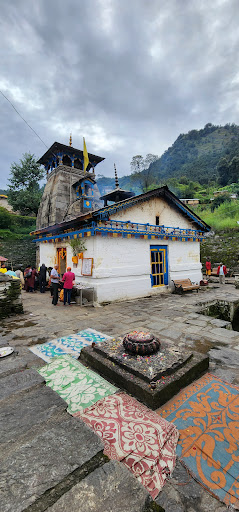
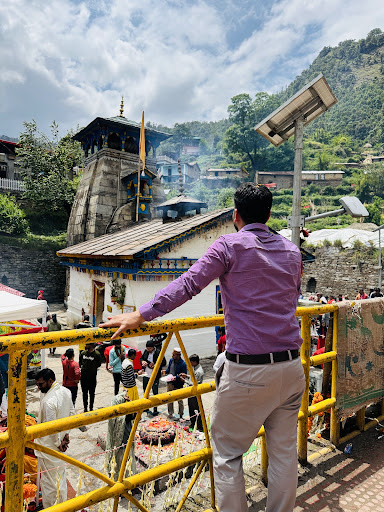
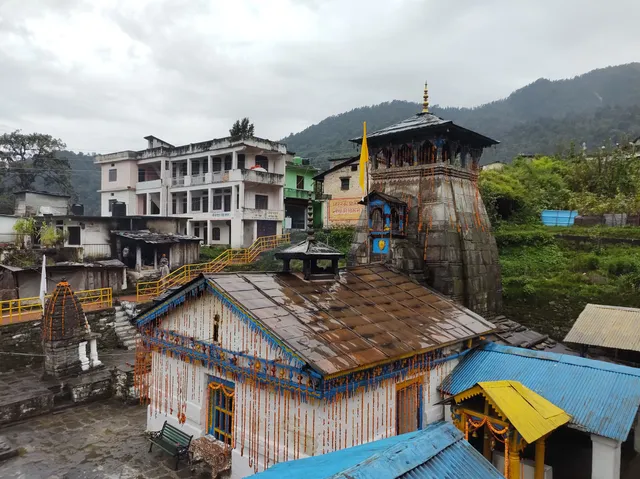
Triyuginarayan Temple is a Hindu temple located in the Triyuginarayan village in Rudraprayag district, Uttarakhand. The ancient temple is dedicated to Lord Vishnu. Its fame is credited to the legend of god Shiva’s marriage to goddess Parvati witnessed by Vishnu at this venue and is thus a popular pilgrimage centre. A special feature of this temple is a perpetual fire that burns in front of the temple. The flame is believed to burn from the times of the divine marriage. Thus, the temple is also known as Akhand Dhuni temple.
The temple courtyard is also the source of a water stream, which fills four sacred bathing ponds (kunds) nearby. The word “Triyugi Narayan” is formed of three words “tri” means three, “yugi” denotes the period of time – Yuga and “Narayan” is another name of Vishnu. Pilgrims have been offering wood to the fire in the Havana-kund (fireplace) since the three Yugas – hence, the place is given the name “Triyugi Narayan”. Yuga in Hindu philosophy is the name of an epoch or era within a cycle of four ages. The four Yugas are Satya Yuga (1,728,000 human years), Treta Yuga (1,296,000 years), the Dvapara Yuga (864,000 years) and finally Kali Yuga (432,000 years), which is the present Yuga.
The name “Akhand Dhuni temple” also originates from the eternal flame legend, “Akhand” means perpetual and “Dhuni” means flame.
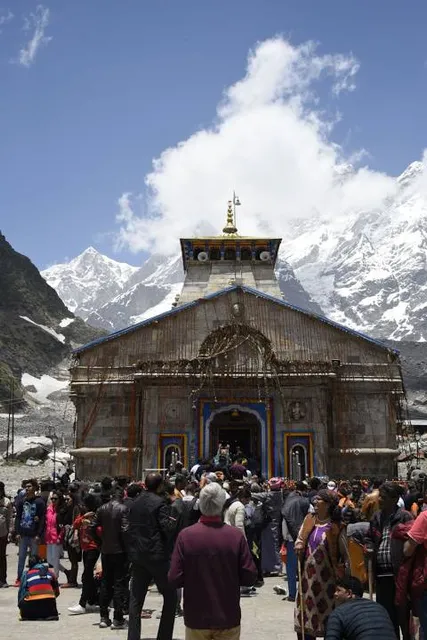
The Triyuginarayan temple resembles the temple of Kedarnath in architectural style and hence attracts a lot of devotees. Adi Shankaracharya is credited with building many temples in the Uttarakhand region. The shrine houses a silver, 2 foot image of god Vishnu (Narayana), accompanied with consort – goddess of wealth Lakshmi and the goddess of music and learning – Saraswati.
In front of the temple, the havana-kund with the eternal flame – the witness of the wedding of Shiva and Parvati – is situated. Devotees add samidha (sacrificial offerings of wood) to the flame and collect the ashes as blessings. A stone called the Brahma Shila – in front of the temple – is regarded as the exact spot of the divine marriage. The ponds of Rudra Kund, Vishnu Kund, Brahma Kund and Saraswati Kund are other holy spots situated near the temple. A water stream called Saraswati Ganga originates in the courtyard of the temple. It fills all the holy ponds in the vicinity. According to Hindu mythology, goddess Parvati was daughter of Himavat or Himavan – the personification of the Himalayas. She was the rebirth of Sati, the first wife of Shiva – who sacrificed her life when her father insulted Shiva. Parvati initially tried to allure Shiva by her beauty, but fails. Finally, she won Shiva by practising rigorous penance at Gauri Kund, which is 5 kilometres away from Triyuginarayan. Pilgrims visiting Triyuginaryan temple also visit the Gauri Kund temple, dedicated to Parvati. Mythology states that Shiva proposed to Parvati at Guptakashi (on the road to Kedarnath) before they got married in the small Triyuginarayan village at the confluence of Mandakini and Sone-Ganga rivers.
Triyuginarayan is believed to be the capital of Himavat. It was the venue of the celestial marriage of Shiva and Parvati, during the Satya Yuga, witnessed in the presence of the holy fire that still burns eternally in front of the temple in a Havana-kund or Agni-kund, a four-cornered fireplace on the ground. Vishnu formalised the wedding and acted as Parvati’s brother in the ceremonies while the creator-god Brahma acted as the priest of the wedding that was witnessed by all the sages of the times. The exact location of the wedding is marked by a stone called Brahma Shila, in front of the temple. The greatness of this place is also recorded in a sthala-Purana (a scripture specific to a pilgrimage centre). According to the scripture, pilgrims who visit this temple consider the ashes from the burning fire as holy and carry it with them. It is also believed that ashes from this fire are supposed to promote...
Read moreThe Triyuginarayan Temple, located in the Rudraprayag district of Uttarakhand, is a revered Hindu temple steeped in ancient mythology and spirituality. Known as the site where Lord Shiva and Goddess Parvati were married, this temple holds immense religious significance. Nestled amidst the serene Garhwal Himalayas at an altitude of 1,980 meters (6,500 feet), it offers not only spiritual fulfillment but also breathtaking views of the surrounding natural beauty. Religious Significance
Mythological Importance: The temple is said to date back to the Treta Yuga, making it one of the oldest shrines in Hinduism. According to Hindu scriptures, Lord Shiva and Goddess Parvati were wed here in the presence of Lord Vishnu, who acted as the presiding priest. This celestial wedding is considered a pivotal moment in Hindu mythology, symbolizing divine union and the cosmic balance of energies.
The Akhand Dhuni (Eternal Flame): The temple is famous for its Akhand Dhuni, an eternal flame that has been burning since the time of the divine wedding. Devotees believe that this sacred fire symbolizes the presence of Lord Shiva and Parvati's divine blessings. Many pilgrims take ash from the dhuni as a token of good fortune and spiritual protection.
Sacred Ponds: Surrounding the temple are four holy kunds (water tanks), each with its own significance: Rudra Kund: Used for cleansing and bathing. Vishnu Kund: Believed to be filled with water from the celestial Ganga. Brahma Kund: Used for rituals. Sarovar Kund: Represents purity and is used for drinking water. Taking a dip in these kunds is considered a purifying ritual for devotees.
Temple Deities and Architecture: The main deity is Lord Vishnu, depicted in his majestic form. The temple’s architecture resembles the Kedarnath Temple, built with stone and showcasing ancient Hindu craftsmanship. The sanctum also houses idols of Goddess Parvati, Lord Shiva, and other deities. The temple exudes an aura of divine energy, and the chanting of Vedic hymns further elevates the spiritual experience.
Cultural and Religious Practices
Weddings at Triyuginarayan: Couples from across India come to the temple to get married, believing that tying the knot here will bless them with eternal love and unity, just as Lord Shiva and Parvati’s union. Special arrangements can be made for such rituals.
Festivals and Celebrations: Major Hindu festivals like Maha Shivaratri, Navratri, and Vishnu Jayanti are celebrated with great fervor. The temple becomes a hub of devotion during these times, with special prayers, cultural programs, and religious discourses.
Pilgrimage Connection: The temple is part of the Char Dham Yatra route and is often visited by pilgrims heading to Kedarnath, as it is just 12 km away.
Location and Accessibility
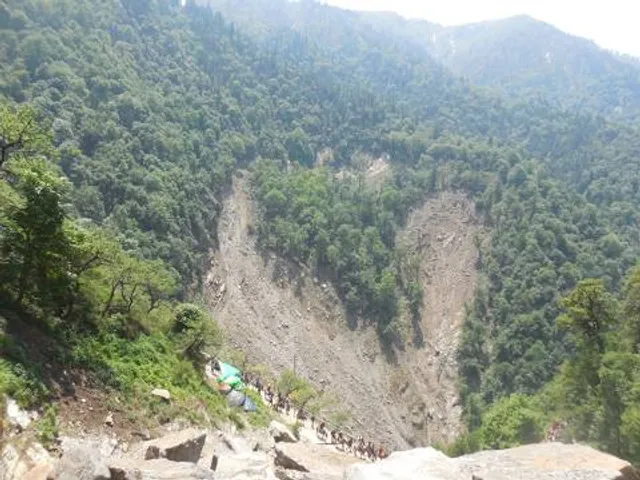
Road Conditions: The temple is about 27 km from Rudraprayag and 12 km from Kedarnath. The road leading to Triyuginarayan is well-paved but narrow in some stretches, requiring careful driving. During the monsoon, landslides can occur, so it’s best to plan your visit in dry seasons.
Spiritual Experience
Visiting the Triyuginarayan Temple is not just a religious journey but also a deeply spiritual one. The peaceful ambiance, the eternal flame, and the legends surrounding the temple fill the heart with devotion and awe. The feeling of standing on the sacred ground where Lord Shiva and Parvati united is a profound experience...
Read moreTriyuginarayan Temple, located in the Rudraprayag district of Uttarakhand, India, is a revered Hindu shrine dedicated to Lord Vishnu. It's situated at an altitude of 6,400 feet above sea level and is famous for being the wedding venue of Lord Shiva and Goddess Parvati.
History and Significance::
The temple's history dates back to ancient times, with its exact origin unknown, but it's mentioned in the Skand Puran, signifying the holy marriage of Lord Shiva and Goddess Parvati. The temple is believed to have been built by Adi Shankaracharya, a renowned Hindu philosopher and theologian. It's considered a sacred spot where couples can get married and seek blessings from Lord Vishnu, Lord Shiva, and Goddess Parvati.
Architecture and Features
The temple's architecture resembles that of the Kedarnath Temple, with intricate stone carvings and sculptures depicting scenes from Hindu mythology. A perpetual fire, believed to have been burning since the time of Lord Shiva's marriage, is a significant feature of the temple. The temple complex includes four sacred ponds or kunds: Rudra Kund, Vishnu Kund, Brahma Kund, and Saraswati Kund, which are believed to have medicinal properties.
Weddings at Triyuginarayan Temple
The temple is a popular destination for couples seeking a unique and sacred wedding experience. Many couples choose to get married here, believing that the blessings of Lord Shiva and Goddess Parvati will bring them a happy and prosperous married life. The temple offers a serene and picturesque setting, surrounded by the majestic Himalayas, making it an ideal location for a romantic and spiritual wedding.
*How to Reach::
By Air: The nearest airport is Jolly Grant Airport in Dehradun, approximately 226 kilometers away. By Train: The nearest railway station is Yog-Nagari Rishikesh Railway Station, about 214 kilometers away. By Road: The temple is accessible by road from Rishikesh and Haridwar, with regular bus and taxi services available.
*Best Time to Visit::
The best time to visit Triyuginarayan Temple is from September to November and April to June, when the weather is pleasant and suitable for travel. Avoid visiting during the monsoon season, as the roads and trekking paths can be slippery and prone to landslides.
*Nearby Attractions::
Kedarnath Temple: A famous Hindu temple located about 15 kilometers away from Triyuginarayan Temple. Chopta Valley: A picturesque hill station known for its natural beauty and adventure activities, located about 50 kilometers away. Gaurikund: A sacred spot and the starting point for the Kedarnath trek, located about 15...
Read more