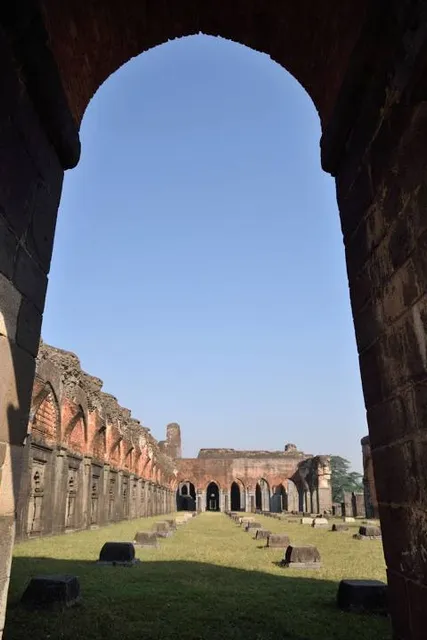
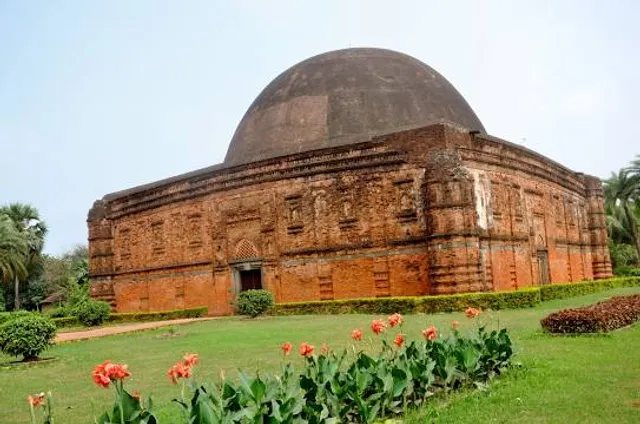
Adina Mosque at Hazrat Pandua or Firuzabad, in Malda district of West Bengal, was the largest mosque in medieval times not only in Bengal but also in the whole of the subcontinent. It was, according to an inscription at its back wall, built in 1373 AD by sikandar shah, son of iliyas shah. For a sultan like Sikandar Shah, who declared himself to be the 'most perfect of the sultans of Arabia and Persia' in 1369 AD, and eventually the khalifa of the faithful, the building of such a mosque was a natural manifestation of his power and wealth. Needless to say, a sultan who could compare himself with the Khalifas of Damascus, Baghdad, Cordova or Cairo could also erect a mosque comparable in size and grandeur to the great mosques of those capitals. It is curious that the Adina Mosque compares with the mosques of those cities not only in size, but also in plan and standardisation; in fact, it rivals the masterpieces of the world. A mosque, described as 'standard', requires a vast rectangular plan with an open courtyard (sahn) surrounded by cloisters (riwaqs) on three sides and the prayer chamber (zullah) towards the qibla. The Adina Mosque conforms to all these principles, and hence is a standard type of mosque. The mosque consists of bricks faced with stones on the lower parts of the walls, and of open bricks on other parts. Its measurement ‘still need to be properly recorded’, but may be approximately accepted as 155 × 87m externally with fluted columns on the corners and 122 × 46m internally with arcade riwaqs by the sides of the courtyard. The 12m wide cloisters on the north, east and south of the courtyard are three aisles deep.
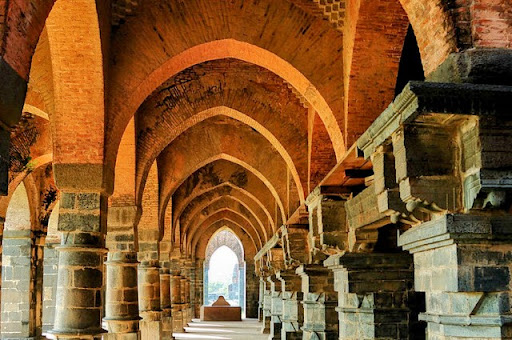
The prayer chamber, measuring 24m in breadth, has five aisles. Dividing the prayer chamber through the middle, a wide vaulted nave runs perpendicular to the qibla wall. It measures 21m × 10m and was once approximately 18m high, but is now fallen. In the absence of a definitive estimate, the domes of the mosque covering squares formed by stone columns have been variously estimated to be 306 and 370. According to Crowe the number is 260. The columns are square at the base, rounded at the middle, and slanting towards the capitals.
The domes carried by triangular pendentives are now fallen except some on the northern cloisters of the prayer chamber. They were of an inverted tumbler shape with an elliptical curve, typical of the dome used throughout the whole sultanate period. The nave, much higher than the cloisters, was covered by a barrel vault, which because of its loftiness dominated the whole structure, and was seen from a...
Read moreThe Adina Mosque is a former mosque in Malda District, West Bengal, India. It was the largest such structure in the Indian subcontinent and was built during the Bengal Sultanate as a royal mosque by Sikandar Shah, who is also buried inside. The mosque is situated in Pandua, a former royal capital.The vast architecture is associated with the hypostyle of the Umayyad Mosque, which was used during the introduction of Islam in new areas. The early Bengal Sultanate harbored imperial ambitions after having defeated the Delhi Sultanate twice in 1353 and 1359. The Adina Mosque was commissioned in 1373. Its construction reused extra materials from pre-Islamic Hindu and Buddhist structures.
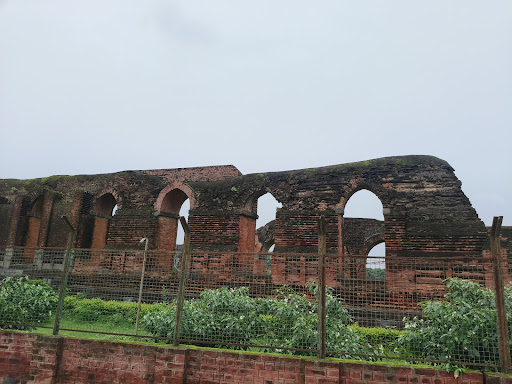
According to the List of Monuments of National Importance in West Bengal (serial no. N-WB-81) Adina Mosque is an ASI listed monument.The design of the mosque incorporated Bengali, Arab, Persian and Byzantine architecture. Although the mosque is eye-catching from far because of its size, but because of the finely precise executed designed decoration makes it hard to see the characteristics it holds without standing in a good distance from it. It was built with rubble masonry that was covered with brick, stone, coatings of stucco, plaster, concrete, glazing or lime smoothing. Stone flowers were integrated into the arches of the interior and exterior all around the building. Its plan is similar to the Great Mosque of Damascus. It had a rectangular hypostyle structure with an open courtyard. There were several hundred domes. The structure measured 172 by 97 m. The entire western wall evokes the imperial style of pre-Islamic Sasanian Persia. The mosque's most prominent feature is its monumental ribbed barrel vault over the central nave, the first such huge vault built in the subcontinent, and another feature shared in common with the Sassanian style. The mosque consciously imitated Persianate imperial grandeur. The prayer hall is five aisles deep, while the north, south and east cloisters around the courtyard consist of triple aisles. In total, these aisles had 260 pillars and 387 domed bays. The interior of the courtyard is a continuous façade of 92 arches surmounted by a parapet, beyond which the domes of the bays can be seen. The ornament on the building is simple, but if you look closer you can see the intensity and disciple in the engravings that have been created on the walls and arches. The interior elevated platform, which was the gallery of the Sultan and his officials, still exists. The Sultan's tomb chamber is attached with the...
Read moreAdina Masjid, Pandua - A Historical Gem in Malda, West Bengal
Adina Masjid, located in Pandua, Malda district of West Bengal, is a remarkable testament to the rich history and architectural brilliance of the Bengal Sultanate period. Built in the 14th century by Sultan Sikandar, this mosque is not only a place of worship but also an important cultural and historical landmark.
The masjid is renowned for its massive structure, featuring Indo-Islamic architecture. The most striking feature is its grand size, with a spacious prayer hall and a beautifully designed exterior. The building's use of red brick, intricate carvings, and large arches creates an imposing yet serene atmosphere. The unique blend of Hindu and Muslim architectural elements here reflects the cultural fusion of the time.
The large central dome and the intricate stonework on the walls add to the mosque's beauty, while the courtyards and surrounding area give a sense of tranquility, making it a perfect spot for those interested in history, architecture, and spirituality.
One of the most notable aspects of Adina Masjid is its historical significance. It once served as one of the largest mosques in Bengal and was a prominent center of learning and culture during the Sultanate period. The place is also known for its peaceful ambiance, providing a sense of timelessness that transports visitors back to a bygone era.
The location is fairly easy to access, though it is slightly away from the hustle and bustle of Malda's city center, which adds to its charm and quietude. While the site is not as crowded as some other tourist spots, the serene and peaceful environment makes it a worthwhile visit for anyone interested in history, architecture, or Islamic heritage.
Pros: Majestic architecture and historical significance Peaceful, serene location away from the city's hustle Rich cultural blend of Hindu and Muslim architecture Ideal for history and architecture enthusiasts
Cons: Not very well-known among mainstream tourists, so information about the site might be limited Can be a bit challenging to locate without proper directions
Overall, Adina Masjid is a hidden gem in Malda, perfect for those looking to explore the historical depth and architectural beauty of...
Read more