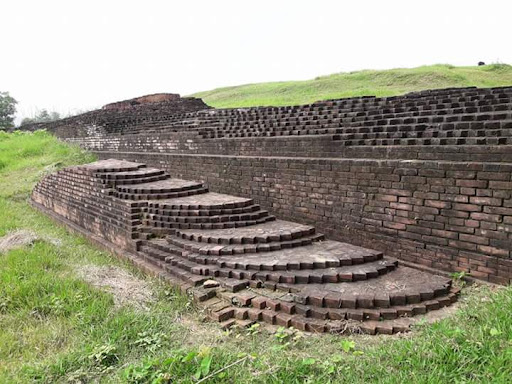
started digging the area in the early 1980s. The work was carried out in two phases Ãâ in 1982-83 and 1988-99. The excavation revealed a gigantic brick structure in an extensive yard surrounded by walls. Stucco heads, terracotta human and animal figurines, copper utensils and other objects were found at the site.
Almost nothing is known about the background of the structure. But that will not hamper a weekend outing at the site, about 125 km from the city. The visit can be clubbed with a trip to Mayapur.
Ballal Dhipi can be reached via Krishnagore. It is best to take a morning train. Get off at Krishnagore station and take a rickshaw to the bus terminus.
The journey to Bamunpukur Bazar, on the way to Mayapur, will take about 45 minutes. Cross the road after getting off the bus, take a right and walk past a Kali temple to Ballal Dhipi.
An ASI board declares the monument to be of national importance. The walls enclose a complex maze. It is difficult to figure out what it represented.
It is evident that the structure on top was built over an earlier one. According to historians, it dates back to the 12th Century. The earlier structure was built between 8th and 9th Century. Archaeologists have found traces of renovation and superimposition over the remains of a temple complex.
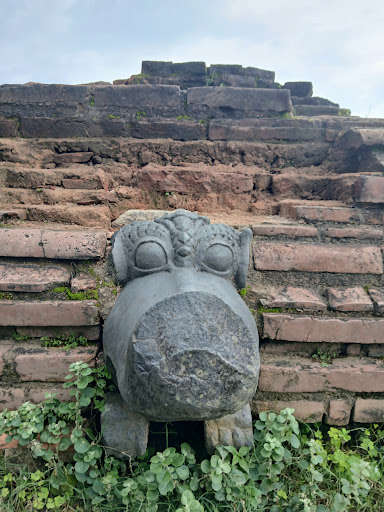
The site is remarkably well preserved. A flight of stairs leads to the top of the mound. On the left of the gigantic construction are some minor structures. The main one contains the stucco stone head of a crocodile. Located near the bottom of a wall, it probably served as a water outlet.
Sadly, this is the only stucco work left on the site. The other stucco stone and terracotta figures, along with the artefacts excavated, have been removed to Ashutosh Museum of Calcutta University.
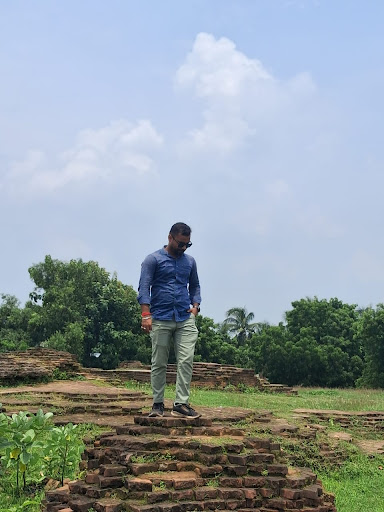
On the top of Ballal Dhipi, the stairs merge with a brick path, leading inside the gigantic structure. The passage to the its back is narrow, roofless and flanked by high walls. The backside offers a panoramic view of the compound.
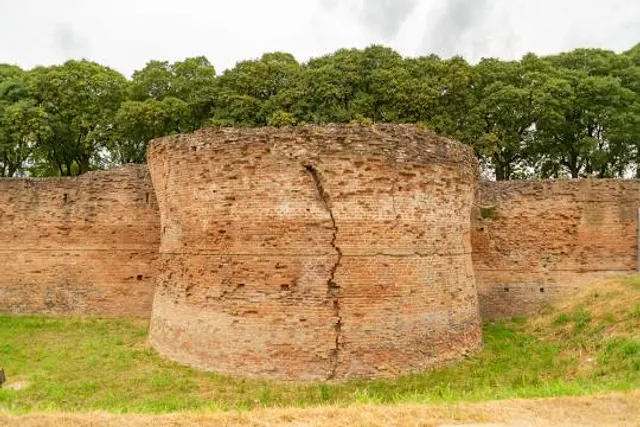
The wall around the yard is surrounded by another wall. The outer wall, of which only fragments remain, is adorned with beautiful brickwork. The magnitude of the structure can be gauged from the thickness of the wall.
It is a pity that not many people are aware of Ballal Dhipi. But that is also a blessing in disguise for the few...
   Read moreFor centuries a huge mound covering an area of 1300 sq. ft. and 30 ft tall have existed in Bamunpukur, a village very close to Mayapur, Nadia. The locals call it the Ballal Dhipi, named after Ballal Sen, of the Sen dynasty, who ruled Bengal in the late 12th century AD. It was only in the late 1970s that it attracted the attention of the Archeological Survey of India (ASI) and digging started in early 1980s and was carried out in two phases. The first phase was carried out in 1982-83 and it was followed by the second and final phase in 1988-89 revealing a stupendous brick structure in an extensive yard, covered on all sides by an enclosure wall. Stucco heads, terracotta human and animal figurines, copper utensils and other objects have also been found from the site. The unearthed huge enclosure contains a complex structure. It was difficult to say what it actually represented.Located about 125 km from Kolkata, Ballal Dhipi can be reached via Krishnanagar. It is best to take the morning train and after getting down at the Krishnanagar station take a rickshaw to the bus stop. Take a bus heading for Mayapur and in about 45 minutes time you will be in Bamunpukur Bazar. After getting down from the bus cross the road and take a right turn and walk past a Kali temple to the Mound of Ballal Sen.
The blue board of ASI declaring it as a Monument of National Importance welcomes you to the historical site. The site is remarkably well preserved. A flight of stairs takes you to the top of the mound. On the left are some minor structures but the gigantic structure lies on the right. The structure on the right contains a stucco stone head of a crocodile.
Located at a lower portion of the wall it probably served as a water outlet. Sadly this is the only stuccowork in the entire site. Apart from the central structure the extensive yard is surrounded on all side by an enclosure wall.
The wall, which exists only in fragments in decorated with beautiful brickwork. The wall, which is several feet thick in some places, is enough to explain the sheer magnitude of...
   Read moreFor hundreds and hundreds of years, a mound of 30-ft in height, spread over 1,300 sq ft was seen at Bamunpukur, a village near Mayapur. It was called Ballal Dhipi, named after Ballal Sen; Nabadwip was the capital of Bengal under Ballal Sen and later Laksman Sen, the eminent rulers of the Sen Empire who reigned from 1159 to 1206. Nothing is known much about its origin and the background of the place. Even historians are unable to come up with any concrete conclusion. But it is only in the late 1970s that the mound attracted the attention of Archaeological Survey of India (ASI) and then the digging started in early 1980s and was carried out in two phases. The first phase was carried out in 1982-83 and it was followed by the second and final phase in 1988-89. The excavation finally led to the discoveries of the Stucco heads, terracotta human and animal figurines, copper utensils and other objects were found at the site. A great wall and a huge surrounding are seen all around the mound. The site is remarkably well preserved. A flight of stairs leads will greet you to the top of the mound. Some minor structures are seen on the left side of the mound. The main one contains the stucco stone head of a crocodile. Located near the bottom of a wall, it probably served as a water outlet. In front of it, there is water storage and instructions are stated not to climb up the said mound. All around are red bricks everywhere of thick ones. From the top of Ballal Dhipi, the stairs come down with a brick path, leading inside the wonderful structure. The passage is narrow, roofless and lay by high walls. The backside offers a birdâs eye view of the compound. There is a little office room of the board and a...
   Read more