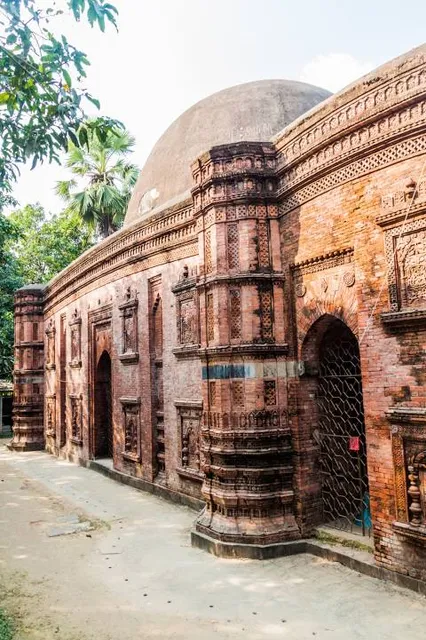
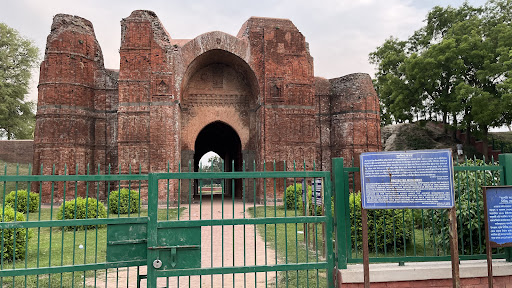
Dakhil Darwaza literally an entrance gate, is the largest structure of its kind in the architectural history of Sultanate Bengal. It was the main entrance to the citadel of lakhnauti, the Muslim name of gaur. The gateway was the most solid and most elegant entrance portal ever erected in Bengal.
The suggestion that it was erected by Sultan nasiruddin mahmud shah (1435-59 AD) at the time of the building of his citadel seems untenable. When the gateway of gunmant mosque, the city congressional mosque of the time of the restored Iliyas Shahis, could not be built to ensure that it could be reasonably time-enduring, how could such a strong and balanced structure like the Dakhil Darwaza be built at that timeFoodgrain We do not have a similar example even in pandua where the largest congressional mosque in Bengal was erected by the second Iliyas Shahi ruler, who is widely acknowledged to be the first great builder amongst the independent rulers of Bengal. The architecture of the gateway is an impressive one, and such an impressing structure could be built only when architecture has attained its full fruition. On this ground, it may be suggested that the Dakhil Darwaza was built in the Husain Shahi period. Antorio de Britto, the Portuguese interpreter (1521 AD), speaks of 'a mosque round the corner in front of Dakhil Darwaza'.
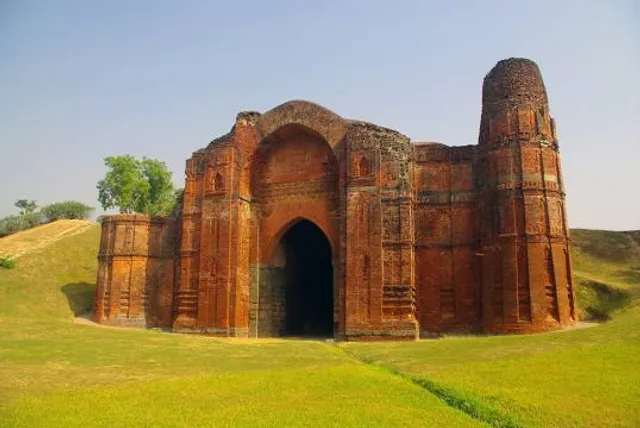
The gateway built of bricks except the piers between the doorways, which are faced with stone up to the springing of the arches, measures 102.5m by 22.5m and consists of a passage 4.5m wide through the middle of the structure. On both sides of the corridor are two guardrooms entered from the former through subsidiary entrances numbering four on each side. The guardrooms measure 22.70m by 2.90m and have also two exits leading outside. The height of the gateway, measured by Cunningham, was about 14.95m of which the entrance arch rises to a height of 10.35m. Behind the wider arch is a smaller archway through which the entrance is made to the vaulted passage. The gateway arch projected in the form of an iwan portal, which is flanked on either side by massive twelve-sided towers at the corners, which are in perfect harmony with the design, and speaks of a gateway commensurable to the dignity and prestige of a great ruler. By a comparison with the entrance gateways of the Bara Sona and chhota sona mosque it can be surmised reasonably that the cornice of the portal was curvilinear.
The decoration of the gateway was not profuse. The ornaments, all in terracotta like other monuments of the time, consisted of string mouldings, at base levels, inset fret-rings around the corner towers - all segmented with vertical offsets, window-shaped arched-panels with hanging motifs inside and rosettes on the spandrels of arches. The arched window motif above the inner arch and flanking the outer arch on both sides are some of the traditional but beautiful examples of Sultanate ornaments stylized from the adina mosque at Pandua-Firuzabad. The Dakhil Dawraza must have been the grandest and the most majestic of all the monuments of...
Read more"Dakhil Darwaza: Gateway to History" - ★★★★★ Step through the majestic Dakhil Darwaza, and you'll find yourself transported to a bygone era of grandeur and splendor. Situated near the India-Bangladesh border in Malda District, this iconic entrance gate to Gour invites visitors to embark on a journey through time. Marvel at its imposing structure and intricate details, and feel the echoes of centuries past whispering tales of glory. A must-visit for history buffs and explorers alike!
"Unlocking the Past: Dakhil Darwaza" - ★★★★★ Prepare to unlock the secrets of history as you pass through the imposing Dakhil Darwaza. Located near Mahadipur in Malda District, this iconic entrance gate to Gour stands as a silent sentinel, guarding the legacy of a bygone era. Its impressive architecture and strategic location near the India-Bangladesh border make it a symbol of strength and resilience. Take a step back in time and immerse yourself in the rich heritage of this historical landmark.
"Dakhil Darwaza: Gateway to Timelessness" - ★★★★★ Enter a realm of timelessness through the majestic Dakhil Darwaza in Malda District. As the gateway to Gour near Mahadipur and the India-Bangladesh international border, this historical landmark beckons travelers to embark on a journey of discovery. Admire its towering presence and intricate design, and feel the weight of centuries of history hanging in the air. Whether you're a history enthusiast or simply in awe of architectural marvels, Dakhil Darwaza promises an unforgettable experience.
"Journey Through History: Dakhil Darwaza" - ★★★★★ Embark on a captivating journey through history as you pass beneath the formidable arches of Dakhil Darwaza. Located near the India-Bangladesh border in Malda District, this iconic entrance gate to Gour is a testament to the region's rich heritage. From its imposing structure to the intricate carvings that adorn its facade, every detail tells a story of the past. Step through its portals and immerse yourself in the grandeur of...
Read moreDakhil Darwaza’ which literally means an entrance gate was the main entrance to the citadel of Lakhnauti. Situated on the North of Lakhnauti city, the gateway was used for welcoming guests with the gun salute and that has given the gate another name – ‘Salami Darwaza’ which means ‘The Welcome Gate’. The massive gate – surely the largest constructed gate in the entire region is entirely built of bricks. Only the piers between the gateways which hold the entrance arches were given support by stone block – which could be an addition later. The structure of Dakhil Darwaza has a width of 24.7 meters and the length of the gate is 24.5 meters and the height is 14.5 meters. While most of the top structure of the gate has been destroyed over time, its glory can still be observed. In the year 1338, the governor of Bengal appointed by the Tughlaq sultans of Delhi claimed independence and for next one and half decades they remained Independent Sultans of Bengal with an affiliation of the Sultanate of Delhi. In the year 1352, Shamsuddin Illiyas Shah found the first independent state of Bengal and the timeline for Bengal Sultanate started. This was the beginning of a two-century-long Sultanate rule of Bengal and it ended only when the Mughals conquered Bengal to convert it into a Subah(Division). The seat of the Sultanate remained mostly in the city of Gour with a small break when it was shifted to nearby Pandua and that had been a major boost for the art and architecture of the region. The Afghan Origin Sultans started massive construction works in the Gour city and the entire city was fortified. As part of the fort, some amazing gates were also constructed which are still standing as the evidence of the good sense of architecture and battle technology of...
Read more