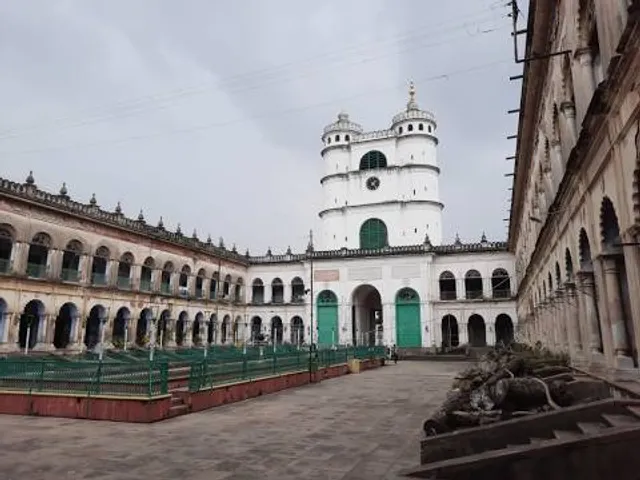
Good... Among the many historic structures that adorn the state of West Bengal, which speak of its rich heritage, culture and architectural grandeur that it once held, Hooghly Imambara is one of them. An experience in itself, the Imambara with its majestically long corridors, its massive clock and the splendid architecture of its main prayer hall, serves as a reminder to the erstwhile but fading magnificence that walked through its lanes. Built in the early 19th Century, the Hooghly Imambara is open to people from all faiths. The Imambara is a Shia Muslim congregation hall wherein all commemoration ceremonies of the community take place. The occasion of Muharram marks a major event for the Shia Muslim community and at Hooghly Imambara, the rituals match to that of Karbala in Iraq, including the mourning hours. This makes the Hooghly Imambara different from all other places. The seventh day of Muharram sees several thousand devotees belonging to all religions flock to Hooghly to take part in the prayer rituals; however, everyone offers their prayers in their own respective ways. It is recommended to carry your own food or snacks since there aren’t any eateries or restaurants in the nearby area.(Only Available drinks and Ice cream type food near Sunclock ) History of Hooghly Imambara: The humble beginning that the Hooghly Imambara had, started with the Persian salt merchant, Mohammad Aga Motahar, who, with his well-earned money, decided to settle down with his family and several servants in the Chinsurha. The building that he built was just a single storied structure where he lived with his family and his servants. However, the home that was built by Mohammad Aga Motahar where he had decided to spend the rest of his life, did not quite suit him and in 1717, he decided to dedicate the building in the name of ‘Allah’ and renamed the building as ‘Nazargah Hossein’. Later, during the year 1735, his son-in-law, Mirza Saleh-ud-din worked on further extensions to the building and named the new extension Tazia Khana (a place where tazias are kept). This old building no longer exists and the new Imambara that we see today was built over the ruins of this structure. The new and elaborate Imambara that we see today was built by Haji Muhammad Mohsin, a religious and pious man, and one of Bengal’s greatest philanthropists, related to Mohammad Aga Motahar through his daughter, Mannujan Khanam and inherited her entire fortune and the zamindaari since she was childless. The wealth that he received from Mannujan Khanam added to his own fortune which was vast as he was a merchant himself. Haji Mohsin was already known for his philanthropic deeds he had carried out between 1776- 77 during the great Bengal famine by establishing many Langarkhanas to feed the people and had also donated a substantial amount of his money towards the famine relief fund. Muhammad Mohsin donated his entire property and money to charity. He formed a trust, and, in his will, he had mentioned clear directions as to how his wealth was to be used and distributed between spends on religious festivals, paying government revenues, repairing cemeteries and old imambara buildings, payments of pensions, and payment of the mutawallis (trustees) of the charitable trust. He also directed that a portion of his funds be used to build the present day Imambara which would be a deed towards the local Muslim community. After his death in 1812, the construction of the Imamabara went into dispute due to internal conflicts among the mutawallis until the government took over the trust and the then Governor- General, Lord Auckland appointed Syed Keramat Ali as the new trustee and handed him the responsibility to build the Imambara. The construction finally began in 1841 and took 20 years to be completed. The Imambara building was built for a humongous sum of INR 2,17,413. Sayed Keramat Ali had handed over the authority of the Imambara to Maulavi Sayed Ashraf Uddin, the eldest son of Nawab Amir Ali just before his...
Read moreThe Hooghly Imambara, situated in Hooghly, West Bengal, stands as a testament to the cultural and religious diversity that has shaped the history of India. Built in 1841 by Haji Mohammad Mohsin, a wealthy philanthropist, the Imambara is a significant Islamic structure with architectural grandeur and historical importance.
At the heart of the complex is the Nizamat Imambara, the main prayer hall, which is one of the largest in the world. The term "Imambara" refers to a congregation hall for Shia Muslims during Muharram, particularly for the rituals and processions commemorating the martyrdom of Imam Hussain, the grandson of Prophet Muhammad. The Nizamat Imambara, with its intricate design and vast interiors, has become a symbol of religious harmony and architectural brilliance.
The architectural style of the Hooghly Imambara is a blend of Indo-Islamic and Persian influences. The massive structure features two towering minarets that flank the central prayer hall, adding to the visual appeal. The exterior is adorned with ornate decorations, showcasing the craftsmanship of the artisans who worked on its construction. The complex also includes a Madrasa for religious education and a large water tank known as the "Baoli" to meet the needs of the community.
One distinctive feature of the Hooghly Imambara is the absence of a central dome, which is a common element in many Islamic structures. Instead, the prayer hall is covered by a massive flat roof, supported by a series of pillars and arches. This unique design not only adds to the architectural charm but also serves a practical purpose, providing a vast open space for the congregation during religious events.
The Hooghly Imambara holds a special place in the history of the region, as it was built during a time when communal harmony was an integral part of the social fabric. Haji Mohammad Mohsin, the founder, was known for his philanthropy and his efforts to bridge the gap between different communities. The Imambara, therefore, stands not just as a place of worship but also as a symbol of unity and tolerance.
The Nizamat Imambara hosts various religious events and ceremonies, attracting both locals and tourists alike. During Muharram, the Imambara comes to life with processions, prayers, and rituals that echo the mourning for Imam Hussain. The atmosphere is filled with devotion and a sense of community as people come together to commemorate the solemn occasion.
Adjacent to the Nizamat Imambara is the Hooghly Imambara's clock tower, which is another notable structure. The clock, installed in the mid-19th century, was a gift from the British East India Company to Haji Mohammad Mohsin. It not only served as a timekeeping device but also became a symbol of the cultural exchange between different communities during that era.
Despite the passage of time, the Hooghly Imambara continues to be a focal point for religious and cultural activities in the region. The complex stands as a living heritage, preserving the traditions and values that have shaped the diverse tapestry of India. Visitors to the Hooghly Imambara not only witness the architectural brilliance of the past but also experience the enduring spirit of communal harmony that the...
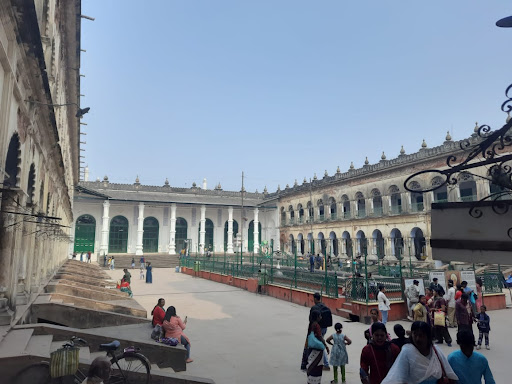
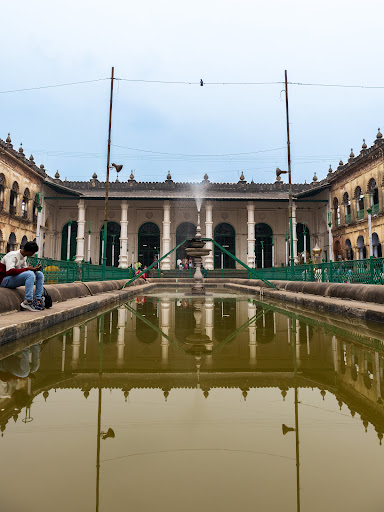
Read moreThis 150-year-old structure is situated on the western bank of Ganga river in Chinsurah, Hooghly. It was built by Haji Md. Mohsin, a renowned philanthropist. It took twenty years from 1841 to 1861 to build this structure. It is a Shia Muslim congregation hall . On entering this Imambara, you will reach to an open courtyard. At the middle of the courtyard, there is a rectangular tank decorated by beautiful fountains. The courtyard is surrounded by two-storied buildings with long corridors and having numerous rooms. These are now used for official purposes and classroom for the madrasah students. There is also a big prayer hall. The clock tower is another spectacular wonder in the Imambara. The clock is placed in the middle of the twin towers erected upon the doorway of the Imambara. Each tower is 150 ft high with 152 stairs leading to the top. The huge clock with two dials, placed on both side of the towers is run by a single central machine and is working perfectly till date. The clock is winded once a week. It is said that two persons are required to carry the key of the clock. The key itself weighs 20 kg. Just above the central unit, three bells of different sizes are present weighing around 3200 kg, 1600 kg and 1200 kg respectively. The small and medium sized bells chimes every 15 minutes and the bigger one every one hour. The Southern Tower is for the men while the Northern Tower is for the women to access. The top floor of the towers offers a spectacular view of the surrounding areas and river Ganges. It is a wonderful experience to see the hammer striking the bell. The visitors are suggested to reach at the top of the tower and wait for the appropriate time for the bell to ring. There is a sundial at the open yard at the back side of the Imambara. There is a concrete table with a fixed hand that still indicated the correct time from dawn till dusk. The Imambara remains open from 8 am to 6 pm from April to August, and 8 am to 5 pm from September to March. Entry tickets cost Rs.10/- You can take photographs at the Imambara freely except inside the...
Read more