The Anubanini petroglyph attributed to him in the city of Sarpol Zahab is one of the oldest stone inscriptions in Iran with an age of about 4800 years. This is the prominent relief of a curtain in which the king is facing the goddess Ishtar (the star that led him to victory over his enemies) standing and placing his foot on the defeated enemy's body. The queen has a ring in her hand and a rope or a chain in her other hand, two captives from her nose. In addition to the king and queen, 9 naked captives can also be seen in the picture
This petroglyph on the chest of a 35-meter high mountain is attributed to King Lulobi, who placed his left foot on the body of a captive and took two other captives from the goddess Inanna. Beneath this picture, the pictures of six other captives are also carved. The stone carving of the lower part, which contains the image of the captives, are all shown naked, and while each hand is tied behind the back, from left to right, behind the head of the king who wears a crown (similar to the helmet of the Eastern Medes and Persians, who about fifteen hundred years later government arrived , are on the move. Under this scene, there is also a petroglyph that shows the victory of Anubani. This work dates back to the 22nd century BC, which is very similar to the famous Naram Sin Akkadi petroglyph, and it may have been historically close to it. After weakening the power of Naram Sin and his son, Sharkali Shari was created by the Lulobi ruler. Anubani's name is Akkadian, and the inscription on the petroglyph is also in Akkadian, and as a result, there is a suspicion that the said ruler may be an Akkadian puppet ruler. The fact that the name of the petroglyph place (Mount Padir) is clearly mentioned, apparently shows that this place was not in the center of Anubani's possessions and maybe it was the scene of victory or the border of his possessions.
This work is similar to the Biston stone inscription that was made about 2000 years after it, and according to some researchers, the stone carvers of the Biston stone inscription made that work with the inspiration of the Anubani petroglyphs.
Two of the captives, who are bigger than the other captives, are behind the goddess Inanna (Ishtar), and the other captives are in the lower row, all naked, with their hands tied behind their backs. Under the feet of the king, another captive was trampled and an inscription in Akkadian language with this theme was quoted
Anubani, the mighty king, King Lulobi, has painted his image and that of the goddess Ishtar on Mount Batir. The person who erases these inscriptions and this tablet will be cursed by Anu, Anotum, Enlil, Ninlil, Eded, Ishtar, Sin and Shamsh and his descendants will perish.
Today, this work is located inside a girls' primary school in the city of Sarpol Zahab, at a height of 16 meters and on a rock...
Read more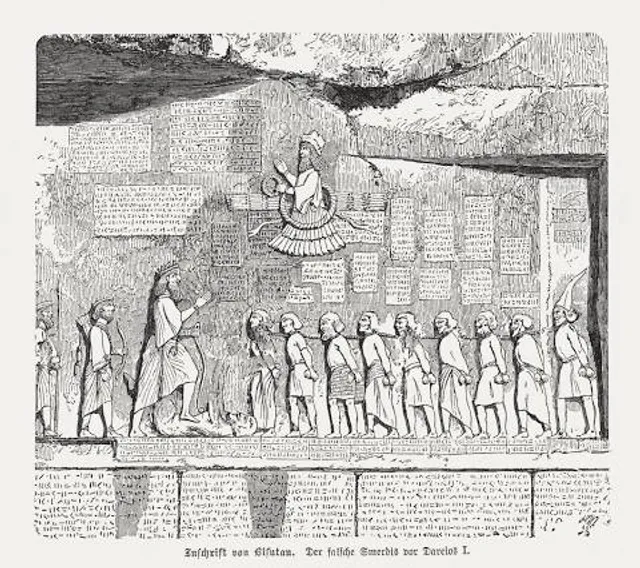
 Learn more insights from Wanderboat AI.